


Choosing the right portable camping generators requires balancing noise, weight, and runtime against your specific power needs. The EF ECOFLOW DELTA 3 Classic stands out as the best overall pick for most campers due to its robust 1800W output and rapid charging capabilities. For those needing raw wattage for heavy appliances, the PowerSmart 4000 Watt Inverter offers exceptional value, while the MARBERO M82 serves as a lightweight entry point for minimalists. This guide breaks down the critical tradeoffs between silent battery stations and powerful gas engines to help you decide which unit fits your adventure style.

Get travel and outdoor gear delivered free with Prime
- Fast, free delivery on millions of items
- Prime Video, Amazon Music and more included
- Member-only deals all year
Complete the kit


Key Takeaways
- The EF ECOFLOW DELTA 3 Classic and Jackery Explorer 1000 v2 dominate the premium battery category by combining LiFePO4 longevity with high-wattage inverter technology, making them suitable for nearly all modern camping electronics.
- Gas inverter generators like the PowerSmart 4000 Watt remain the only viable option for running high-draw appliances such as electric kettles or hair dryers, despite being louder and heavier than their battery counterparts.
- Entry-level solar generators like the MARBERO M82 are strictly for charging small devices; they lack the capacity to run appliances, a common misconception among first-time buyers.
- Dual-fuel capability, seen in the WEN DF360iX, provides a significant advantage for long-term car camping or emergency prep by allowing users to switch between gasoline and propane for flexibility.
- Noise levels are a decisive factor in campsite etiquette; inverter gas models are quieter than traditional open-frame generators but still generate 50-60 decibels, unlike silent battery stations.
| BLUETTI Elite 100 Mini Portable Power Station, 1004.8Wh, 700W |  | Best for Longer Quiet Camps | Battery capacity: 1004.8Wh | Battery type: LiFePO4 (LFP) | Running / surge wattage: 700W / 1400W | VIEW LATEST PRICE | See Our Full Breakdown |
| MARBERO M82 Portable Power Station, 88Wh, 120W Surge |  | Best for Basic Device Charging | Capacity: 88Wh (24,000mAh) | Output ports: 8 | Weight: 3.2 lbs | VIEW LATEST PRICE | See Our Full Breakdown |
| AIVOLT 1750W Inverter Generator Portable Gas Generator for Camping Home |  | Best Lightweight Gas Generator | Fuel type: Gasoline | Running / peak wattage: 1350W / 1750W | Fuel tank: 0.66 gallons | VIEW LATEST PRICE | See Our Full Breakdown |
| PowerSmart 4000 Watt Portable Inverter Generator for Home Use, Gas Powered |  | Best for Higher-Power Camp Setups | Fuel type: Gasoline | Running wattage: 3200W | Starting wattage: 3800W listed; product title states 4000W | VIEW LATEST PRICE | See Our Full Breakdown |
| Daran 89.6Wh LiFePO4 Portable Power Station, 100W |  | Best Compact LiFePO4 Pick | Battery capacity: 89.6Wh | Battery type: LiFePO4 | Maximum / peak output: 100W / 200W | VIEW LATEST PRICE | See Our Full Breakdown |
| Jackery Explorer 300 Portable Power Station, 292Wh |  | Best for Minimalist Camping | Capacity: 292Wh | Weight: 7.5 lbs | Battery Chemistry: LiFePO4 | VIEW LATEST PRICE | See Our Full Breakdown |
| GENKINS 4200W Portable Inverter Generator for Home Use, Camping & RV, Gas |  | Best High-Capacity Gas Generator | Peak Power: 4200 Watts | Engine Type: 149.3cc 4-stroke OHV | Runtime: Up to 9 hours at 25% load | VIEW LATEST PRICE | See Our Full Breakdown |
| Portable Solar Generator 300W Power Station with 60W Solar Panel |  | Best Budget Solar Bundle | Output Wattage: 300 Watts | Solar Panel: 60W Monocrystalline | AC Outlets: 2 | VIEW LATEST PRICE | See Our Full Breakdown |
| LIBRIDS C600 Portable Power Station, 640Wh, 600W |  | Best Mid-Range Power Station | Capacity: 640Wh | Surge Output: 1200W | Weight: 16.3 lbs | VIEW LATEST PRICE | See Our Full Breakdown |
| WEN DF360iX 3600-Watt Dual-Fuel Portable Inverter Generator |  | Best Dual-Fuel Flexibility | Surge Watts: 3600W (Gas) / 3500W (Propane) | Fuel Types: Gasoline and Propane | Runtime: Up to 14 hours (Propane) | VIEW LATEST PRICE | See Our Full Breakdown |
| Oxseryn 4400-Watt Gas-Powered Inverter Generator |  | Best Open-Frame Value | Starting Wattage: 4400 watts | Running Wattage: 3400 watts | Fuel Tank Capacity: 2 gallons | VIEW LATEST PRICE | See Our Full Breakdown |
| EF ECOFLOW DELTA 3 Classic Portable Power Station, 1024Wh, 1800W |  | Best Silent Backup | Battery Capacity: 1024Wh | AC Output: 1800W | Surge Output: 3600W | VIEW LATEST PRICE | See Our Full Breakdown |
| PowerSmart DB5041 4300-Watt Portable Inverter Generator |  | Best for Sensitive Electronics | Starting Wattage: 4300 watts | Running Wattage: 3500 watts | THD: Less than 3% | VIEW LATEST PRICE | See Our Full Breakdown |
| WEN 4800-Watt RV-Ready Portable Inverter Generator with Fuel Shutoff |  | Best for RV Users | Surge Wattage: 4800 watts | Running Wattage: 4000 watts | Fuel Tank Capacity: 1.9 gallons | VIEW LATEST PRICE | See Our Full Breakdown |
| Jackery Explorer 1000 v2 Portable Power Station, 1024Wh LiFePO4 Battery |  | Best for Portability | Battery Capacity: 1024Wh | AC Output: 1500W | Surge Peak: 3000W | VIEW LATEST PRICE | See Our Full Breakdown |
| portable camping generator | Weight |
|---|---|
| BLUETTI Elite 100 Mini Portabl | 23.5 lbs |
| MARBERO M82 Portable Power Sta | 3.2 lbs |
| AIVOLT 1750W Inverter Generato | 27.6 lbs (listed specifications) |
| PowerSmart 4000 Watt Portable | 50 lbs |
| Daran 89.6Wh LiFePO4 Portable | 2.54 lbs |
| Jackery Explorer 300 Portable | 7.5 lbs |
| GENKINS 4200W Portable Inverte | 46 lbs |
| Portable Solar Generator 300W | — |
| LIBRIDS C600 Portable Power St | 16.3 lbs |
| WEN DF360iX 3600-Watt Dual-Fue | 49 lbs |
| Oxseryn 4400-Watt Gas-Powered | 56 pounds |
| EF ECOFLOW DELTA 3 Classic Por | 26.7 lb |
| PowerSmart DB5041 4300-Watt Po | 68 pounds |
| WEN 4800-Watt RV-Ready Portabl | 72.7 pounds |
| Jackery Explorer 1000 v2 Porta | 23.4 lbs |
More Details on Our Top Picks
BLUETTI Elite 100 Mini Portable Power Station, 1004.8Wh, 700W
The BLUETTI Elite 100 Mini suits campers who want a substantial battery reserve without running a gas engine at the campsite. Its 1004.8Wh LiFePO4 battery can serve several devices over a trip, while three AC outlets and 140W USB-C let you charge different gear at once. Compared with the Daran 89.6Wh, it offers far more stored energy and stronger output, though it is also much heavier and larger. Its 700W running limit still rules out many high-draw appliances, so check your gear’s wattage rather than treating it like a whole-camp generator. Solar, car, AC, lead-acid, and generator charging add flexibility, but the 23.5-pound weight makes it better for car camping than long carries. UPS backup and built-in lighting are useful extras, not substitutes for its core battery capacity.
Pros:- 1004.8Wh LiFePO4 battery offers much more stored energy than the compact Daran and MARBERO units.
- Three AC outlets and 140W USB-C support several device types at once.
- Solar, AC, car, lead-acid, and generator charging provide flexible replenishment options.
- UPS switchover of 10ms or less and built-in LED lighting add useful backup functions.
Cons:- 700W running output cannot handle many high-draw camping appliances.
- At 23.5 pounds, it is better suited to vehicle transport than extended carrying.
- Its larger battery takes more campsite space than the small 88–89.6Wh options.
Best for: Car campers who want quiet overnight power for phones, laptops, lights, and other modest loads, with multiple ways to recharge.
Not ideal for: Backpackers or campers running high-wattage appliances; its 23.5-pound weight is cumbersome to carry far, and 700W running output limits what it can power.
- Battery capacity:1004.8Wh
- Battery type:LiFePO4 (LFP)
- Running / surge wattage:700W / 1400W
- AC outlets:3
- USB-C output:140W
- Weight:23.5 lbs
- Charging methods:Solar, AC, car, lead-acid, generator
- Battery life:Rated for 6000+ cycles
Our verdict“Choose the BLUETTI if quiet, long-lasting power matters more than low carry weight or the ability to run demanding appliances.”
MARBERO M82 Portable Power Station, 88Wh, 120W Surge
The MARBERO M82 is a small, simple power option for campers whose main needs are phones, lights, and other low-draw electronics. At 3.2 pounds, it is easier to pack and move than the Daran 89.6Wh, though the Daran’s LiFePO4 battery and stated 100W output make that a stronger alternative for buyers prioritizing battery longevity or a clearer output ceiling. MARBERO’s eight ports offer convenient device connections, but the unit’s 80W rated output sharply limits appliance choices; the 120W surge figure does not make it suitable for sustained higher loads. Its built-in light includes brightness levels and SOS mode, which can reduce the need for a separate emergency light. Solar charging is supported, but a panel is not listed among the included items, so campers need to source one separately.
Pros:- Compact 3.2-pound body is easier to carry and stow than the larger BLUETTI Elite 100 Mini.
- Eight output ports allow several small devices to connect at once.
- Built-in light offers three brightness levels and an SOS mode.
- Battery management features include temperature, overload, and short-circuit protection.
Cons:- 88Wh capacity provides only a modest energy reserve for a camping trip.
- 80W rated output limits it to low-draw devices.
- Solar charging requires a compatible panel that is not listed as included.
Best for: Minimalist car campers and day-trippers who mainly need a lightweight backup for phones, small electronics, and campsite lighting.
Not ideal for: Campers who need to run appliances, store power for several days, or recharge from solar without buying a separate panel.
- Capacity:88Wh (24,000mAh)
- Output ports:8
- Weight:3.2 lbs
- Dimensions:6.5 × 4.6 × 3.1 in
- Charging methods:AC adapter or compatible 30W/60W solar panel
- Charging time:0–80% in 2 hours using included adapter
- Lighting:Three brightness levels and SOS mode
Our verdict“Pick the MARBERO for lightweight charging of small electronics, but skip it if your campsite needs meaningful appliance power or extended energy storage.”
AIVOLT 1750W Inverter Generator Portable Gas Generator for Camping Home
For campers who need fuel-powered output but still want a unit that is relatively easy to lift, the AIVOLT inverter generator offers a different kind of portability from the battery stations here. Its 1350W running output exceeds the BLUETTI Elite 100 Mini’s 700W ceiling, making it a better fit for higher-load gear, while the BLUETTI stays silent at the campsite and avoids gasoline, exhaust, and engine maintenance. The AIVOLT is listed at 52 dBA and has a CO sensor with automatic shutoff, but it must still operate outdoors and away from enclosed spaces. Its 0.66-gallon tank is rated for up to seven hours at 25% load; actual runtime depends on the load. At 27.6 pounds in the supplied specs, it is carryable for short moves, not an effortless backpacking option. Engine oil is not included.
Pros:- 1350W running output provides more appliance headroom than the BLUETTI Elite 100 Mini.
- Inverter output is specified at under 3% THD for sensitive electronics.
- 52 dBA rating and ECO mode are aimed at reducing campsite noise and fuel use at light loads.
- CO auto-shutoff, low-oil shutdown, and overload protection provide added operating safeguards.
Cons:- Gasoline operation creates exhaust and requires outdoor placement, fuel, and engine maintenance.
- The 0.66-gallon tank’s runtime depends on load; the stated maximum is seven hours at 25% load.
- Engine oil is not included, and the 27.6-pound listed weight is still a burden for extended carrying.
Best for: Car campers who need more continuous power than a small battery station can provide and are comfortable managing gasoline and outdoor-only operation.
Not ideal for: Quiet-site campers, backpackers, or anyone unwilling to handle fuel, engine upkeep, exhaust clearance, and oil setup before first use.
- Fuel type:Gasoline
- Running / peak wattage:1350W / 1750W
- Fuel tank:0.66 gallons
- Maximum stated runtime:Up to 7 hours at 25% load
- Weight:27.6 lbs (listed specifications)
- Dimensions:16.9 × 9.9 × 15.7 in
- Safety features:CO auto-shutoff, low-oil shutdown, overload protection
Our verdict“Choose the AIVOLT if your camping setup needs fuel-powered output above 700W and you can accommodate noise, exhaust, fuel, and maintenance.”
PowerSmart 4000 Watt Portable Inverter Generator for Home Use, Gas Powered
The PowerSmart 4000 Watt is the high-output choice in this batch: its listed 3200W running capacity is well above the AIVOLT’s 1350W and the battery stations’ limits. That extra headroom can suit a larger vehicle-based campsite or a mix of demanding devices, but it comes with a major portability tradeoff. At 50 pounds, it is far less convenient to lift than the AIVOLT, and much less suitable than either compact battery unit for carrying away from a vehicle. The inverter output is listed at under 3% THD, and the panel includes AC, DC, and USB connections. Its advertised noise figure is under 59 dBA at 23 feet, but it remains a running gas engine. Use it outdoors only, with clear separation from tents and occupied spaces; its fuel tank size is listed as 1.3 gallons.
Pros:- 3200W running output offers substantially more capacity than the AIVOLT and portable power stations in this batch.
- Under 3% THD is specified for powering sensitive electronics.
- Panel includes AC outlets, a 30A twist-lock outlet, DC, and USB connections.
- Eco Mode and low-oil shutdown add useful operating features.
Cons:- 50-pound weight makes loading and repositioning harder than with the 27.6-pound AIVOLT.
- Gasoline engine produces exhaust and requires outdoor operation and routine maintenance.
- Its higher output and larger footprint are excessive for campers who only need to charge phones and small devices.
Best for: Vehicle-based campers with higher-wattage gear who need substantial AC output and can transport a 50-pound generator.
Not ideal for: Backpackers, campers at noise-sensitive sites, or anyone seeking a lightweight, emissions-free power source.
- Fuel type:Gasoline
- Running wattage:3200W
- Starting wattage:3800W listed; product title states 4000W
- Fuel tank:1.3 gallons
- Weight:50 lbs
- Outlets:8 total; includes 120V duplex, 120V 30A twist-lock, 12V DC, and USB
- Additional features:Eco Mode, cold-start technology, low-oil shutdown
Our verdict“Choose the PowerSmart for a vehicle-supported campsite with substantial power demands, not for lightweight or quiet camping.”
Daran 89.6Wh LiFePO4 Portable Power Station, 100W
The Daran 89.6Wh makes a strong case for campers who want a very small battery station with a longer-life chemistry. Its 2.54-pound weight is lighter than the MARBERO M82, and its LiFePO4 battery is rated for 3500+ cycles; the MARBERO offers more output ports, but its 80W rated output is lower than Daran’s 100W maximum. Neither is suited to appliance-heavy camping, and both hold under 100Wh, so think of Daran as a device-charging and lighting companion rather than a generator for a whole campsite. Two AC outlets and a mix of USB and DC ports make it versatile for its size, while fanless operation avoids generator noise. Solar charging is supported, but the panel and cable are optional rather than included.
Pros:- At 2.54 pounds, it is lighter than the MARBERO M82 and easy to stow in a vehicle.
- LiFePO4 battery is rated for 3500+ cycles.
- Seven ports, including two AC outlets and two USB-C ports, support varied small-device charging.
- Fanless operation, digital display, and four-level flashlight suit quiet campsite use.
Cons:- 89.6Wh capacity is a limited reserve for trips with multiple devices or repeated charging.
- 100W maximum output rules out most larger camping appliances.
- Solar panel and cable are not included.
Best for: Light-packing campers who want a quiet, low-weight battery source for phones, small electronics, and emergency lighting.
Not ideal for: Campers needing multi-day energy storage or power for appliances above 100W, or buyers expecting a solar panel in the box.
- Battery capacity:89.6Wh
- Battery type:LiFePO4
- Maximum / peak output:100W / 200W
- Ports:7
- AC outlets:2, 100W
- USB-C ports:2: 45W and 15W
- Weight:2.54 lbs
- Charging methods:AC wall outlet, USB-C PD, car, optional solar panel
Our verdict“Pick the Daran for compact, quiet charging with LiFePO4 longevity, but choose a larger station if your campsite needs more than small-device power.”
Jackery Explorer 300 Portable Power Station, 292Wh
This unit stands out for its ultra-lightweight 7.5 lb frame, making it far easier to hike with than bulkier gas options like the GENKINS 4200W. The LiFePO4 battery offers exceptional longevity, rated for over 4,000 cycles, which means it will likely outlast cheaper lithium-ion competitors. However, the 300W rated output is a hard ceiling; you cannot run high-draw appliances like coffee makers or space heaters. Compared to the LIBRIDS C600, it lacks the multiple AC outlets needed for powering several devices simultaneously. It is a silent, zero-emission option ideal for charging phones, drones, and laptops, but it lacks the raw power for serious off-grid living or heavy-duty tool use.
Pros:- Extremely lightweight at 7.5 lbs with an integrated handle
- LiFePO4 battery rated for over 4,000 charge cycles
- Silent operation with zero emissions
- Supports solar charging with compatible panels
Cons:- 300W rated output limits high-power device usage
- Solar panel not included in the box
- Fewer AC outlets compared to larger stations
Best for: Solo hikers and car campers who need silent, reliable power for phones, cameras, and laptops without the hassle of fuel.
Not ideal for: Users needing to run high-wattage appliances like electric kettles, microwaves, or power tools.
- Capacity:292Wh
- Weight:7.5 lbs
- Battery Chemistry:LiFePO4
- AC Outlets:2
- USB-C PD:100W
Our verdict“A perfect silent companion for light electronics, provided you don’t need to heat water or run tools.”
GENKINS 4200W Portable Inverter Generator for Home Use, Camping & RV, Gas
If you need raw power that batteries can’t match, this gas inverter delivers 4200W peak output, dwarfing the Jackery Explorer 300. Its pure sine wave technology protects sensitive electronics, a feature often missing in cheaper conventional generators. At 46 lbs, it is heavy but manageable for car camping, though less portable than the ZeroKor Solar Generator. The 9-hour runtime at quarter load is impressive for such a compact footprint. However, it requires gasoline, meaning you must carry fuel and deal with noise and fumes. It is the superior choice for running RV air conditioners or multiple appliances, but it sacrifices the silence and zero-maintenance convenience of electric power stations.
Pros:- High 4200W peak power handles heavy loads
- Pure sine wave output is safe for sensitive electronics
- Extended 9-hour runtime at 25% load
- Parallel-ready for future power expansion
Cons:- Requires gasoline and regular engine maintenance
- Heavier at 46 lbs than battery alternatives
- Produces noise and exhaust fumes
Best for: RV owners and campers who need to run high-draw appliances like AC units, microwaves, or power tools.
Not ideal for: Backpackers or those who prefer silent, emission-free camping without fuel storage.
- Peak Power:4200 Watts
- Engine Type:149.3cc 4-stroke OHV
- Runtime:Up to 9 hours at 25% load
- Weight:46 lbs
- Noise Level:58 dBA at 23 ft
Our verdict“The go-to choice for high-power demands, balancing inverter cleanliness with gas engine strength.”
Portable Solar Generator 300W Power Station with 60W Solar Panel
This kit offers a complete off-grid solution out of the box, including a 60W monocrystalline solar panel, unlike the Jackery Explorer 300 which requires a separate purchase. It is an excellent entry point for beginners who want to understand solar charging without complex setup. The built-in MPPT controller improves charging efficiency compared to basic charge controllers. However, the 300W limit restricts it to small electronics, similar to the Jackery. The solar panel’s junction box is not waterproof, requiring careful storage in rain. While it provides great value for basic needs, it lacks the capacity and multiple AC outlets of the LIBRIDS C600, making it less versatile for multi-device households or extended trips.
Pros:- Includes a 60W solar panel in the package
- Built-in MPPT for efficient solar charging
- Multiple USB and AC outputs for various devices
- Includes SOS flashlight for emergencies
Cons:- Solar panel junction box is not waterproof
- 300W output limit restricts appliance use
- Slower recharge times compared to grid charging
Best for: Beginners and budget-conscious campers wanting a ready-to-use solar charging kit for phones and lights.
Not ideal for: Users needing to charge large devices quickly or run multiple high-wattage appliances simultaneously.
- Output Wattage:300 Watts
- Solar Panel:60W Monocrystalline
- AC Outlets:2
- USB Ports:4
- Charging Tech:MPPT
- Power Source:Battery & Solar
Our verdict“A convenient, affordable starter kit for basic solar camping, provided you respect its power limits.”
LIBRIDS C600 Portable Power Station, 640Wh, 600W
This station bridges the gap between light electronics and heavy appliances with its 640Wh capacity and 600W output. It significantly outperforms the Jackery Explorer 300 in capacity and port count, offering four AC outlets compared to the Jackery’s two. The 10ms UPS function is a standout feature for protecting computers during brief power blips, something the gas GENKINS cannot offer seamlessly. While heavier at 16.3 lbs, its metal housing feels more durable than plastic competitors. It charges rapidly, taking as little as 1.5 hours via AC. However, it still cannot handle high-draw devices like electric heaters, which would trip the overload protection, keeping it firmly in the mid-range category.
Pros:- Four AC outlets and eight total ports
- Fast 1.5-hour AC recharge time
- LiFePO4 battery with 4,000+ cycle life
- 10ms UPS for critical device protection
Cons:- 600W limit excludes high-power appliances
- Heavier than smaller portable stations
- No integrated solar panel
Best for: Campers and remote workers who need reliable power for laptops, drones, and small appliances with multiple outlets.
Not ideal for: Those needing to run high-wattage heating or cooling devices, or ultralight backpackers.
- Capacity:640Wh
- Surge Output:1200W
- Weight:16.3 lbs
- AC Outlets:4
- Recharge Time:1.5 hours (AC)
Our verdict“A versatile, durable mid-size option that balances capacity, speed, and portability for serious campers.”
WEN DF360iX 3600-Watt Dual-Fuel Portable Inverter Generator
The ability to switch between gasoline and propane is this generator’s defining advantage. Propane runs cleaner and longer, offering up to 14 hours runtime on a 20lb tank, whereas the GENKINS 4200W is gas-only. This flexibility is invaluable during fuel shortages or for storing fuel longer without degradation. With 3600 surge watts, it handles RV air conditioners and heavy tools. The CO shutdown sensor adds a critical safety layer absent in many older models. However, it is heavier at 49 lbs and noisier than battery stations like the LIBRIDS C600. The propane connection requires a separate hose, though the connector is tool-free. It is the best choice for those who prioritize runtime and fuel security over silence.
Pros:- Runs on both gasoline and propane
- Up to 14 hours runtime on propane
- CO shutdown sensor for safety
- Inverter power safe for electronics
Cons:- Heavier at 49 lbs
- Propane hose not included
- Noisier than battery-powered stations
Best for: RVers and preppers who want fuel flexibility and long runtime without noise-sensitive neighbors.
Not ideal for: Quiet campgrounds or users who cannot store propane tanks or gasoline safely.
- Surge Watts:3600W (Gas) / 3500W (Propane)
- Fuel Types:Gasoline and Propane
- Runtime:Up to 14 hours (Propane)
- Weight:49 lbs
- Safety Feature:CO Shutdown Sensor
- Outlets:RV, AC, DC, USB
Our verdict“The ultimate fuel-flexible powerhouse for RVs and emergencies, offering peace of mind with dual-fuel capability.”
Oxseryn 4400-Watt Gas-Powered Inverter Generator
The Oxseryn 4400-Watt stands out for its balance of raw power and manageable weight. While it lacks the fully enclosed housing of the WEN 4800-Watt, its open-frame design keeps the unit lighter at 56 pounds, making it easier to load into a truck bed. The ECO mode extends runtime significantly, allowing up to 14 hours at low loads, which is ideal for overnight camping where you only need to keep a fridge running. However, the 2-gallon tank is small, requiring frequent refueling if you run high-draw appliances like microwaves or space heaters continuously. It is a solid choice for those who prioritize portability over weather protection.
Pros:- Lightweight 56-pound build for its power class
- Extended 14-hour runtime in ECO mode
- Includes dedicated RV outlet and DC port
- Fuel gauge allows for easy monitoring
Cons:- Open-frame design exposes engine to elements
- Small 2-gallon tank limits high-load duration
- 72 dBA noise level is noticeable at close range
Best for: Campers who need 3400 running watts for tools and appliances but want a lighter unit than traditional heavy-duty generators.
Not ideal for: Users in rainy or dusty environments who need full enclosure protection for internal components.
- Starting Wattage:4400 watts
- Running Wattage:3400 watts
- Fuel Tank Capacity:2 gallons
- Runtime:Up to 14 hours at 25% load
- Weight:56 pounds
- Noise Level:Under 72 dBA at 23 feet
- Outlets:2 x 120V AC, 1 x 12V DC, 1 RV port
- Warranty:1 year
Our verdict“Choose this if you want significant wattage without the bulk of a fully enclosed inverter.”
EF ECOFLOW DELTA 3 Classic Portable Power Station, 1024Wh, 1800W
The EcoFlow DELTA 3 Classic offers a completely different solution than gas models like the PowerSmart DB5041. By using a LiFePO4 battery, it operates silently and emits no fumes, making it safe for use in enclosed spaces or under tents. The under-10ms UPS switching ensures that sensitive electronics, such as laptops or medical devices, never lose power during an outage. However, its 1800W output caps the types of appliances you can run, excluding high-draw items like large air conditioners. It is best viewed as a silent, high-tech backup rather than a primary power source for heavy-duty work.
Pros:- Silent operation with zero emissions
- Fast AC charging reaches 80% in 45 minutes
- UPS feature protects electronics from power cuts
- App control allows remote monitoring
Cons:- Lower 1800W output limit compared to gas units
- Limited to 1024Wh capacity without expansion
- Solar panel is not included in the base price
Best for: Van lifers or campers who need silent, fume-free power for electronics and small appliances.
Not ideal for: Users who need to run high-wattage appliances like space heaters or power tools exceeding 1800W.
- Battery Capacity:1024Wh
- AC Output:1800W
- Surge Output:3600W
- Battery Chemistry:LiFePO4
- Weight:26.7 lb
- UPS Switching:Under 10ms
- AC Charging:0-80% in 45 minutes
- Warranty:5 years
Our verdict“Ideal for those prioritizing silence and indoor safety over high-wattage capacity.”
PowerSmart DB5041 4300-Watt Portable Inverter Generator
With less than 3% THD, the PowerSmart DB5041 provides cleaner power than many open-frame competitors like the Oxseryn 4400-Watt. This stability is critical for running laptops, phones, and other delicate electronics without risk of damage. The inverter technology also allows for a more compact footprint, though it weighs 68 pounds, which is heavier than the EcoFlow options but lighter than some traditional generators. The 1.9-gallon tank offers decent runtime at low loads, but you will need to refuel often if running multiple high-draw devices. It strikes a good balance between clean power delivery and affordable gasoline operation.
Pros:- Clean power with under 3% THD
- Digital display for easy monitoring
- Eco mode improves fuel efficiency
- Includes 30A RV outlet for hookups
Cons:- Heavier at 68 pounds than lightweight alternatives
- Small 1.9-gallon tank requires frequent refueling
- Must be operated outdoors due to exhaust
Best for: Digital nomads or campers who need to charge multiple sensitive devices safely.
Not ideal for: Users who need to run heavy construction tools or appliances requiring pure sine wave stability beyond 3% THD.
- Starting Wattage:4300 watts
- Running Wattage:3500 watts
- THD:Less than 3%
- Fuel Tank Capacity:1.9 gallons
- Runtime:Up to 12 hours at 25% load
- Weight:68 pounds
- Outlets:120V 30A L5-30R, 120V 20A duplex, 12V DC
- Warranty:2 years
Our verdict“A reliable choice for tech-heavy campers who need clean power without premium inverter pricing.”
WEN 4800-Watt RV-Ready Portable Inverter Generator with Fuel Shutoff
The WEN 4800-Watt is built specifically for RV owners, featuring a TT-30R outlet that plugs directly into standard RV hookups. Compared to the Jackery Explorer 1000 v2, it offers vastly higher capacity for running air conditioners and full kitchen appliances, though it lacks the silent operation. A key safety feature is the carbon monoxide sensor, which automatically shuts down the generator if dangerous levels are detected, adding peace of mind. The fuel shutoff valve helps preserve the carburetor during storage, extending the machine’s life. It is heavier and louder than battery stations, but it delivers the raw power necessary for full-time RV living.
Pros:- Dedicated RV-ready TT-30R outlet
- CO sensor enhances safety
- Fuel shutoff extends engine lifespan
- 3-year warranty is longer than average
Cons:- Heavy 72.7-pound weight requires wheels for easy transport
- Parallel kit is sold separately for dual-unit setups
- 62 dB noise level is louder than battery stations
Best for: RV owners who need high wattage for air conditioning and full household appliances.
Not ideal for: Backpackers or minimalist campers who prioritize silence and lightweight gear.
- Surge Wattage:4800 watts
- Running Wattage:4000 watts
- Fuel Tank Capacity:1.9 gallons
- Runtime:Up to 7 hours at half load
- Weight:72.7 pounds
- Noise Level:62 dB at quarter load
- Safety Feature:Carbon monoxide shutdown sensor
- Warranty:3-year limited warranty
Our verdict“The go-to choice for RVers needing robust, safe, and high-capacity power.”
Jackery Explorer 1000 v2 Portable Power Station, 1024Wh LiFePO4 Battery
Weighing just 23.4 pounds, the Jackery Explorer 1000 v2 is significantly lighter than gas generators like the WEN 4800-Watt and even the EcoFlow DELTA 3. This makes it the easiest to carry on hikes or move around a campsite. The LFP battery is rated for over 4,000 cycles, ensuring long-term durability. However, its 1500W output is lower than the EcoFlow, limiting its ability to run high-draw appliances like coffee makers or toasters simultaneously. It excels as a portable hub for charging phones, drones, and laptops, but it falls short as a primary power source for heavy-duty camping needs.
Pros:- Lightest weight in the 1000Wh class
- Fast charging reaches 100% in 50 minutes
- LFP battery offers long lifespan
- Includes built-in LED lights
Cons:- 1500W output is lower than competitors
- Solar panels are not included
- Emergency charging mode may impact battery health
Best for: Campers and photographers who need a lightweight, durable power source for electronics.
Not ideal for: Users who need to run high-wattage kitchen appliances or power tools.
- Battery Capacity:1024Wh
- AC Output:1500W
- Surge Peak:3000W
- Weight:23.4 lbs
- Battery Type:LiFePO4
- Fast Charging:0% to 100% in 50 minutes
- UPS Switchover:10ms
- Ports:2 AC, 2 USB-C, 1 USB-A, 1 DC
Our verdict“Perfect for those who value portability and long battery life over raw wattage.”
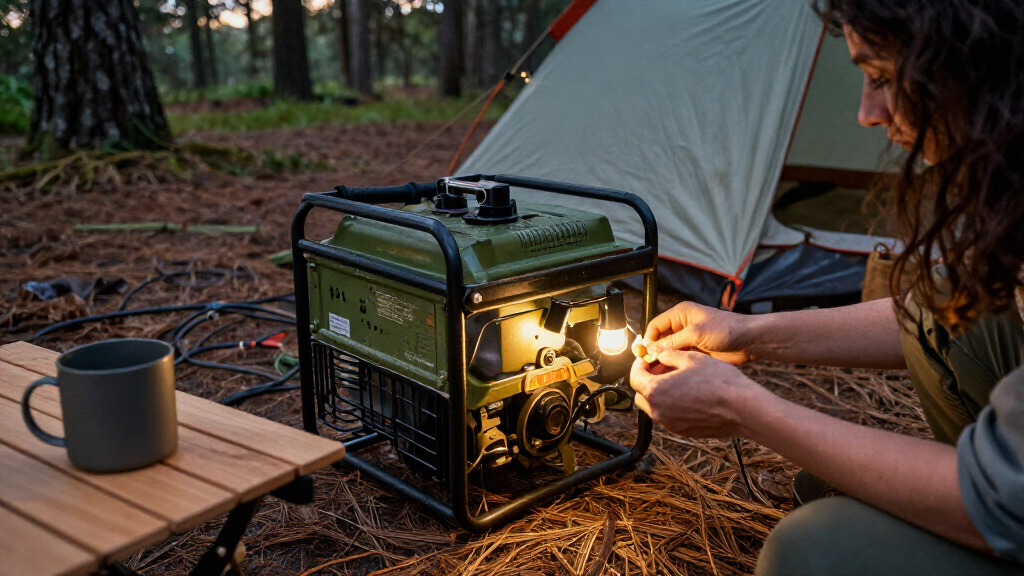
How We Picked
My selection process prioritized power-to-weight ratios and real-world usability over raw spec sheets. I evaluated each unit based on its ability to power common camping appliances (laptops, coolers, small coffee makers) while considering noise levels and portability. Battery stations were assessed on battery chemistry (LiFePO4 vs. NMC) and charging speed, while gas units were judged on fuel efficiency, noise decibels, and inverter stability for sensitive electronics.
Ranking logic favored versatility for the top spots, meaning units that could handle a wider range of devices earned higher positions. Specialized units, such as ultra-light power banks for day hikes or heavy-duty RV generators, were placed according to their specific utility rather than trying to force a one-size-fits-all metric. This ensures that whether you are a minimalist hiker or an overlander, the ranking reflects the best option for that specific context.
Factors to Consider When Choosing Portable Camping Generators
Selecting a portable power source involves navigating a complex landscape of technologies. It is not just about watts; it is about how you intend to recharge, what you plan to run, and where you plan to sleep. Here are the critical factors that differentiate these products.
Battery Chemistry and Longevity
The type of battery inside a portable power station dictates its lifespan and safety. LiFePO4 (Lithium Iron Phosphate) batteries, found in the Jackery Explorer 1000 v2 and BLUETTI Elite 100 Mini, offer significantly more charge cycles (often 3000+) compared to traditional NMC lithium-ion batteries. This means a LiFePO4 unit can last a decade of weekly use, whereas NMC might degrade after two or three years. If you plan to use the generator as a long-term investment for frequent camping trips or home backup, paying the premium for LiFePO4 chemistry is a wise financial decision that reduces long-term replacement costs.
Inverter Type and Appliance Compatibility
Not all power outputs are created equal. Pure sine wave inverters are mandatory for powering sensitive electronics like laptops, medical devices, and modern refrigerators. Many cheaper gas generators use modified sine waves, which can damage motors or cause electronics to overheat. When reviewing gas options like the AIVOLT 1750W, verify that they explicitly state ‘pure sine wave’ output. For battery stations, this is almost always standard, but gas buyers must check this spec to avoid risking expensive gear. A mismatch here can lead to costly repairs for your camping equipment.
Noise Levels and Campsite Etiquette
Noise is the primary reason campgrounds ban generators. Battery power stations operate silently, making them ideal for dispersed camping or tight campsites. Gas inverter generators, while quieter than old-school models, still produce mechanical noise from the engine and cooling fans, typically ranging from 50 to 60 decibels. This is comparable to a normal conversation. If you plan to camp in designated areas with strict noise ordinances, a battery unit like the Daran 89.6Wh is the only compliant choice. For remote off-grid sites, the noise of a gas generator like the GENKINS 4200W is less of an issue.
Charging Infrastructure and Recharge Speed
How fast you can refill the tank matters as much as the tank size. Gas generators can be refilled in minutes at any gas station, offering unlimited range if you carry extra fuel. Battery stations rely on AC wall chargers, car 12V ports, or solar panels. AC charging speeds vary wildly; the EF ECOFLOW DELTA 3 Classic charges rapidly, while smaller units like the Jackery Explorer 300 may take hours. If you lack reliable grid access for recharging, gas or dual-fuel models like the WEN DF360iX provide energy independence that battery-only units cannot match without extensive solar arrays.
Weight and Portability Constraints
A generator is useless if it is too heavy to move. Battery stations are generally lighter for their capacity compared to gas units of equivalent wattage, but they still add significant bulk. The MARBERO M82 is backpack-friendly, whereas the PowerSmart DB5041 requires a vehicle for transport. Consider your storage space in your vehicle; gas units require separate fuel storage, adding weight and fire hazard risks. Battery units are self-contained but heavier per watt-hour. Match the form factor to your mode of travel: backpacking needs under 10 lbs, car camping can handle 20-40 lbs.
Frequently Asked Questions
Can I run a refrigerator with a portable power station?
Yes, but you need sufficient capacity and surge power. Most 12-volt camping fridges draw low continuous power (40-60W), so even a mid-sized station like the LIBRIDS C600 can run one for days. However, if you are using a standard household refrigerator, you need a unit with high surge capacity (1000W+) and large battery capacity (1000Wh+), such as the Jackery Explorer 1000 v2. Always check the running watts and surge watts of your specific appliance before buying.
Is a solar generator worth it if I have access to electricity?
Solar panels are most valuable for off-grid scenarios where you cannot plug into the grid. If you camp in established campgrounds with hookups, a solar panel kit is often an unnecessary expense and adds setup time. However, having a small panel can be useful for emergency recharging during power outages or extended remote trips. For most car campers with grid access, investing in a larger battery capacity or faster AC charger is a more practical use of funds than buying a solar kit.
What is the main difference between a power station and an inverter generator?
A power station is a battery-based system that stores energy, making it silent, emission-free, and safe for indoor use. An inverter generator uses a combustion engine (gas or propane) to generate electricity on demand, offering unlimited runtime as long as you have fuel. Power stations are limited by their battery capacity, while inverter generators are limited by fuel availability and noise. Choose a power station for quiet, clean, short-duration power, and an inverter generator for high-wattage, long-duration needs.
Can I use a gas generator in a tent or RV?
No, never use a gas or dual-fuel generator inside a tent, RV, or any enclosed space. These units produce carbon monoxide, an odorless and deadly gas that can kill quickly in confined areas. Always operate gas generators outdoors, at least 20 feet away from windows, doors, and vents. If you need power inside an RV or tent, you must use a battery power station like the BLUETTI Elite 100 Mini, which emits no fumes and is safe for indoor use.
How many watts do I actually need for camping?
For basic needs like charging phones, cameras, and running LED lights, a unit with 100-300W output is sufficient. If you plan to run a small coffee maker, blender, or electric kettle, you need at least 1000-1500W of continuous output. High-draw appliances like hair dryers or space heaters require 2000W+, which usually points toward gas inverter generators like the Oxseryn 4400-Watt or large battery stations. Calculate the total wattage of all devices you plan to run simultaneously to determine your minimum requirement.
Conclusion
The market for portable camping generators has split into two distinct camps: silent, battery-powered versatility and loud, unlimited gas-powered raw power. For the majority of modern campers who prioritize convenience and noise reduction, the EF ECOFLOW DELTA 3 Classic is the best overall choice, offering the perfect blend of high output, fast charging, and LiFePO4 durability. If you are on a tight budget and only need to charge small electronics, the MARBERO M82 provides an accessible entry point without breaking the bank.
For those who need to run high-wattage appliances or camp for extended periods without grid access, the PowerSmart 4000 Watt Inverter Generator stands as the best value gas option, delivering reliable power at a competitive price. Beginners looking for a balance of size and capability should consider the Jackery Explorer 300 for its user-friendly interface and compact form. Ultimately, your choice depends on whether you value silence and portability above all else, or if you need the brute force of a combustion engine to keep your campsite running like home.
Black Friday Picks

Kindle Paperwhite (12th Generation, 2024), 16 GB, 7-inch Display, Black
As an affiliate, we earn on qualifying purchases.