
In 2026, I recommend the Seafrogs Waterproof Housing for Canon R50 for its great access to controls and affordability. The Ikelite Housing for Panasonic G85/G80 offers deep-water durability and full control. For Olympus E-M10 II users, the Ikelite TTL Housing provides excellent flash synchronization. Each option is tailored for different camera brands and diving needs, ensuring reliable performance underwater. Keep going to find out more details on these top choices.
Key Takeaways
- Compatibility with popular mirrorless models like Canon R50, Panasonic G85, and Olympus E-M10 II ensures optimal control and functionality.
- High depth ratings (up to 200 feet) and durable materials like polycarbonate or aluminum provide reliable underwater performance.
- Housing features include interchangeable ports and wide-angle lenses to suit various underwater photography needs.
- Controls mimicking camera buttons and ergonomic design facilitate easy operation and stability underwater.
- Support for TTL flash circuitry and secure lighting mounts enhance exposure accuracy and overall image quality.
| Seafrogs Waterproof Housing for Canon R50 + Lenses |  | Versatile Depth Performer | Depth Rating: 40 meters | Camera Compatibility: Canon EOS R50 | Control Access: Mechanical controls for all functions | VIEW LATEST PRICE | See Our Full Breakdown |
| Ikelite Underwater Housing for Panasonic G85/G80 |  | Professional-Grade Clarity | Depth Rating: 60 meters (~200 ft) | Camera Compatibility: Panasonic G85/G80 | Control Access: Mechanical controls for nearly all functions | VIEW LATEST PRICE | See Our Full Breakdown |
| Ikelite Underwater TTL Housing for Olympus E-M10 II |  | Compact and Reliable | Depth Rating: 60 meters (~200 ft) | Camera Compatibility: Olympus E-M10 II | Control Access: All important functions accessible | VIEW LATEST PRICE | See Our Full Breakdown |
More Details on Our Top Picks
-
B071Z763H6
Amazon Product B071Z763H6
As an affiliate, we earn on qualifying purchases.
Seafrogs Waterproof Housing for Canon R50 + Lenses
If you’re looking for a reliable underwater housing tailored to Canon EOS R50 users, the Seafrogs Waterproof Housing stands out. It’s specifically designed to fit the R50 and long lenses like 24-70mm f/2.8 and EF 24-105mm f/4L, giving you full access to controls with mechanical buttons. The housing includes a wide-angle dry lens dome, enhancing underwater shots. Rated for 40 meters, it’s perfect for diving, snorkeling, or water sports. Plus, with the vacuum leak prevention system, I feel confident that my gear stays dry. It’s durable, versatile, and built to handle harsh environments, making it a top choice for underwater photography.
- Depth Rating:40 meters
- Camera Compatibility:Canon EOS R50
- Control Access:Mechanical controls for all functions
- Port System:Interchangeable port with wide angle dry lens dome
- Waterproof Features:Vacuum leak prevention with VPS-100 system
- Construction Material:Not specified
- Additional Feature:Interchangeable port system
- Additional Feature:Mechanical camera controls
- Additional Feature:Vacuum leak prevention system
-
B01M1A5XPG
Amazon Product B01M1A5XPG
As an affiliate, we earn on qualifying purchases.
Ikelite Underwater Housing for Panasonic G85/G80
The Ikelite Underwater Housing for Panasonic G85/G80 stands out for photographers who demand full control and durability during their underwater shoots. It’s precisely designed for the G85 and G80, giving you access to almost all camera functions through mechanical controls like push-buttons and dials. Made from tough polycarbonate and ABS plastic, it offers excellent optical clarity and minimizes distortion. With a waterproof rating of up to 200 feet, it’s built for serious dives. The housing supports interchangeable ports for different lenses and features a TTL-compatible flash bulkhead, making it versatile for various lighting setups. It’s a reliable choice for underwater photography in challenging conditions.
- Depth Rating:60 meters (~200 ft)
- Camera Compatibility:Panasonic G85/G80
- Control Access:Mechanical controls for nearly all functions
- Port System:Interchangeable dome and flat ports (sold separately)
- Waterproof Features:No mention of vacuum system
- Construction Material:Polycarbonate and ABS plastic
- Additional Feature:Customizable lens options
- Additional Feature:TTL circuitry for strobes
- Additional Feature:Supports up to 200 ft depth
Ikelite Underwater TTL Housing for Olympus E-M10 II
For underwater photographers seeking reliable compatibility with their Olympus OM-D E-M10 Mark II, the Ikelite Underwater TTL Housing stands out thanks to its built-in TTL circuitry, which guarantees accurate flash exposure at every depth. Designed specifically for this mirrorless camera, it offers easy access to all essential controls, excluding the Fn3 button and diopter adjustment. Rated for depths up to 200 feet, it’s built with durable materials and has slightly negative buoyancy in freshwater. Its compact, lightweight design makes it ideal for deep-water photography, ensuring both protection and functionality. The Ikelite housing delivers consistent results, making it a solid choice for serious underwater shooters.
- Depth Rating:60 meters (~200 ft)
- Camera Compatibility:Olympus E-M10 II
- Control Access:All important functions accessible
- Port System:Interchangeable ports (implied support)
- Waterproof Features:No mention of vacuum system
- Construction Material:Durable housing (material not specified)
- Additional Feature:Built-in TTL circuitry
- Additional Feature:Durable, lightweight construction
- Additional Feature:Slightly negative buoyancy
Factors to Consider When Choosing Underwater Housings for Mirrorless Cameras
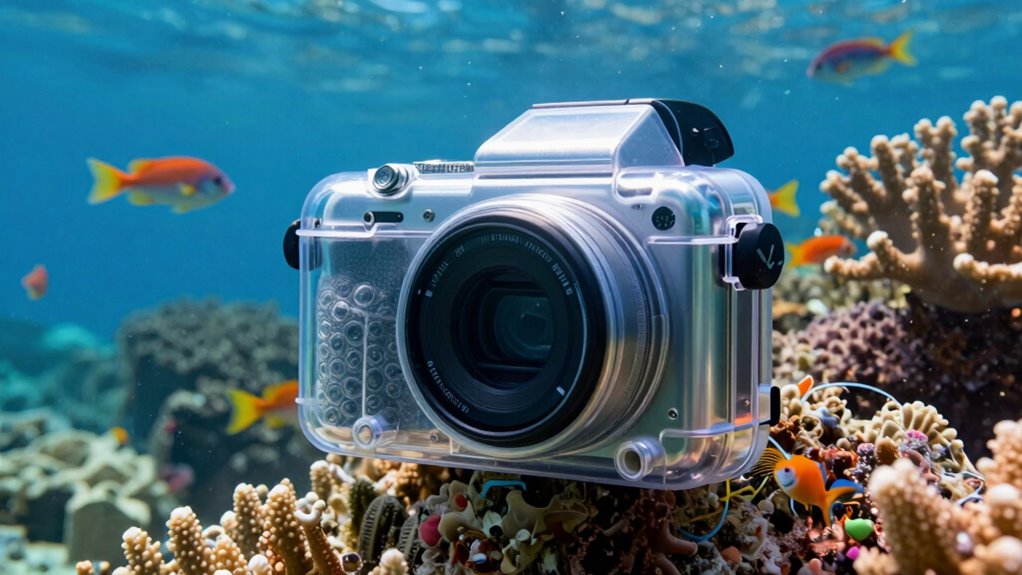
When choosing an underwater housing, I consider key factors like camera compatibility, depth ratings, and lens options to guarantee it suits my shooting needs. I also pay attention to control accessibility underwater and the durability of the build material to withstand harsh conditions. Getting these right helps me capture great shots without worry.
Camera Compatibility Requirements
Choosing an underwater housing that fits your mirrorless camera perfectly is vital for guaranteeing full control and protection during your dives. It’s important to verify that the housing is specifically designed for your camera model, so all buttons, dials, and ports are accessible and functional. Compatibility with your lenses is also key; check if the housing supports your existing lenses or if you’ll need additional accessories like specific lens ports. Additionally, make sure the housing’s depth rating exceeds your planned water activities to guarantee durability and safety. Consider if it allows for extra equipment, such as external strobes or leak detection systems, which can enhance your underwater photography experience. Proper compatibility ensures seamless operation and peace of mind during your underwater adventures.
Depth and Pressure Ratings
Depth and pressure ratings are critical factors to contemplate because they determine how well an underwater housing can withstand the forces encountered at various depths. These ratings indicate the maximum water depth the housing can handle safely, usually ranging from 40 to over 200 meters. As you go deeper, water pressure increases, requiring housings designed to resist this external force. Exceeding the rated depth risks water ingress, which can damage your camera and compromise safety. For deep-sea diving or professional work, choose housings with higher pressure ratings to ensure durability under extreme conditions. Regular maintenance and proper sealing are essential to preserve the housing’s integrity over time. Understanding these ratings helps you select a housing that matches your diving needs, preventing accidents and equipment failure.
Lens Port Options
Selecting the right lens port is vital for capturing high-quality underwater images, as it directly influences image sharpness, distortion, and field of view. Flat ports are ideal for standard lenses, providing minimal distortion and maximum clarity, while dome ports suit wide-angle or fisheye lenses, offering a broader perspective underwater. Interchangeable port systems give flexibility, letting me customize my setup based on lens size and shooting needs. Precise measurements of my lens diameter and filter thread are essential to guarantee compatibility and avoid optical issues. Using the correct port type minimizes distortions and boosts sharpness, especially with wide-angle or macro lenses. Some housings also feature specialized wet or dry ports, allowing adaptation to different lenses and underwater conditions for best results.
Control Accessibility Underwater
When I evaluate underwater housings, I pay close attention to how controls are arranged and how accessible they are. Ideally, the controls should mimic the camera buttons and dials, making adjustments seamless beneath the surface. The placement and size of buttons matter a lot; they need to be easy to operate, even with bulky gloves or in low visibility. Precise control access allows me to tweak settings like ISO, aperture, and shutter speed without removing the camera from the housing. Well-designed layouts reduce the risk of accidental adjustments or damage. Additionally, compatibility with external controls, such as TTL flash triggers and leak detectors, enhances safety and functionality. Overall, easy and reliable control accessibility is essential for confident underwater shooting.
Build Material Durability
Choosing the right build material for an underwater housing is essential because it determines how well the case can withstand the rigors of diving. Durable materials like polycarbonate, ABS plastic, and aluminum offer resistance to impact and corrosion, crucial for longevity. Polycarbonate and ABS plastic housings are lightweight yet strong, making them ideal for extended underwater use and easier handling. Aluminum housings provide superior strength and corrosion resistance but are heavier and more expensive. The material choice also affects the housing’s ability to endure high-pressure environments at greater depths. Proper sealing and high-quality materials are vital to prevent water ingress and ensure durability in harsh underwater conditions. Ultimately, selecting the right material balances strength, weight, and cost for your diving needs.
Lighting and Strobe Support
Lighting and strobe support play a crucial role in achieving well-exposed underwater images, especially in low-light conditions. Choosing a housing with TTL strobe support allows for automatic flash exposure, ensuring consistent, properly lit shots without manual adjustments. Compatibility with external strobes and lighting systems is essential for flexible, high-quality illumination tailored to different environments. Proper sealing and waterproof integrity are critical to prevent water ingress that could damage delicate lighting equipment. Adjustable strobe ports and mounts within the housing help position lights for even coverage and minimal backscatter. Some housings feature specialized connectors and circuitry that synchronize TTL flash firing with the camera, improving exposure accuracy. Prioritizing these features ensures reliable lighting control and better overall image quality underwater.
Ease of Handling and Buoyancy
Handling an underwater housing comfortably is essential for capturing sharp, well-composed images. Proper buoyancy balance makes handling easier and reduces fatigue during long shoots. Slight negative buoyancy helps keep the camera stable underwater, while positive buoyancy can make control difficult. Many housings feature buoyancy foam or adjustable weights to help achieve the right floatation and handling. An ergonomic design with accessible controls allows for intuitive operation, minimizing the risk of slips or drops. Ease of handling directly impacts underwater stability, especially when adjusting settings or shooting moving subjects in challenging conditions. When choosing a housing, prioritize one that offers good buoyancy control and ergonomic features, so you can focus on capturing stunning images without struggling with your gear.
Frequently Asked Questions
What Are the Latest Innovations in Underwater Housing Technology for 2026?
In 2026, underwater housing tech has skyrocketed, focusing on durability, ease of use, and integrated tech. I’ve seen innovations like smart seals that detect leaks instantly, lightweight yet ultra-strong materials, and built-in touchscreen controls that sync seamlessly with cameras. Plus, improved port designs allow quicker lens changes, and integrated lighting systems enhance clarity. These advancements make underwater photography more reliable, intuitive, and enjoyable for everyone, including me!
How Do Underwater Housings Impact Camera Performance and Image Quality?
Underwater housings can considerably impact my camera’s performance and image quality. They protect my gear from water pressure, preventing damage, but if not well-designed, they can cause reflections, distortions, or reduce clarity. I always choose housings with clear glass ports and precise seals to guarantee sharp images and reliable operation. Properly selected housing enhances my underwater photography, letting me capture stunning, crisp shots without compromising my camera’s capabilities.
Are There Eco-Friendly Underwater Housing Options Available This Year?
Absolutely, eco-friendly underwater housings are available now. I’ve seen brands using recycled plastics and sustainable materials, which reduce environmental impact without sacrificing quality. Some companies also prioritize manufacturing processes that minimize waste and energy use. As a photographer, I appreciate these options because they allow me to explore underwater worlds responsibly. If you’re seeking eco-conscious gear, I recommend researching brands committed to sustainability—it’s a great step toward protecting our oceans.
What Safety Features Should I Look for in Underwater Housings?
Ever wondered how to keep your gear safe underwater? I look for housings with secure latches, reliable seals, and pressure ratings suited for my diving depths. It’s also smart to choose ones with clear viewports and easy-to-operate controls, especially if I need quick adjustments. Do I want a housing with a built-in buoyancy aid? Absolutely. Safety features like these give me peace of mind and protect my camera from mishaps.
How Do Maintenance and Cleaning Practices Vary for Different Housings?
Maintenance and cleaning practices vary depending on the housing material and design. I always rinse my housing with fresh water after each dive to remove salt and debris. For silicone seals, I gently inspect and lubricate them regularly to prevent dryness or cracking. If my housing has filters or ports, I clean them carefully with a soft brush. Following the manufacturer’s instructions guarantees my equipment stays in top condition for safe, leak-free dives.
Conclusion
Choosing the right underwater housing feels like a fortunate coincidence—matching your camera’s needs with the perfect protective shell. As I’ve discovered, the Seafrogs, Ikelite G85, and Olympus housings each bring unique strengths that can turn your underwater adventures into stunning visuals. When you find that perfect fit, it’s almost as if the ocean itself aligns to support your passion. Trust me, a little luck combined with the right gear makes all the difference.