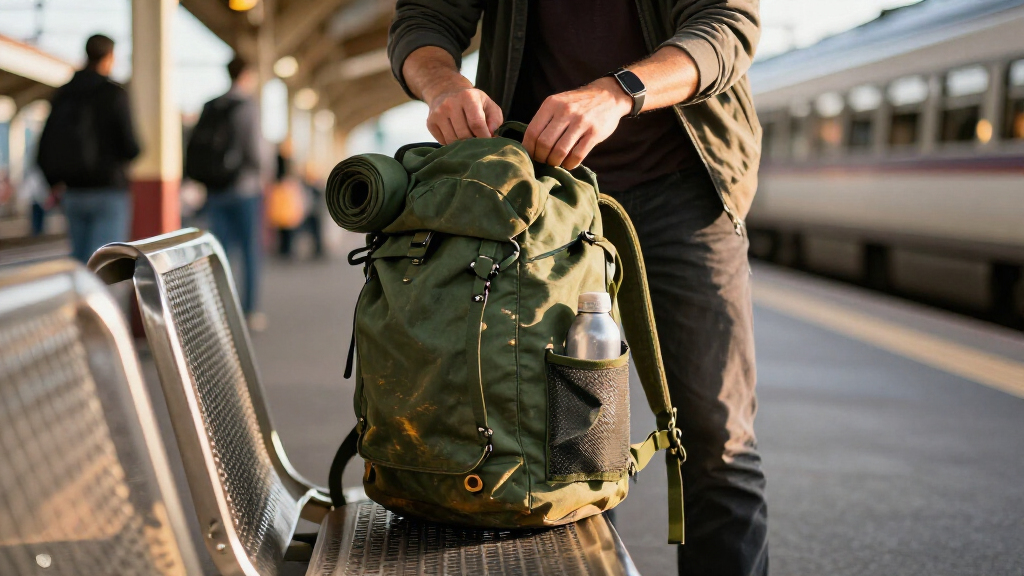
Choosing a compact travel backpack often comes down to a practical question: should it fit under the seat, or should it hold enough to serve as your main cabin bag? Personal-item travel backpacks prioritize small dimensions and light packing; carry-on travel backpacks give you more room for clothes, shoes and trip extras. That extra capacity can reduce the need for checked luggage, but only if your ticket includes an overhead cabin bag and the backpack meets the airline’s limits.

Get travel and outdoor gear delivered free with Prime
- Fast, free delivery on millions of items
- Prime Video, Amazon Music and more included
- Member-only deals all year

Osprey Ultralight Collapsible Stuff Pack, Black
- ✔ Capacity: 18 liters
- ✔ Weight: 0.329 lb
- ✔ Material: 40D high-tenacity nylon; recycled main body fabric

4Monster 16L Water-Resistant Packable Hiking Daypack
- ✔ Capacity: 16 liters
- ✔ Weight: Listed as 59.53 g and 4 oz / 113 g in the description
- ✔ Material: 30D tear-resistant nylon with reinforced stitching

WATERFLY 20L Lightweight Packable Hiking Daypack
- ✔ Capacity: 20 liters
- ✔ Weight: 290 g (10.2 oz)
- ✔ Material: Recycled nylon
The better fit depends on the trip, the airline and how much you are willing to carry. Choose a personal-item bag for short trips, strict budgets and travelers who pack light. Choose a carry-on bag for longer trips or more gear, provided you have access to overhead-bin space. The comparisons below focus on the dimensions, packing room, access, comfort, airline restrictions and value that shape that choice.
At a Glance
| Criteria | Personal-item travel backpacks | Carry-on travel backpacks | Winner |
|---|---|---|---|
| Typical capacity | Usually about 20–30 liters, depending on shape and brand | Usually about 30–45 liters, depending on dimensions and design | B |
| Airline fit | Designed to fit under a seat, but limits vary by airline and ticket | Aims to meet standard cabin-bag limits, which differ by airline | A |
| Packing flexibility | Best for a tight capsule wardrobe and essentials | Can carry more clothes, shoes and equipment | B |
| Organization and access | Often has fewer compartments to keep the bag compact | More likely to offer a clamshell opening and dedicated compartments | B |
| Carrying comfort | Lower weight and bulk are easier in crowds and on transit | More room for a supportive harness, but greater load can feel heavier | A |
| Price and travel costs | Often less expensive; may help avoid a cabin-bag fee when accepted | Often costs more; may replace checked luggage if cabin baggage is included | Depends |
| Best trip length | Overnights and short trips with light packing | Several days or longer when packing efficiently | Depends |
Osprey Ultralight Collapsible Stuff Pack, Black
For most travelers, the Osprey Ultralight Collapsible Stuff Pack makes the strongest all-around case because it combines an 18-liter capacity with features that help when the bag is actually on our backs. Its padded mesh shoulder straps and adjustable sternum strap offer more carrying support than the minimal details listed for the 4Monster, while stretch side pockets and an internal key clip add practical access without turning the bag into a bulky organizer. It folds into its own pocket, so it can live inside a suitcase until we need an extra day bag.That balance earns Osprey the top spot, but it does not win every comparison. The 4Monster is lighter by its stated weight and has water-resistant fabric, which may suit a traveler who wants a simple spare bag for fair-weather outings. WATERFLY provides two more liters than Osprey and four zippered compartments, making it better for those who separate small items or carry more. Osprey’s key compromise is that it is not water resistant; we would plan to protect electronics and other sensitive contents separately if rain is likely. Hand-wash-only care also calls for more attention than a bag we can treat casually.We recommend this as the best overall compact travel backpack when carrying comfort and a useful middle-ground capacity matter more than built-in weather protection or the most compartments. Its certified recycled main body fabric is a useful material detail, though buyers should still choose based on fit and intended load. The listed packability makes it easy to bring along; the soft, collapsible format still points toward day-trip use rather than a substitute for a structured travel pack.
Pros:
- Folds into its own pocket for storage in luggage
- Padded mesh shoulder straps and adjustable sternum strap add carrying support
- 18-liter capacity offers a middle ground between the smaller 4Monster and larger WATERFLY
- Main body uses recycled nylon with bluesign and GRS certifications
Cons:
- Not water resistant, so contents need separate protection in wet weather
- Hand wash only
- One main compartment offers less separation than WATERFLY’s four compartments
Best for: Travelers who want a packable 18-liter day bag with more shoulder and sternum-strap support for city walks and day trips.
Not ideal for: Anyone who needs described water resistance, multiple zippered compartments, or a structured backpack for carrying heavy loads.
Bottom line: We rank Osprey first for its useful capacity and more supportive straps, provided we can manage its lack of water resistance.
“We rank Osprey first for its useful capacity and more supportive straps, provided we can manage its lack of water resistance.”
4Monster 16L Water-Resistant Packable Hiking Daypack
The 4Monster 16L Daypack is our pick for travelers who want a simple bag that can disappear into luggage and come out for a light outing. At 16 liters, it has the smallest stated capacity in this lineup, and the supplied weight description gives two figures: 59.53 g and 4 oz / 113 g. That inconsistency makes the precise weight unclear, but the design is plainly positioned as a lightweight, foldable option. Its 30D tear-resistant nylon, reinforced stitching, and water-resistant fabric give it a more protective description than Osprey for splashes and light rain.Compared with Osprey, 4Monster trades supportive strap details for a simpler layout and a smaller load. The listing names a main compartment, one front zipper pocket, and two mesh side pockets, but does not specify padded straps or a sternum strap. WATERFLY is the better choice if we need 20 liters and four zippered compartments; its 290 g stated weight is also much clearer, though heavier than 4Monster’s lower listed figure. The 4Monster’s water resistance is limited to light rain and splashes in the description, so we would not rely on it in prolonged wet weather.This bag’s appeal is that it is a low-fuss backup for souvenirs, a short walk, or carrying a few essentials when a larger travel pack stays behind. The tradeoff is equally clear: a soft, lightweight bag is less suited to heavy loads, and the available details do not suggest the same carrying support as Osprey. Choose it when compactness and basic pockets matter more than a larger capacity or a comfortable setup for a full day’s heavier carry.
Pros:
- Folds into a compact pouch for easy luggage storage
- Water-resistant fabric is described for light rain and splashes
- Tear-resistant 30D nylon with reinforced stitching
- Front zip pocket and two mesh side pockets keep a few essentials accessible
Cons:
- Weight is listed inconsistently as 59.53 g and 113 g
- Soft lightweight design is less suited to heavy loads
- Water resistance is not described for heavy rain
Best for: Travelers seeking a small, lightweight packable day bag for light essentials, short outings, and fair-weather use.
Not ideal for: People carrying heavy items, those who need a larger organized interior, or anyone expecting reliable protection in sustained rain.
Bottom line: We choose 4Monster when a minimal, small-capacity spare bag matters more than carrying support or room for a full day’s gear.
“We choose 4Monster when a minimal, small-capacity spare bag matters more than carrying support or room for a full day’s gear.”
WATERFLY 20L Lightweight Packable Hiking Daypack
When we want a packable bag to hold more than just a few essentials, the WATERFLY 20L Daypack stands out for combining the largest stated capacity here with four zippered compartments. That organization can make travel days easier: we can separate items instead of letting everything settle into a single main space. It folds to 8.7 × 6.3 inches and weighs 290 g, so it remains portable, though Osprey is lighter at its stated 0.329 lb and 4Monster is positioned as the more minimal option.The extra room comes with a clear tradeoff. WATERFLY is the heaviest option with a supplied weight figure, and its 20-liter capacity may be more bag than we need if our goal is simply to stash a compact spare in a carry-on. Compared with Osprey, it offers more compartments and described water resistance, but Osprey includes padded mesh straps and an adjustable sternum strap. Compared with 4Monster, WATERFLY gives us four zippered compartments and more space, while 4Monster claims less weight and a smaller 16-liter footprint. WATERFLY’s water-resistant fabric is not defined beyond that phrase, so we should not infer waterproof protection.This is the best fit for travelers who expect to use their compact backpack regularly and want room to keep belongings sorted. Its recycled nylon and three-year warranty are useful considerations, but the listing does not specify a support system comparable to Osprey’s. We would skip it if minimal packed bulk is the overriding concern, or if we need confirmed protection for electronics in heavy rain. For shoppers prioritizing capacity and compartment access, however, it offers a distinct advantage over the more spare designs.
Pros:
- Largest stated capacity in this group at 20 liters
- Four zippered compartments provide more separation than Osprey’s single compartment
- Folds to a compact 8.7 × 6.3 in size
- Made from recycled nylon and includes a three-year warranty
Cons:
- At 290 g, it weighs more than the other stated weights suggest
- Water resistance is not specified beyond the general description
- No stretch fabric, and the listing does not detail a sternum strap or padded strap support
Best for: Travelers who want a larger packable daypack with several zippered compartments for separating travel essentials.
Not ideal for: Minimalists seeking the lightest listed setup, or travelers who need a specified level of rain protection and strap support.
Bottom line: We recommend WATERFLY when extra capacity and zippered organization outweigh the benefit of the lightest possible pack.
“We recommend WATERFLY when extra capacity and zippered organization outweigh the benefit of the lightest possible pack.”
As an Amazon Associate we earn from qualifying purchases.
Key Differences
The main tradeoff is space against airline flexibility. A personal-item backpack is smaller, so it is easier to carry through a crowded station and may fit under the seat. That can be especially useful on basic fares that charge for larger cabin bags. But personal-item dimensions are not universal: check the airline and ticket before relying on a bag’s advertised fit. A soft-sided pack may compress, but an overfilled one can still exceed the limit.
A carry-on backpack gives you a wider packing margin. It can hold more clothing and gear, and a suitcase-style opening can make packing and finding items easier. The costs are added bulk, a fuller load and dependence on overhead-bin access. On some fares, a standard cabin bag is included; on others, it costs extra or is restricted. Paying for the larger bag makes sense when the trip calls for its capacity and the fare allows it. For short, light trips, the extra volume can be unnecessary weight.
Detailed Comparison
Typical capacity (Carry-on travel backpacks wins — moderate)
Carry-on backpacks win by a moderate margin. They commonly offer roughly 30–45 liters, compared with about 20–30 liters for personal-item models, though shape and usable space vary. The difference can mean another outfit, a second pair of shoes or room for work gear. Choose the smaller category if you can pack within its limits; extra capacity is only helpful when you need it.
Airline fit (Personal-item travel backpacks wins — moderate)
Personal-item backpacks have a moderate advantage for under-seat travel. Their smaller footprint is intended to fit below the seat, which can keep essentials nearby and may avoid a larger-bag fee. Airline limits and seat space vary, and some basic fares restrict what you can bring. Carry-on backpacks are intended for overhead bins and must meet that airline’s cabin-bag rules. Measure the packed bag and check the fare before flying.
Packing flexibility (Carry-on travel backpacks wins — major)
Carry-on backpacks win by a major margin for travelers who need more gear. Their greater volume leaves room for longer trips, bulky layers or specialized equipment. That can help you skip checked luggage when the fare includes a cabin bag. A personal-item pack demands tighter choices and may require laundry or repeat outfits. If your packing list is already lean, however, the smaller bag keeps you from carrying unused space.
Organization and access (Carry-on travel backpacks wins — minor)
Carry-on backpacks have a minor edge. Their larger panels can accommodate clamshell openings, laptop sleeves and separate pockets for shoes or toiletries. These features can make it easier to find things without unpacking the whole bag. A personal-item pack may offer a simpler layout that works well for a small load, but every compartment takes up some space. Compare pocket layout with your actual packing needs.
Carrying comfort (Personal-item travel backpacks wins — moderate)
Personal-item backpacks win by a moderate margin for light travel. Their smaller size encourages a lighter load and makes them easier to manage on stairs, transit and crowded streets. Carry-on packs may have room for a more substantial harness, but their extra capacity can invite overpacking. Fit, strap shape and weight distribution matter more than the category label. Try a loaded bag when possible, especially if you expect to walk far.
Price and travel costs (moderate difference)
Neither category wins for every traveler. Personal-item models often cost less upfront, and on a fare that permits one free personal item, a compliant bag may avoid the cost of adding a cabin bag. Carry-on backpacks often cost more, yet can be good value if their space replaces checked luggage or serves many trips. Check what baggage your ticket includes and compare the full trip cost, not just the bag price.
Best trip length (moderate difference)
The winner depends on packing habits and laundry access. Personal-item backpacks suit overnight trips and short breaks for travelers who repeat outfits or pack minimal layers. Carry-on backpacks suit several days or longer when you need more changes of clothes or equipment. Trip length alone is not decisive: a minimalist may travel for a week with a small pack, while a short business trip can require more formal clothing and work gear.
Personal-item travel backpacks: Pros and Cons
Pros:
- Small size is easier to carry on public transit and through crowded spaces.
- Can fit under the seat and keep travel essentials close at hand.
- Often has a lower purchase price and may help avoid cabin-bag fees.
- Encourages lighter packing.
Cons:
- Limited room for shoes, bulky clothing and extra equipment.
- Requires tighter packing choices and may call for laundry on longer trips.
- Under-seat dimensions and allowances vary by airline and fare.
Carry-on travel backpacks: Pros and Cons
Pros:
- More capacity for clothing, shoes and work or activity gear.
- Can replace checked luggage on trips when a cabin bag is included.
- Often has room for clamshell access and more specialized compartments.
- Useful for longer trips or less predictable packing needs.
Cons:
- More bulk and weight to carry, especially when fully packed.
- May need to go in the overhead bin and meet that airline’s size rules.
- Can cost more to buy and may trigger a baggage fee on restrictive fares.
Who Should Choose What
Choose Personal-item travel backpacks if:
- You usually take overnight or short trips and pack a compact wardrobe.
- Your fare includes a personal item but charges for an overhead cabin bag.
- You want a light bag that stays under the seat and is easy to carry on transit.
Choose Carry-on travel backpacks if:
- You need space for several days of clothing, shoes or specialized equipment.
- Your fare includes a cabin bag or the additional capacity is worth the fee.
- You want one backpack to replace checked luggage on many trips.
Skip both if: Neither size works for your usual load: choose checked luggage or a larger travel bag if you need more capacity, or a smaller daypack if you travel with only essentials.
Value for Money
Pay more for a carry-on backpack when you will use its extra capacity and your ticket includes overhead-bin baggage or the bag helps you avoid checked-luggage costs. It can be worthwhile for frequent trips, longer stays and travelers who carry work or activity gear. Paying more simply for a larger pack does not make sense if you routinely leave it half empty or face a fee to bring it aboard.
A personal-item backpack is often the better value for light packers on fares that allow it free. Its lower purchase price matters, but the bigger saving can come from avoiding an added baggage charge. That saving depends on the airline’s rules and the fare purchased. Compare bag cost, baggage fees and how often you travel before choosing; the cheapest bag is not necessarily the lowest-cost option over repeated trips.
Final Verdict
For most travelers who pack light, a personal-item backpack is the more practical compact choice: it is easier to carry, can stay under the seat and may keep baggage costs down. Choose a carry-on backpack if you regularly need more room and your ticket allows an overhead bag at a reasonable cost. The deciding factor is whether the extra capacity earns its weight and price on your actual trips. Check the packed dimensions against the airline and fare before buying.
Frequently Asked Questions
Is a personal-item backpack the same as a carry-on backpack?
No. A personal-item backpack is intended to fit below the seat, while a carry-on backpack is intended for an overhead bin. Airlines set their own size limits and baggage allowances, so check both the dimensions and your ticket conditions.
Can a personal-item backpack work for a weeklong trip?
Yes, if you pack lightly and have access to laundry. A compact wardrobe, repeat outfits and minimal shoes help. If you need several clothing changes, bulky layers or equipment, a carry-on backpack is usually easier.
Is a carry-on backpack worth paying more for?
It can be if you use the capacity regularly, your fare includes an overhead bag or it lets you avoid checked luggage. For short trips with a small packing list, the added price and weight may not pay off.
Do airline size rules apply to soft backpacks?
Yes. A soft bag can compress, but an overfilled pack may still exceed the airline’s limits or fail to fit in a sizer. Check the specific airline and fare, and measure the bag when packed rather than relying only on its empty dimensions.
Black Friday Picks

Kindle Paperwhite (12th Generation, 2024), 16 GB, 7-inch Display, Black
As an affiliate, we earn on qualifying purchases.