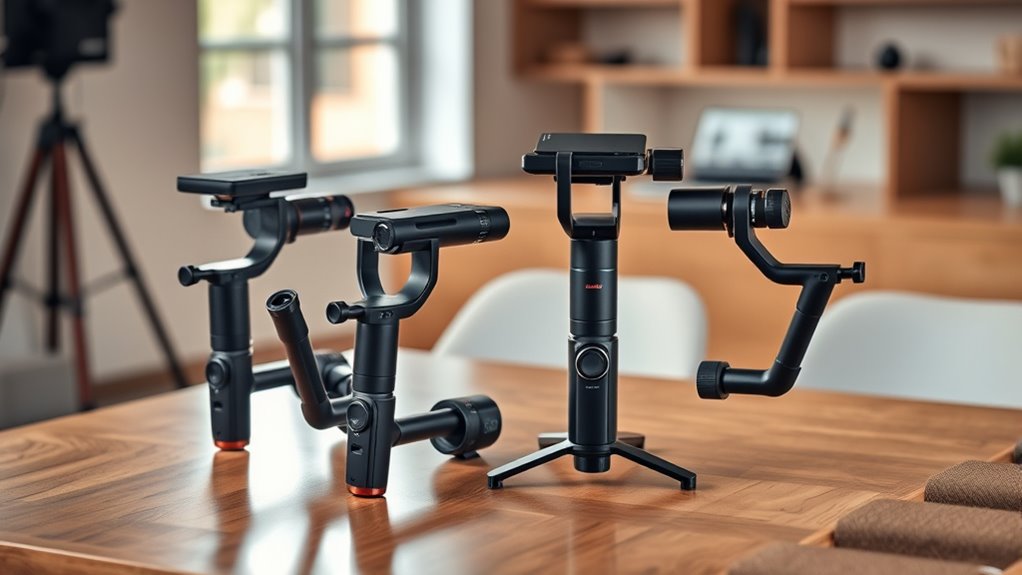

Choosing among gimbal stabilizers for videography comes down to one question: what are you mounting on it? Phone shooters and camera shooters need entirely different tools, and the biggest mistake buyers make is overpaying for payload they don’t use or under-buying for a camera the gimbal can’t hold. For most people shooting on a smartphone, the DJI Osmo Mobile 7P stands out as the best overall pick thanks to its extension rod, strong tracking, and refined app. If you shoot on a mirrorless camera, the DJI RS 3 Mini offers serious stabilization in a lightweight body, while the hohem iSteady V3 is the value play for phone video on a budget. Read on for the full breakdown of all twelve options.

Get travel and outdoor gear delivered free with Prime
- Fast, free delivery on millions of items
- Prime Video, Amazon Music and more included
- Member-only deals all year
Complete the kit



Key Takeaways
- Payload is the great dividing line in this roundup: the FeiyuTech SCORP-C (5.5 lbs), SCORP 2, and DJI RS 3 Mini handle mirrorless and DSLR rigs, while every other pick is phone-only — buying the wrong class of gimbal is the most expensive mistake here.
- DJI‘s Osmo Mobile line dominates phone stabilization, but the 7P’s built-in extension rod and the 8’s newer tracking features justify their step up over the standard Osmo Mobile 7 for solo creators.
- The hohem iSteady X3 and COMITOK L7C Pro prove that sub-$60 foldable gimbals can deliver smooth footage, though weaker motors mean shaky results with heavier phones or cases.
- The Zeadio handle grip isn’t a gimbal at all — it’s a passive stabilizer — and it only makes sense as a backup tool or for GoPro-style run-and-gun where electronic stabilization already exists in-camera.
- The GoPro Fluid Pro uniquely bridges two worlds by supporting both action cams and smartphones, but its camera ecosystem lock-in makes it a niche pick compared to dedicated phone gimbals.
| DJI Osmo Mobile 7 Gimbal Stabilizer for iPhone & Android |  | Best Overall Smartphone Gimbal | Weight: 300 grams | Max Operating Time: 10 hours | Compatibility: iPhone & Android | VIEW ON AMAZON | See Our Full Breakdown |
| FeiyuTech SCORP-C Gimbal Stabilizer for DSLR and Mirrorless Cameras |  | Best Value Camera Gimbal | Payload: 5.5 lbs (2.5 kg) | Weight: 1200 grams | Stabilization: 3-axis | VIEW ON AMAZON | See Our Full Breakdown |
| FeiyuTech SCORP 2 Gimbal Stabilizer for DSLR and Mirrorless Cameras |  | Best Premium Camera Gimbal | Payload: 2.5 kg | Stabilization: 3-axis | Screen: 1.3-inch touchscreen | VIEW ON AMAZON | See Our Full Breakdown |
| hohem iSteady V3 Ultra Gimbal Stabilizer for iPhone |  | Best for Solo Creators | Stabilization: 3-axis, iSteady 9.0 | Tracking: AI with 360° panning | Remote: Detachable 1.22-inch touchscreen, 33 ft range | VIEW ON AMAZON | See Our Full Breakdown |
| Zeadio Video Action Stabilizing Handle Grip with Cold-Shoe Mount |  | Best Budget Stabilization Fix | Compatibility: All cameras and camcorders with 1/4-20 thread | Mounting: Standard 1/4-20 thread | Accessory Mount: Cold-shoe | VIEW ON AMAZON | See Our Full Breakdown |
| DJI Osmo Mobile 7P Gimbal Stabilizer for iPhone and Android |  | Best Feature-Rich Phone Gimbal | Gimbal Type: 3-axis phone gimbal | Operating Time: 10 hours | Compatibility: iPhone, Android | VIEW ON AMAZON | See Our Full Breakdown |
| GoPro Fluid Pro AI 3-Axis Gimbal Stabilizer for GoPro Cameras and Smartphones |  | Best for GoPro Ecosystem Shooters | Gimbal Type: 3-axis | Compatibility: Mobile phones, GoPro cameras (Bluetooth only with HERO9 Black and newer), select compact point-and-shoot cameras | Battery Life: Up to 18 hours (gimbal only), 11 hours (AI tracking), 6 hours (tracking + fill light) | VIEW ON AMAZON | See Our Full Breakdown |
| DJI Osmo Mobile 8 Standard Combo Gimbal Stabilizer for Phone |  | Best for Everyday Vlogging | Stabilization: 3-axis | Rotation: 360° pan | Battery Life: 10 hours | VIEW ON AMAZON | See Our Full Breakdown |
| Hohem iSteady X3 Upgraded 3-Axis Foldable Phone Gimbal Stabilizer with Remote, Fill Light, Extendable Rod & Tripod |  | Best Budget-Friendly Travel Pick | Stabilization: 3-axis | Weight: 0.93 lbs | Foldable: Yes | VIEW ON AMAZON | See Our Full Breakdown |
| DJI RS 3 Mini Camera Gimbal Stabilizer for Canon, Sony, Nikon, Fujifilm |  | Best for Mirrorless Camera Work | Gimbal Type: 3-axis camera gimbal | Load Capacity: Up to 2 kg (4.4 lbs) | Weight: 795g (1.75 lbs) | VIEW ON AMAZON | See Our Full Breakdown |
| DJI Osmo Mobile 8 Gimbal Stabilizer for Phone |  | Best Feature-Rich Smartphone Gimbal | Brand: DJI | Model: Osmo Mobile 8 | Stabilization: 3-axis with 360° pan rotation | VIEW ON AMAZON | See Our Full Breakdown |
| COMITOK L7C Pro Gimbal Stabilizer for iPhone and Android |  | Best Budget Pick | Model: L7C Pro | Stabilization: 3-axis foldable | Battery Capacity: 2600mAh | VIEW ON AMAZON | See Our Full Breakdown |
| gimbal stabilizers for videography | Compatibility | Stabilization | Weight |
|---|---|---|---|
| DJI Osmo Mobile 7 Gimbal Stabi | iPhone & Android | 3-axis | 300 grams |
| FeiyuTech SCORP-C Gimbal Stabi | Sony, Canon, Nikon, Panasonic, Fujifilm DSLR & mirrorless | 3-axis | 1200 grams |
| FeiyuTech SCORP 2 Gimbal Stabi | — | 3-axis | — |
| hohem iSteady V3 Ultra Gimbal | — | 3-axis, iSteady 9.0 | 15.1 oz |
| Zeadio Video Action Stabilizin | All cameras and camcorders with 1/4-20 thread | — | — |
| DJI Osmo Mobile 7P Gimbal Stab | iPhone, Android | — | — |
| GoPro Fluid Pro AI 3-Axis Gimb | Mobile phones, GoPro cameras (Bluetooth only with HERO9 Black and newer), select compact point-and-shoot cameras | — | — |
| DJI Osmo Mobile 8 Standard Com | — | 3-axis | — |
| Hohem iSteady X3 Upgraded 3-Ax | iPhone and Android | 3-axis | 0.93 lbs |
| DJI RS 3 Mini Camera Gimbal St | Canon, Sony, Nikon, Fujifilm mirrorless cameras | — | 795g (1.75 lbs) |
| DJI Osmo Mobile 8 Gimbal Stabi | — | 3-axis with 360° pan rotation | — |
| COMITOK L7C Pro Gimbal Stabili | Phones under 7 inches, up to 0.62 lbs | 3-axis foldable | 0.8 lbs |
More Details on Our Top Picks
DJI Osmo Mobile 7 Gimbal Stabilizer for iPhone & Android
DJI’s Osmo Mobile 7 stands out as the most balanced phone gimbal in this lineup, pairing ActiveTrack 7.0 subject tracking with a foldable frame that collapses small enough for a jacket pocket. The built-in tripod removes a common extra purchase, and the 10-hour battery outlasts the hohem iSteady V3 Ultra by about an hour of runtime while weighing roughly the same. Compared with the budget-oriented COMITOK L7C Pro, the Osmo’s tracking is noticeably stickier when subjects turn or leave frame. The tradeoff is software friction: Android users must sideload the app from DJI’s website since it left Google Play, and advanced accessories like the Tracking Kit cost extra. Still, for the widest combination of portability, tracking quality, and battery life, this pick makes the most sense for most phone videographers.
Pros:- ActiveTrack 7.0 keeps subjects locked even during fast movement
- Foldable design with built-in tripod eliminates extra gear
- 10-hour battery with USB-C charging that can also power your phone
- Lightweight 300g body reduces fatigue on long shoots
Cons:- Android app must be sideloaded from DJI’s website rather than Google Play
- Useful extras like the Tracking Kit require a separate purchase
- Some platform-specific features are limited depending on your phone
Best for: Smartphone content creators who want reliable all-day tracking without carrying extra accessories
Not ideal for: Android users who want a frictionless app install experience, or creators who need the extension rod and fill light the hohem V3 Ultra includes
- Weight:300 grams
- Max Operating Time:10 hours
- Compatibility:iPhone & Android
- Stabilization:3-axis
- Tracking:ActiveTrack 7.0
- Design:Foldable with built-in tripod
- Charging:USB-C
Our verdict“The safest choice for phone videographers who want polished tracking and portability in one package without accessory clutter.”
FeiyuTech SCORP-C Gimbal Stabilizer for DSLR and Mirrorless Cameras
For videographers stepping up from phone rigs to real camera bodies, the SCORP-C delivers professional handling at a friendlier price than the DJI RS 3 Mini. Its scorpion-style integrated hanging handle lets you drop into underslung low-angle shots instantly — something the RS 3 Mini’s traditional arms make less convenient — and the folding bracket means you can set it down without hauling a tripod. The 5.5lb payload covers mainstream Sony, Canon, Nikon, Panasonic, and Fujifilm bodies with light lenses, and thoughtful touches like axis locks, a center-of-gravity memory slider, and an Arca quick-release plate speed up every rebalancing session. The compromise is a heavier 1.2kg body and no built-in screen, so you’ll control settings through buttons and the app rather than a touchscreen like the SCORP 2 offers.
Pros:- Integrated hanging handle makes underslung and low-angle shooting effortless
- Stands on its own via folding bracket, no tripod needed between setups
- 10-13 hour battery with 18W fast charging adds 30 minutes in 5 minutes
- Broad compatibility across Sony, Canon, Nikon, Panasonic, and Fujifilm bodies
Cons:- Heavier than competitor camera gimbals at 1.2kg, tiring on long handheld days
- No built-in display, requiring app or button-based control for settings
- Payload limits exclude heavier cinema lenses and large DSLR combos
Best for: Budget-conscious mirrorless or DSLR shooters who want pro ergonomics and long runtime for standard camera setups
Not ideal for: Run-and-gun shooters who want an onboard touchscreen and lighter carry weight — the SCORP 2 or RS 3 Mini suit them better
- Payload:5.5 lbs (2.5 kg)
- Weight:1200 grams
- Stabilization:3-axis
- Battery:2500mAh, 10-13 hours
- Fast Charging:18W
- Mounting:Arca quick-release plate
- Compatibility:Sony, Canon, Nikon, Panasonic, Fujifilm DSLR & mirrorless
- Special Modes:AB trajectory memory, flash mode, panorama, time-lapse
Our verdict“The smart middle path for camera shooters who want professional handling features without paying flagship gimbal prices.”
FeiyuTech SCORP 2 Gimbal Stabilizer for DSLR and Mirrorless Cameras
The SCORP 2 is FeiyuTech’s flagship answer to the DJI RS 3 Mini, and its headline advantage is the built-in AI tracking sensor — gesture-controlled subject tracking that works without an app or an add-on module, a feature the RS 3 Mini simply doesn’t match out of the box. The 1.3-inch touchscreen fixes the biggest gripe I’d have with the cheaper SCORP-C, letting you swap modes and tweak parameters mid-shoot without pulling out a phone. A quick vertical setup mode also makes short-form content far less fiddly than re-balancing on older gimbals. Against the SCORP-C, you’re paying more for that sensor, screen, and wireless control — and the learning curve is steeper as a result. Shooters with simple, static setups may find the SCORP-C does everything they need for less.
Pros:- Integrated AI sensor tracks subjects with gestures, no phone app required
- 1.3-inch touchscreen enables fast on-gimbal adjustments
- Quick vertical mode streamlines portrait and short-form shooting
- Both wireless Bluetooth and cable control for flexibility across cameras
Cons:- Complex feature set creates a real learning curve for new gimbal users
- Substantial weight becomes fatiguing during long handheld sessions
- 2.5kg payload caps out with heavier lens and body combinations
Best for: Working solo videographers who need app-free AI tracking and direct touchscreen control on paid shoots
Not ideal for: Beginners with basic stabilization needs — the setup complexity and feature depth are overkill versus the SCORP-C
- Payload:2.5 kg
- Stabilization:3-axis
- Screen:1.3-inch touchscreen
- Tracking:Built-in AI sensor with gesture control
- Connectivity:Wireless (Bluetooth) and cable
- Vertical Shooting:Quick vertical setup mode
- Warranty:1 year
- Included:Gimbal, tripod, control cables, plates, slider, camera base, screws
Our verdict“The camera gimbal for solo professionals who want intelligent tracking built in rather than bolted on.”
hohem iSteady V3 Ultra Gimbal Stabilizer for iPhone
Where the DJI Osmo Mobile 7 focuses on polished tracking, the iSteady V3 Ultra doubles down on the solo-creator toolkit: a detachable touchscreen remote with 33-foot range, an 8-inch extension rod, a built-in tripod, and an adjustable fill light — accessories that would cost extra on DJI equivalents. The upgraded iSteady 9.0 stabilization holds up well for walking and running shots, and 360° AI tracking handles people, pets, and objects with fewer re-centers than the lighter-duty iSteady X3. The compromises are real, though: at 15.1 oz it’s chunkier than most phone gimbals, the 9-hour battery trails the Osmo Mobile 7, and juggling remote, rod, and light settings takes practice. For one-person productions where nobody is behind the camera, this model is better suited than anything else in the phone category here.
Pros:- Detachable touchscreen remote controls tracking and previews from up to 33 feet away
- Built-in extension rod and tripod unlock high and low-angle perspectives
- Adjustable fill light with brightness and color temperature control
- 360° AI tracking handles faces, pets, and objects without an operator
Cons:- Heavier and less pocketable than slimmer phone gimbals in this lineup
- Battery life trails leading competitors at around 9 hours
- Mastering remote, rod, light, and app functions takes time
Best for: Vloggers, fitness coaches, and pet or family creators who film themselves and need remote control plus integrated lighting
Not ideal for: Minimalists who prioritize the lightest pocketable gimbal — the extra hardware makes it heavier and bulkier than the Osmo Mobile 7
- Stabilization:3-axis, iSteady 9.0
- Tracking:AI with 360° panning
- Remote:Detachable 1.22-inch touchscreen, 33 ft range
- Extension Rod:8 inches
- Fill Light:Built-in, adjustable brightness and color temp
- Battery Life:Up to 9 hours
- Max Phone Weight:14.11 oz
- Folded Size:6.3 inches
- Weight:15.1 oz
Our verdict“The ultimate one-person film crew: ideal when you’re both the operator and the subject.”
Zeadio Video Action Stabilizing Handle Grip with Cold-Shoe Mount
Not every videographer needs motors. The Zeadio handle grip takes the opposite approach from every powered gimbal in this roundup: it’s a passive, cushioned handle with a standard 1/4-20 thread and a cold-shoe mount, and it works with literally any camera that has the thread — no batteries, no balancing, no app. Compared with the FeiyuTech SCORP-C, it obviously can’t produce motor-smooth tracking shots, but it also never needs charging, never needs rebalancing when you swap lenses, and never fights you on payload. The cold-shoe lets you mount a light or microphone, which is something even the pricier phone gimbals here can’t do directly. The honest limitation is that it reduces shake rather than eliminating it, so it belongs in the bag as a lightweight companion or entry point, not as a replacement for true 3-axis stabilization.
Pros:- Universal 1/4-20 compatibility with virtually every camera and camcorder
- No batteries, balancing, or setup — grab and shoot instantly
- Cold-shoe mount supports a light or microphone for two-accessory rigs
- Cushioned, lightweight handle stays comfortable on long shoots
Cons:- Only dampens shake; cannot produce gimbal-smooth tracking footage
- No adjustable stabilization features or additional mounting configurations
Best for: Action-sports shooters and run-and-gun videographers who want simple, battery-free shake reduction on any camera
Not ideal for: Anyone who needs buttery-smooth walking or tracking footage — only a motorized gimbal like the SCORP-C delivers that
- Compatibility:All cameras and camcorders with 1/4-20 thread
- Mounting:Standard 1/4-20 thread
- Accessory Mount:Cold-shoe
- Power:None required (passive)
- Handle:Cushioned grip
- Use Cases:Extreme sports, moving low-angle filming
Our verdict“A zero-fuss, low-cost stability upgrade for camera shooters — as long as you understand it complements a gimbal rather than replacing one.”
DJI Osmo Mobile 7P Gimbal Stabilizer for iPhone and Android
The Osmo Mobile 7P stands out for packing nearly every tool a phone shooter could want into one package: a multifunctional module that handles native tracking, a fill light, and even audio, plus a built-in extension rod and tripod. Compared with the DJI Osmo Mobile 8 Standard Combo, the 7P’s module is the real differentiator — the 8 leans on AI tracking but asks you to buy extras separately for lighting and mic functionality. The 10-hour battery comfortably covers a full day of vlogging or event shooting, which the Hohem iSteady X3 can’t even confirm on paper.
The tradeoff is software friction: the DJI Mimo app has been pulled from Google Play, so Android users must sideload it from DJI’s site, and some platform integrations are restricted. If you shoot primarily on iPhone, this matters far less.
Pros:- Multifunctional module bundles tracking, fill light, and audio into one accessory
- 10-hour battery outlasts a full shooting day without recharging
- Built-in extension rod and tripod enable selfies, group shots, and static framing without extra gear
- 3-axis stabilization delivers smooth footage across walking and tracking shots
Cons:- DJI Mimo app removed from Google Play forces Android users to sideload from DJI’s website
- App restrictions limit compatibility with some third-party platforms
Best for: Smartphone vloggers and content creators who want tracking, lighting, and audio handled by a single accessory instead of buying pieces separately
Not ideal for: Android users who want a frictionless app-store install — the sideloading requirement and platform restrictions add setup headaches
- Gimbal Type:3-axis phone gimbal
- Operating Time:10 hours
- Compatibility:iPhone, Android
- Features:Native tracking, fill light, built-in extension rod, tripod
- Charging:USB-C
- Included Accessories:Multifunctional module, magnetic phone clamp
Our verdict“If you want one phone gimbal that replaces several accessories, the 7P is the most complete option here — provided you can live with DJI’s app situation.”
GoPro Fluid Pro AI 3-Axis Gimbal Stabilizer for GoPro Cameras and Smartphones
The GoPro Fluid Pro AI occupies a slot nobody else in this lineup covers: it stabilizes phones, GoPro cameras, and select compact point-and-shoots on the same platform. That flexibility is the whole argument — every other phone gimbal here, including the DJI Osmo Mobile 7P, is phone-only, meaning action-camera shooters otherwise have no in-roundup option. Battery endurance is a standout, with up to 18 hours gimbal-only (11 with AI tracking, 6 with tracking plus fill light), nearly double what DJI’s phone gimbals offer.
The cost of that versatility is complexity. Setup is more involved than the plug-and-play feel of the Hohem iSteady X3, GoPro connectivity is Bluetooth-only with HERO9 Black and newer, and the added mounts and motors make it noticeably heavier to carry around all day.
Pros:- Stabilizes GoPro cameras, smartphones, and select compact cameras on one platform
- AI subject tracking keeps moving subjects framed automatically
- Up to 18 hours of battery life supports multi-day shoots without charging
- Integrated fill light and zippered case add shooting and travel value
Cons:- Setup process is more complicated than dedicated phone gimbals
- Bluetooth-only connectivity with some GoPro models limits camera control
- Heavier than phone-only rivals, which hurts all-day portability
Best for: Action-camera videographers and hybrid shooters who bounce between a GoPro and a smartphone and want one stabilizer for both
Not ideal for: Casual phone-only vloggers who want grab-and-go simplicity — the setup process and weight are overkill for light social media use
- Gimbal Type:3-axis
- Compatibility:Mobile phones, GoPro cameras (Bluetooth only with HERO9 Black and newer), select compact point-and-shoot cameras
- Battery Life:Up to 18 hours (gimbal only), 11 hours (AI tracking), 6 hours (tracking + fill light)
- Tracking:AI subject tracking via detachable module
- Lighting:Integrated fill light
- Included Accessories:Gimbal, AI Tracking Module, mounting brackets, tripod base, charging cables, zippered case
Our verdict“This makes the most sense for GoPro-first creators who also shoot on a phone; smartphone-only users will find it heavier and fussier than the DJI alternatives.”
DJI Osmo Mobile 8 Standard Combo Gimbal Stabilizer for Phone
Where the Osmo Mobile 7P goes maximal with its multifunctional module, the Osmo Mobile 8 Standard Combo bets on simplicity: 360° pan rotation, AI native tracking, a built-in extension rod and tripod, and a 10-hour battery in a package that connects and starts shooting almost immediately. That quick-setup character is what separates it from the GoPro Fluid Pro AI, which demands real configuration before your first smooth shot.
The honest tradeoff is that some capabilities are locked behind separate purchases — buyers expecting the 7P’s integrated lighting and audio will find the 8’s standard combo thinner out of the box. And like its sibling, it inherits the same DJI Mimo app availability issues, which will frustrate Android shooters more than iPhone users. For straightforward vlogging and live streaming, though, the core stabilization and tracking hold up well.
Pros:- 10-hour battery supports long streaming and shooting sessions
- 360° pan rotation with AI tracking enables dynamic, cinematic moves
- Built-in extension rod and tripod cover most solo-shooting scenarios
- Quick connection and setup gets you filming in minutes
Cons:- DJI Mimo app compatibility issues affect some platforms
- Some features, including lighting accessories, are sold separately
Best for: Vloggers and live streamers who want reliable stabilization, tracking, and framing tools without paying for features they won’t use
Not ideal for: Buyers who want everything in one box — lighting and other extras are sold separately, making the 7P the better all-in-one choice
- Stabilization:3-axis
- Rotation:360° pan
- Battery Life:10 hours
- Tracking:AI native tracking
- Built-in Features:Extension rod, tripod
- Includes:Gimbal, magnetic phone clamp
Our verdict“A sensible everyday pick for phone videographers who value fast setup and core stabilization over the 7P’s fuller accessory suite.”
Hohem iSteady X3 Upgraded 3-Axis Foldable Phone Gimbal Stabilizer with Remote, Fill Light, Extendable Rod & Tripod
At 0.93 lbs and fully foldable, the Hohem iSteady X3 is the lightest-footprint option in this batch, and that portability is its core pitch against the DJI Osmo Mobile 8, which carries more bulk for similar core functionality. The detachable remote with a 32.8 ft range is a genuine differentiator — solo travelers can frame shots from a distance without relying solely on gesture control, and the magnetic fill light plus extendable rod and tripod round out a kit that costs less than DJI’s equivalents.
Compromises show up in the details. The remote’s range can falter in crowded environments like markets or events, the app setup curve is steeper than DJI’s, and Hohem doesn’t publish a battery life figure — a real gap when DJI confidently quotes 10 hours. For travel-first shooters, the weight savings may justify the uncertainty; for all-day event coverage, it might not.
Pros:- Foldable 0.93 lb design slips into a daypack easily
- Detachable remote enables hands-off shooting up to 32.8 ft away
- Magnetic fill light improves indoor and nighttime footage
- AI tracking and gesture control make solo filming practical
Cons:- Remote range can drop in crowded environments
- App setup is more complicated than DJI’s ecosystem
- No published battery life spec, making shoot planning harder
Best for: Travel content creators and budget-conscious vloggers who prioritize a packable kit with remote shooting over brand-name polish
Not ideal for: Event or wedding shooters who need guaranteed long battery runtimes and reliable remote performance in crowded venues
- Stabilization:3-axis
- Weight:0.93 lbs
- Foldable:Yes
- Remote Control Range:32.8 ft
- Compatibility:iPhone and Android
- Features:Fill light, extendable rod, tripod, AI tracking, gesture control
Our verdict“The value play for travelers and casual creators who want DJI-style features at a lighter weight — just don’t plan a full event day around an unverified battery.”
DJI RS 3 Mini Camera Gimbal Stabilizer for Canon, Sony, Nikon, Fujifilm
The DJI RS 3 Mini plays a different sport from everything else in this roundup: it stabilizes real mirrorless camera and lens setups up to 2 kg from Canon, Sony, Nikon, and Fujifilm, where phone gimbals like the DJI Osmo Mobile 7P top out at smartphone weight. At 795g it’s remarkably light for a camera gimbal — noticeably lighter than the FeiyuTech SCORP-C class of stabilizers — making it one of the few options a traveling filmmaker will actually carry. The 1.4-inch full-color touchscreen simplifies adjustments, and native vertical shooting is a thoughtful nod to social-first deliverables.
Drawbacks are structural: it won’t handle heavier DSLR bodies, so anyone running pro glass on a full-frame DSLR should look at the FeiyuTech SCORP models instead. Battery details are thin, and the required DJI Ronin app is unavailable on Google Play, echoing DJI’s broader software friction.
Pros:- Supports up to 2 kg, covering most mirrorless camera and lens combinations
- 795g body is travel-friendly for a camera gimbal
- Native vertical shooting streamlines social media content creation
- Full-color touchscreen and Bluetooth shutter control speed up operation
Cons:- Not suitable for heavier DSLR cameras
- DJI Ronin app required for full functionality is unavailable on Google Play
- Battery specifications are not clearly documented
Best for: Mirrorless shooters producing client or social video who need professional stabilization without hauling a full-size cinema rig
Not ideal for: DSLR users with heavy bodies and large lenses — the 2 kg payload ceiling rules out most professional DSLR setups
- Gimbal Type:3-axis camera gimbal
- Load Capacity:Up to 2 kg (4.4 lbs)
- Weight:795g (1.75 lbs)
- Screen:1.4-inch full-color touchscreen
- Compatibility:Canon, Sony, Nikon, Fujifilm mirrorless cameras
- Connectivity:Bluetooth shutter control
- Shooting Modes:Native vertical shooting
Our verdict“The clear choice in this roundup for mirrorless videographers — phone shooters should stay with the Osmo line, and DSLR shooters should step up to the FeiyuTech SCORP options.”
DJI Osmo Mobile 8 Gimbal Stabilizer for Phone
The Osmo Mobile 8 sits at the top of DJI’s phone-gimbal lineup for a reason: it bundles an extension rod, tripod, and multifunctional module with native tracking, audio, and lighting into one package. Compared with the Osmo Mobile 7P, the 8 pushes further with 360° pan rotation, which opens up dynamic spins and whip-pan transitions for vlogs that feel intentionally cinematic rather than accidentally shaky. The 10-hour battery also doubles as a power bank for your phone — a real advantage over the Hohem iSteady X3, which prioritizes portability over runtime. The tradeoffs are genuine, though: app compatibility is spotty on some platforms, initial setup takes patience, and like every phone gimbal here, it simply can’t carry a mirrorless rig the way the DJI RS 3 Mini can.
Pros:- Excellent 3-axis stabilization for professional-looking smooth footage
- Native tracking with built-in audio and lighting via the multifunctional module
- 10-hour battery that can also charge your phone
- Built-in extension rod and tripod add filming flexibility without extra gear
Cons:- App compatibility issues on some phone platforms limit feature access
- Setup process can feel complex for first-time gimbal users
- Smartphone-only design leaves no upgrade path to larger cameras
Best for: Vloggers and content creators who want tracking, lighting, audio, and an extension rod in a single smartphone kit
Not ideal for: Videographers shooting on mirrorless or DSLR cameras — the payload is smartphone-only
- Brand:DJI
- Model:Osmo Mobile 8
- Stabilization:3-axis with 360° pan rotation
- Battery Life:10 hours
- Features:Native tracking with audio and lighting, extension rod, tripod
- Included Accessories:Multifunctional module, magnetic phone clamp, power cable, storage pouch
- Warranty:2 years
Our verdict“This pick makes the most sense for phone-first creators who want the most complete feature set in one box and don’t mind an app-dependent workflow.”
COMITOK L7C Pro Gimbal Stabilizer for iPhone and Android
Not everyone needs DJI money for steady footage. The COMITOK L7C Pro covers the fundamentals — 3-axis stabilization, AI face and object tracking, and gesture control — at a price that undercuts the DJI Osmo Mobile 8 while folding down smaller than most rivals at 6 x 4.3 inches. Its no-leveling setup is genuinely friendlier for newcomers than DJI’s more involved calibration process, and the 0.8 lb weight makes it a grab-and-go option the FeiyuTech SCORP-C can never match. The compromises show up in polish: tracking is less reliable than the Osmo Mobile 8’s native system, the full feature set requires an app download, and anything heavier than 0.62 lbs or larger than 7 inches is off the table. Compared with the GoPro Fluid Pro, it trades cross-camera versatility for a lower cost of entry.
Pros:- Foldable, lightweight design that fits in a small bag
- AI face tracking, object tracking, and gesture control at a budget price
- Quick setup with no manual leveling required
- 2600mAh battery with an 80-minute recharge time
Cons:- Phone support capped at 7 inches and 0.62 lbs
- Tracking performance is less consistent than premium rivals like the Osmo Mobile 8
- App download required to unlock full functionality
Best for: Beginners and casual creators who want smooth tracking footage without a premium gimbal investment
Not ideal for: Serious videographers who need rock-solid tracking reliability or plan to mount action cameras and larger devices
- Model:L7C Pro
- Stabilization:3-axis foldable
- Battery Capacity:2600mAh
- Charging Time:80 minutes
- Weight:0.8 lbs
- Compatibility:Phones under 7 inches, up to 0.62 lbs
- Tracking Modes:Face tracking, object tracking, gesture control
- Folded Dimensions:6 x 4.3 x 1.8 inches
- Included Accessories:Grip tripod, Type-C USB cable, wrist strap, user manual
Our verdict“A sensible entry point for casual smartphone creators, as long as you accept softer tracking performance than the pricier DJI options.”

How We Picked
I evaluated each stabilizer against the criteria that actually determine whether footage looks professional: stabilization performance under real movement (walking, panning, tracking subjects), payload capacity relative to its intended camera, ease of balancing and setup, battery life, and the usefulness of extra features like tracking, extension rods, and built-in lights. A gimbal with brilliant motors but a painful balancing process loses points for usability, because the best stabilizer is the one you actually pull out of the bag.
I also weighted value within each category separately — phone gimbals were compared against phone gimbals, camera gimbals against camera gimbals — because a $90 phone gimbal can outperform a $300 camera gimbal for its intended job. That logic drives the ranking: versatile, well-built picks with clean software rise to the top, budget options earn their place through honest tradeoffs rather than inflated feature lists, and single-purpose tools like the Zeadio grip are positioned for the narrow jobs they do well.
Factors to Consider When Choosing Gimbal Stabilizers For Videography
Before picking a specific model, it helps to understand the broader landscape of gimbal stabilizers for videography — the categories, the hidden costs, and the mistakes that cost buyers money.Phone Gimbal vs. Camera Gimbal: Match the Tool to the Camera
The single biggest decision comes before any brand comparison: are you stabilizing a smartphone or a dedicated camera? Phone gimbals like the Osmo Mobile line and hohem options are lightweight, foldable, and rely on your phone’s own camera quality — which in 2026 is genuinely strong for most online video. Camera gimbals like the SCORP-C, SCORP 2, and RS 3 Mini carry heavier payloads, support physical lenses, and give you real depth of field, but they demand balancing time, extra batteries, and a bigger bag. A common mistake is buying a camera gimbal ‘to grow into’ while shooting exclusively on a phone — the unused payload just becomes dead weight. The reverse mistake is cheaper but more frustrating: mounting a full-frame DSLR on a phone-class gimbal and watching the motors strain and fail mid-shoot.
Payload Capacity: Buy Headroom, Not Maximums
Every gimbal lists a maximum payload, but that number assumes a perfectly balanced rig — something you rarely achieve in the field once you add a lens, microphone, or light. My advice is to add at least 20-30% headroom over your heaviest real-world setup. A Sony a7-series body with a zoom lens can eat through the FeiyuTech SCORP-C’s 5.5 lb rating faster than the spec sheet suggests, and an overloaded gimbal reveals itself through drift, motor whine, and shortened battery life rather than outright failure. For phone shooters, the equivalent concern is heavy cases, external lenses, and add-on lights — the iSteady X3 handles a bare phone far better than a phone dressed in accessories. Underbuying payload is the most common cause of disappointing gimbal performance.
Balancing and Setup Time: The Feature Nobody Advertises
Camera gimbals require physical balancing before every shoot, and this varies widely between models — the DJI RS 3 Mini’s quick-release plates and auto-lock axes make it dramatically faster to deploy than older designs, while budget camera gimbals can turn a lens swap into a ten-minute re-balancing session. Phone gimbals skip most of this, but motor responsiveness still differs: cheaper units like the COMITOK L7C Pro may need recalibration through an app each time you change cases. If you shoot run-and-gun content where a moment can pass in thirty seconds, setup speed matters more than any spec on the box. Think honestly about how you shoot — a technically superior gimbal that stays home because setup is tedious is worthless.
Software and Tracking: The Invisible Differentiator
Modern gimbal stabilizers for videography are as much software products as hardware. DJI’s tracking, gesture controls, and ActiveTrack integration are consistently the smoothest in this lineup, which is why the Osmo Mobile 7P and 8 rank so highly for solo creators who film themselves. hohem’s AI tracking on the iSteady V3 works well for the price but can struggle with fast subjects or busy backgrounds. FeiyuTech’s app is functional but less polished for phone-side features, though camera gimbals rely less on software since your camera handles the recording. Check whether the app supports your specific phone model and whether firmware updates are frequent — abandoned software turns a great gimbal into a paperweight within a couple of years.
Battery Life and Travel Weight
Battery runtime on these gimbals ranges roughly from 8 to 20 hours, but the real question is how you shoot. A wedding videographer running all day needs different endurance than a travel vlogger capturing ten short clips. Also factor in charging behavior: gimbals that charge your phone while stabilizing (like several DJI models) effectively extend your total shooting time, while others drain both devices simultaneously. Weight matters most for travel and hiking — foldable phone gimbals like the iSteady X3 fit in a jacket pocket, while a SCORP 2 with camera attached becomes a dedicated arm workout after an hour. The best gimbal is the one whose weight doesn’t talk you out of bringing it.
When a Gimbal Is the Wrong Tool Altogether
An honest buying guide should admit that not every videographer needs a gimbal. Modern phones and action cams have excellent built-in electronic stabilization, and a lightweight handle like the Zeadio grip combined with that in-body stabilization can handle casual footage for a fraction of the cost. Gimbals shine for walking shots, long takes, and deliberate camera movement — they do less for static interviews or tripod-style content. If you primarily shoot in one location, a tripod may serve you better. But if your footage involves movement, subject tracking, or dynamic vlogging, a dedicated gimbal remains the clearest single upgrade to perceived production value you can buy.
Frequently Asked Questions
Can I use a phone gimbal like the DJI Osmo Mobile 8 with a case on my phone?
Most phone gimbals work with slim cases, but thick rugged cases, battery cases, or add-on lenses can push the motor limits and cause drift or vibration. The safest approach is to test your specific phone-and-case combo on the gimbal and check whether the motors strain or the balance point requires readjustment. Heavier setups like a Pro Max-sized phone in a case sit closer to the payload ceiling, which reduces battery life and can affect tracking smoothness. If you use accessories like external lenses or lights, factor their weight in before buying, and consider a case you can quickly remove for gimbal work. Recalibrating the gimbal through its app after changing your setup resolves most balance-related wobble.
Is a camera gimbal like the DJI RS 3 Mini worth it if I only own a kit lens?
It depends on your ambitions, but a kit lens setup is actually a reasonable starting point because it’s light and easy to balance — you’ll get the full benefit of the gimbal without straining the motors. The RS 3 Mini is designed for exactly this class of mirrorless camera, and its payload headroom means you can grow into heavier lenses later without replacing the gimbal. What you should honestly evaluate first is whether your footage involves movement: walking shots, tracking subjects, and dynamic vlogging justify a camera gimbal, while static talking-head content usually doesn’t. Also remember that a camera gimbal adds balancing time, extra batteries, and bag weight to every shoot. If you’re already committed to camera-based video, it’s one of the better long-term investments in this lineup.
What’s the real difference between the DJI Osmo Mobile 7, 7P, and 8?
The Osmo Mobile 7 is the core stabilizer and covers the fundamentals: solid 3-axis stabilization, tracking, and DJI’s polished app. The 7P adds a built-in extension rod, a stronger motor for larger phones, and a multifunctional module that enables subject tracking without the app running — genuinely useful if you film yourself. The Osmo Mobile 8 represents the newer generation with updated tracking and battery behavior, and its combo variants bundle accessories like a tripod and extension rod. The practical decision comes down to whether you film yourself: solo creators get the most from the 7P or 8’s tracking features, while shooters who always frame their own shots can save money with the standard 7. All three produce noticeably similar stabilization quality in normal conditions.
Are cheap gimbals under $60 like the hohem iSteady X3 or COMITOK L7C Pro actually usable?
Yes, with clear expectations. Both deliver surprisingly smooth 3-axis stabilization for basic walking and panning shots, and for casual social content they close most of the gap with premium models. Where they fall short is with heavy phones, accessories, or demanding conditions — weaker motors mean drift, slower response to sudden movements, and shorter effective battery life. The software experience is also less refined, with apps that are functional but not as polished as DJI’s. If you’re experimenting with stabilized video or buying your first gimbal, a budget model is a sensible way to learn whether the tool fits your workflow before spending more. Just don’t expect them to replace a camera gimbal or handle a phone loaded with add-ons.
Do I need a gimbal if my phone already has electronic image stabilization?
Electronic stabilization and a gimbal solve different problems, and combining them produces the best results. Your phone’s software stabilization crops the frame and smooths minor shake, but it struggles with the up-and-down bobbing of walking, fast direction changes, and rolling shutter effects. A gimbal physically moves the camera to counter motion before the sensor ever sees it, giving you smoother footage without the crop and processing artifacts. Many creators actually run both — the gimbal handles gross movement while in-body stabilization cleans up the remainder. If you shoot mostly stationary content, your phone’s built-in stabilization may be enough and a simple handle like the Zeadio grip suffices. For walking shots and dynamic vlogging, a gimbal remains the single biggest jump in perceived footage quality.
Conclusion
Mapping these twelve options to buyer types makes the decision straightforward. For best overall, the DJI Osmo Mobile 7P wins for smartphone videographers — the extension rod, strong tracking, and refined software cover nearly every solo-creator scenario, and the Osmo Mobile 8 is the pick if you want the newest generation instead. For best value, the hohem iSteady V3 delivers AI tracking and a built-in tripod at a price that undercuts DJI while keeping the features that matter. For best premium, camera shooters should look at the FeiyuTech SCORP 2 or, for lighter mirrorless rigs, the DJI RS 3 Mini — both turn professional-looking movement shots into routine work. For beginners, the hohem iSteady X3 or standard Osmo Mobile 7 offer forgiving, affordable entry points without overwhelming complexity. And for specific needs: GoPro shooters get a purpose-built tool in the GoPro Fluid Pro, heavy full-frame setups belong on the SCORP-C’s 5.5 lb payload, and anyone who just needs a simple grip for already-stabilized footage can grab the Zeadio handle. Whatever you choose, match the gimbal to the camera you actually own — that single decision separates a purchase you’ll use daily from one that collects dust.
Fall Picks
fall essentials
As an affiliate, we earn on qualifying purchases.