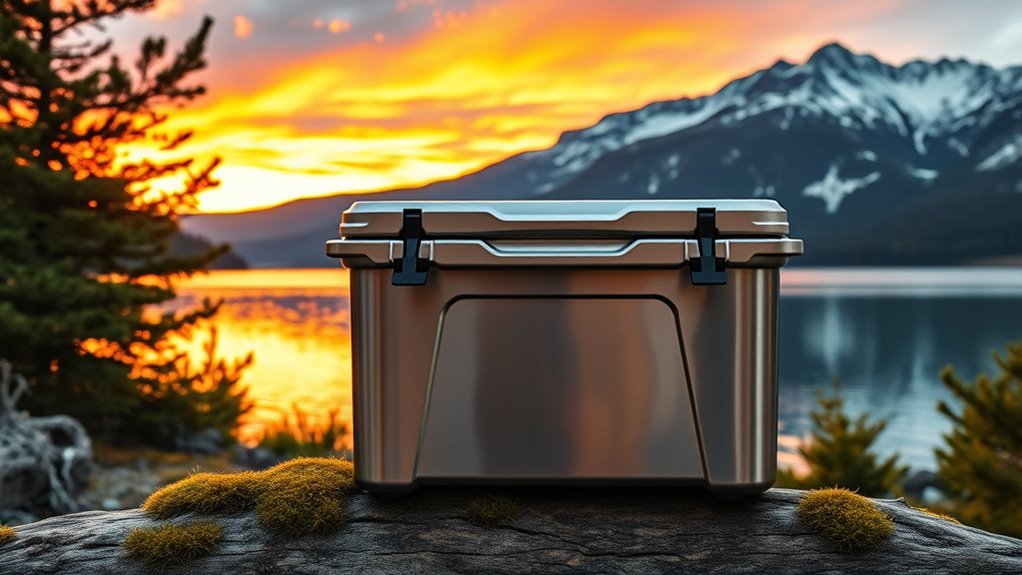

Among these high-end camping coolers, I rank the YETI Tundra 45 as the best overall for campers who want a premium, durable hard cooler without stepping up to a bulky 65-quart size. The RTIC 52 QT Ultra-Light Wheeled is a standout when rolling a larger load matters, while the Igloo Maxcold Glide 110 Qt suits group trips that need substantial capacity. The main tradeoff is between robust insulation and build, which can mean more weight and cost, and lighter or wheeled designs that are easier to move but may not suit every rugged use. Capacity also has to match the trip: a large cooler can hold more provisions, but it takes up more vehicle and campsite space. Read on for the full breakdown and a guide to choosing the right cooler for your camping style.

Get travel and outdoor gear delivered free with Prime
- Fast, free delivery on millions of items
- Prime Video, Amazon Music and more included
- Member-only deals all year
Complete the kit


Key Takeaways
- The YETI Tundra 45 is my best overall pick: it sits between the more compact Tundra 35 and larger Tundra 65, giving many campers a useful balance of capacity and manageable size.
- Wheels change the carrying equation: the RTIC 52 QT Ultra-Light Wheeled and Igloo models make more sense for moving loaded coolers, while the non-wheeled YETI Tundras prioritize a different balance of portability and hard-cooler construction.
- Group capacity has a real footprint: the 110-quart Igloo Maxcold Glide offers far more room than compact options, but buyers need storage and vehicle space to match.
- Premium branding is not the only route to a camping-ready cooler: Lifetime and Coleman options cover practical needs, while rotomolded alternatives such as the Laka emphasize heavy-duty construction without being YETI models.
- Some picks trade ruggedness for convenience: the Coleman 25-Quart is compact and strap-carried, and the Titan Zipperless HardBody prioritizes quick access; neither serves the same role as a large, heavy-duty ice chest.
| RTIC 52 QT Ultra-Light Wheeled Hard Cooler |  | Best Wheeled Balance | Capacity: 52 quarts; up to 78 cans | Weight: 30 lbs | Dimensions: 29 × 18.25 × 18.75 inches | VIEW ON AMAZON | See Our Full Breakdown |
| Lifetime Hard Cooler, High Performance Ice Chest |  | Best for Bear-Country Camping | Ice retention: Up to 8 days | Bear resistance: IGBC-certified when locked | Material: Heavy-duty polyethylene, urethane, and polypropylene | VIEW ON AMAZON | See Our Full Breakdown |
| Coleman 25-Quart Hard Cooler, 36-Can Capacity, Padded Strap, 3 Days Cold |  | Best Compact Carry Cooler | Volume: 25 quarts | Capacity: Up to 36 cans | Cold retention: Up to 3 days | VIEW ON AMAZON | See Our Full Breakdown |
| Coleman Classic Series Insulated Portable Rolling Cooler with Wheels |  | Best for Large Camping Groups | Capacity: 101 cans without ice; 50 cans with 26 lbs of ice | Ice retention: Up to 5 days | Wheels: Six-inch all-terrain wheels | VIEW ON AMAZON | See Our Full Breakdown |
| Reclaimed Ocean Plastic Rotomolded Cooler, 30 Quart Heavy-Duty Ice Chest for Camping and Outdoor Activities |  | Best Eco-Conscious Rotomolded Pick | Capacity: 30 quarts | Material: Ocean-bound plastic | Construction: Rotomolded | VIEW ON AMAZON | See Our Full Breakdown |
| YETI Tundra 35 Cooler |  | Best Compact Premium Cooler | Capacity: 20 cans | Insulation: PermaFrost, up to 3 inches | Dimensions: 21 3/8 × 16 1/8 × 15 3/4 inches | VIEW ON AMAZON | See Our Full Breakdown |
| Igloo Maxcold Glide 110 Qt Wheeled Cooler |  | Best for Maximum Capacity on Wheels | Capacity: 110 quarts; stated capacity of 168 cans | Material: Polyethylene | Insulation: ThermeCool | VIEW ON AMAZON | See Our Full Breakdown |
| Hard Cooler, Insulated Ice Chest Box Holds Ice for More Days, Portable Cooler with Handle, Cup Holders, Double Latches for Camping, Beach, Picnic, Fishing, Boat, Barbecue |  | Best Accessory-Rich 60-Quart Pick | Capacity: 60 quarts | Dimensions: 27.32 × 17.51 × 16.92 inches | Weight: 26.45 pounds | VIEW ON AMAZON | See Our Full Breakdown |
| Igloo Trailmate 52 Qt Roller Cooler, Sportsman |  | Best Mid-Size Cooler for Rolling Over Rougher Routes | Capacity: 52 quarts | Can capacity: Up to 80 cans | Wheels: 6.25-inch soft-ride wheels | VIEW ON AMAZON | See Our Full Breakdown |
| YETI Tundra 65 Cooler |  | Best Premium Cooler for Extended Group Camps | Model: YETI Tundra 65 | Construction: Rotomolded | Insulation: Pressure-injected polyurethane foam | VIEW ON AMAZON | See Our Full Breakdown |
| Laka Cooler – 45 Quart Rotomolded Hard Cooler |  | Best for Extended Trips | Capacity: 45 quarts | Can capacity: 36 cans | Ice capacity: 45 lb | VIEW ON AMAZON | See Our Full Breakdown |
| RTIC 32 QT Ultra-Light Hard Cooler |  | Best Lightweight Hard Cooler | Capacity: 32 quarts | Can capacity: Up to 48 cans | Ice capacity: 30 lb | VIEW ON AMAZON | See Our Full Breakdown |
| Coleman Chiller 48 Quart Cooler with Ice Retention and Leak Resistance |  | Best for Casual Campers | Capacity: 48 quarts | Can capacity: 31 cans with ice | Stated ice retention: Up to 60 hours | VIEW ON AMAZON | See Our Full Breakdown |
| YETI Tundra 45 Cooler |  | Best Premium Rugged Cooler | Capacity: 26 cans | Dimensions: 25.5 x 16 x 15.5 in | Weight: 23 lb | VIEW ON AMAZON | See Our Full Breakdown |
| Titan Zipperless HardBody Cooler |  | Best for Quick-Access Organization | Capacity: Up to 48 cans | Stated ice retention: Conflicting claims: 2 days in title; up to 3 days in description | Liner: Removable HardBody liner with SmartShelf | VIEW ON AMAZON | See Our Full Breakdown |
| highend camping cooler | Capacity | Material | Weight | Insulation |
|---|---|---|---|---|
| RTIC 52 QT Ultra-Light Wheeled | 52 quarts; up to 78 cans | — | 30 lbs | 2.5 inches of closed-cell foam |
| Lifetime Hard Cooler | — | Heavy-duty polyethylene, urethane, and polypropylene | 25.5 lbs | — |
| Coleman 25-Quart Hard Cooler | Up to 36 cans | — | — | — |
| Coleman Classic Series Insulat | 101 cans without ice; 50 cans with 26 lbs of ice | Eco-friendly plastic using 15% less plastic | — | — |
| Reclaimed Ocean Plastic Rotomo | 30 quarts | Ocean-bound plastic | — | — |
| YETI Tundra 35 Cooler | 20 cans | — | 20 pounds | PermaFrost, up to 3 inches |
| Igloo Maxcold Glide 110 Qt Whe | 110 quarts; stated capacity of 168 cans | Polyethylene | — | ThermeCool |
| Hard Cooler | 60 quarts | Marine-grade nylon and polyurethane foam | 26.45 pounds | — |
| Igloo Trailmate 52 Qt Roller C | 52 quarts | — | — | 1.5-inch foam-insulated walls and lid |
| YETI Tundra 65 Cooler | Fits 54 cans or 16.8 kg of ice | — | — | Pressure-injected polyurethane foam |
| Laka Cooler | 45 quarts | Rotomolded polyethylene | 28 lb | — |
| RTIC 32 QT Ultra-Light Hard Co | 32 quarts | Polyethylene with foam insulation | 14.7 lb | 2.5 in closed-cell foam |
| Coleman Chiller 48 Quart Coole | 48 quarts | Plastic with foam insulation | 7.6 lb | — |
| YETI Tundra 45 Cooler | 26 cans | Rotomolded construction | 23 lb | PermaFrost, FatWall |
| Titan Zipperless HardBody Cool | Up to 48 cans | — | — | Deep Freeze Performance Insulation |
More Details on Our Top Picks
RTIC 52 QT Ultra-Light Wheeled Hard Cooler
The RTIC 52 QT Ultra-Light pairs substantial capacity with wheels, making it a practical middle ground between compact carry coolers and oversized rolling chests. Its 30-pound empty weight is more than 30% lighter than similar coolers, according to the product description, while 2.5 inches of closed-cell foam is intended to support multi-day ice retention. That combination makes hauling it to a campsite easier than carrying a comparable hard cooler, though a full load can still be unwieldy. Compared with the Coleman Classic Series rolling cooler, the RTIC has less stated capacity but offers thicker specified insulation and a smaller overall footprint. It is the better fit when insulation and manageable storage matter more than holding 101 cans. The tradeoff is that its 52-quart body still needs room at home and in the vehicle.
Pros:- 30-pound empty weight is relatively light for a wheeled hard cooler of this capacity.
- 2.5 inches of closed-cell foam supports multi-day cooling.
- All-terrain wheels help move it over rough campsite surfaces.
- 52-quart capacity suits group food and drinks without reaching the size of a 101-can chest.
Cons:- A full 52-quart load can still be heavy to pull or lift.
- Its 29-inch length and broad body require dedicated storage space.
Best for: Campers who want a wheeled, mid-to-large cooler with substantial insulation but do not need capacity for a very large group.
Not ideal for: Small-vehicle campers or buyers who need a cooler that stays easy to carry after it is fully loaded.
- Capacity:52 quarts; up to 78 cans
- Weight:30 lbs
- Dimensions:29 × 18.25 × 18.75 inches
- Insulation:2.5 inches of closed-cell foam
- Wheels:Puncture-resistant all-terrain wheels
- Handle:Ergonomic handle
Our verdict“Choose the RTIC if you want a moderately sized wheeled cooler with substantial insulation and can accommodate its loaded weight and footprint.”
Lifetime Hard Cooler, High Performance Ice Chest
For campsites where wildlife security matters as much as capacity, the Lifetime Hard Cooler has a clear advantage: it is IGBC-certified bear-resistant when locked, and its lock holes let you add compatible locks (not included). The stated ice retention of up to eight days also suits longer trips better than the Coleman 25-quart cooler’s three-day claim. Its 25.5-pound weight is relatively manageable for a hard cooler, but there are no wheels, so carrying it with food and ice can become a chore. The capped drain can connect to a garden hose, and rope handles, bottle openers, and serviceable feet add useful campsite details. Compared with the wheeled RTIC 52 QT, the Lifetime gives up rolling convenience and a specified foam thickness in exchange for bear resistance and a longer stated retention period.
Pros:- IGBC-certified bear resistance when locked, providing a security feature absent from the Coleman 25-quart model.
- Up to eight days of stated ice retention suits extended outings.
- Capped drain supports garden-hose drainage.
- Includes rope handles, two bottle openers, and serviceable feet.
Cons:- Locks for the lock holes are not included.
- No wheels, so moving it becomes harder once packed with ice and food.
- Its exterior dimensions may be awkward for compact vehicle or home storage.
Best for: Campers in bear country who can secure the cooler with locks and want a hard-sided chest for multi-day trips.
Not ideal for: People who need wheels for moving a loaded cooler, or buyers who do not camp in areas where bear resistance is useful.
- Ice retention:Up to 8 days
- Bear resistance:IGBC-certified when locked
- Material:Heavy-duty polyethylene, urethane, and polypropylene
- Exterior dimensions:28.4 × 18.1 × 17.5 inches
- Interior dimensions:21–23 × 12–13.7 × 13 inches
- Weight:25.5 lbs
- Drain:Capped drain compatible with a garden hose
- Handles and hardware:Two rope handles with molded grips, two latches, and two lock holes; locks not included
Our verdict“Pick the Lifetime for locked, bear-resistant storage and extended trips, provided you are comfortable carrying it without wheels.”
Coleman 25-Quart Hard Cooler, 36-Can Capacity, Padded Strap, 3 Days Cold
The Coleman 25-quart is the compact choice here: its 36-can capacity is enough for a smaller camping group, and a padded strap makes it easier to carry than the large rolling Coleman Classic Series. Its stated cold retention is up to three days, supported by walls up to two inches thick. That is a shorter trip profile than the Lifetime Hard Cooler’s claim of up to eight days, so I would favor the Coleman for weekend outings rather than extended stays. A seat lid, steel latch, tie-down straps, and oversized drain plug add practical utility, but the product data warns that it does not protect against food-borne bacteria and requires thorough cleaning. Its limited capacity also means larger groups may need a second cooler or a bigger option.
Pros:- Compact 25-quart size is easier to fit in a vehicle than the Coleman Classic Series rolling cooler.
- Padded strap helps with carrying between vehicle and campsite.
- Up to three days of stated cold retention suits shorter outings.
- Seat lid, tie-down straps, non-slip feet, and oversized drain plug add campsite utility.
Cons:- 36-can capacity is limiting for larger groups or longer trips.
- Three-day stated retention is shorter than the Lifetime Hard Cooler’s up-to-eight-day claim.
- Requires thorough cleaning and does not protect against food-borne bacteria.
Best for: Solo campers, couples, and small groups who want a portable cooler for short trips and value a shoulder strap over wheels.
Not ideal for: Large groups or campers who need longer stated ice retention, bear resistance, or capacity for several days of shared provisions.
- Volume:25 quarts
- Capacity:Up to 36 cans
- Cold retention:Up to 3 days
- Wall thickness:Up to 2 inches
- Carry feature:Padded strap
- Lid:Seat lid
- Closure and drainage:Steel latch and oversized drain plug
- Other features:Tie-down straps and non-slip feet
Our verdict“Choose this Coleman for short, small-group trips where easier carrying matters more than high capacity or extended ice retention.”
Coleman Classic Series Insulated Portable Rolling Cooler with Wheels
When group capacity takes priority, the Coleman Classic Series rolling cooler stands apart with room for 101 cans without ice, or 50 cans alongside 26 pounds of ice. Its six-inch all-terrain wheels and dual tow and swing-up handles help move that load, while the lid can support up to 250 pounds and includes four cup holders. The tradeoff is scale: this is much larger than the 52-quart RTIC, and a full cooler will be heavy even with wheels. Its stated ice retention of up to five days falls short of the Lifetime Hard Cooler’s up-to-eight-day claim, but the Lifetime cannot match this stated can capacity or rolling setup. I’d choose the Coleman for car camping, tailgating, and shared provisions—not minimalist trips or tight vehicle storage.
Pros:- 101-can capacity accommodates substantially more than the 52-quart RTIC.
- Six-inch all-terrain wheels and dual handles help move a bulky load.
- Seat lid supports up to 250 pounds and includes four cup holders.
- Easy-clean liner and built-in ruler add useful group-trip features.
Cons:- Large footprint can be difficult to store or fit in a compact vehicle.
- A fully loaded cooler remains heavy despite its wheels.
- Up to five days of stated ice retention is less than the Lifetime Hard Cooler’s up-to-eight-day claim.
Best for: Families and large camping groups who need a high-capacity rolling cooler, a seat lid, and easy access to drinks.
Not ideal for: Solo campers, small-vehicle owners, or anyone prioritizing bear resistance or the longest stated ice retention.
- Capacity:101 cans without ice; 50 cans with 26 lbs of ice
- Ice retention:Up to 5 days
- Wheels:Six-inch all-terrain wheels
- Handles:Dual tow and swing-up handles
- Lid capacity:Supports up to 250 lbs
- Built-in features:Four cup holders and a built-in ruler
- Material:Eco-friendly plastic using 15% less plastic
Our verdict“Pick this Coleman for large, vehicle-supported camping trips where capacity and rolling convenience matter more than compact storage or maximum stated retention.”
Reclaimed Ocean Plastic Rotomolded Cooler, 30 Quart Heavy-Duty Ice Chest for Camping and Outdoor Activities
This 30-quart rotomolded cooler gives eco-conscious campers a smaller hard-sided option made from ocean-bound plastic. Its UV-resistant construction, lockable lid, non-slip feet, and integrated bottle openers suit exposed campsite use, while the product description claims multiple days of ice retention without specifying an exact duration. That makes performance harder to compare directly with the Lifetime Hard Cooler’s stated up-to-eight-day retention. At 30 quarts, it also sits between the compact Coleman 25-quart and the 52-quart RTIC, balancing group usefulness with a less imposing capacity. The costs of that middle ground are clear: it may still be heavy due to its rotomolded construction, and it is too small for larger groups. A one-year warranty is also shorter than some buyers may want from a heavy-duty cooler.
Pros:- Ocean-bound plastic gives the cooler a distinct material choice compared with the polyethylene-based Lifetime.
- Rotomolded, heavy-duty construction is designed for outdoor use.
- UV-resistant exterior and non-slip feet suit exposed campsites.
- Lockable lid and integrated bottle openers provide useful built-in features.
Cons:- 30-quart capacity may not cover larger groups or extended shared trips.
- The product data gives no exact ice-retention duration, making direct performance comparisons difficult.
- Rotomolded construction may make it heavy, and the warranty is limited to one year.
Best for: Environmentally minded couples or small camping groups seeking a rugged, mid-size cooler made with ocean-bound plastic.
Not ideal for: Large groups needing high capacity, or buyers who want a specific multi-day retention figure to compare against other coolers.
- Capacity:30 quarts
- Material:Ocean-bound plastic
- Construction:Rotomolded
- Ice retention:Multiple days; exact duration not specified
- Lid:Lockable
- Exterior feature:UV-resistant
- Base:Non-slip feet
- Warranty:1 year
Our verdict“Choose this cooler for a rugged, mid-size option made from ocean-bound plastic, but skip it if you need maximum capacity or a clearly specified ice-retention period.”
YETI Tundra 35 Cooler
The YETI Tundra 35 brings high-end construction to a size better suited to short trips, small groups, and vehicles with limited cargo space. Its rotomolded body, up-to-3-inch insulation, and bear-resistant design prioritize toughness and cold retention over low carry weight. Compared with the much larger YETI Tundra 65, it is easier to fit into a packed vehicle, but its stated capacity of 20 cans calls for careful packing on longer outings. The included dry goods basket also helps keep items that should stay out of meltwater separate. At 20 pounds before loading, it is not a light cooler, and its premium positioning may be hard to justify for casual use. I’d choose it for a small crew that values rugged protection more than maximum volume.
Pros:- Rotomolded construction and bear-resistant design suit demanding outdoor settings.
- Up to 3 inches of PermaFrost insulation supports extended cold retention.
- Compact capacity is easier to place in a vehicle than the YETI Tundra 65.
- Included dry goods basket separates food from ice and meltwater.
Cons:- A 20-pound empty weight makes it relatively heavy for its capacity.
- The 20-can capacity may be restrictive for groups or multi-day trips.
- Premium positioning may not make sense for occasional, low-demand use.
Best for: Small camping groups and anglers who want bear-resistant construction and strong insulation without bringing a full-size cooler.
Not ideal for: Large families or campers planning extended trips who need room for substantial food and drinks; its stated 20-can capacity is limited.
- Capacity:20 cans
- Insulation:PermaFrost, up to 3 inches
- Dimensions:21 3/8 × 16 1/8 × 15 3/4 inches
- Weight:20 pounds
- Construction:Rotomolded
- Latches:T-Rex Lid Latches
- Bear-resistant:Yes
- Included accessory:Dry goods basket
Our verdict“Choose the Tundra 35 if rugged, bear-resistant construction matters more than carrying a large load or minimizing weight.”
Igloo Maxcold Glide 110 Qt Wheeled Cooler
For group camps and long weekends where volume matters most, the Igloo Maxcold Glide 110 Qt offers room for a stated 168 cans and adds wheel-based transport to a large-capacity design. Its ThermeCool insulation, UV inhibitors, and infrared technology address heat exposure, while stainless steel hinges and an impact-resistant lid are geared toward frequent outdoor handling. Compared with the Igloo Trailmate 52 Qt Roller, the Maxcold gives you substantially more listed capacity, but it is a less compact choice for storage and vehicle loading. The product data does not specify its weight or detailed wheel and handle measurements, so I would check fit and maneuverability before choosing it for rough access routes. A lid ruler is a useful extra for fishing, though it does not offset the burden of moving a fully loaded chest.
Pros:- Stated 168-can capacity suits large groups and extended outings.
- ThermeCool insulation is paired with UV inhibitors and infrared technology for sun exposure.
- Impact-resistant lid closures and stainless steel hinges are suited to outdoor handling.
- Lid ruler adds a practical feature for fishing trips.
Cons:- Large capacity can make the cooler cumbersome when fully loaded.
- Its size may be awkward to store or fit into smaller vehicles.
- The supplied product details do not specify weight or wheel and handle dimensions.
Best for: Large families, fishing groups, and camp hosts who need high drink capacity and can roll a bulky cooler from vehicle to site.
Not ideal for: Solo campers, small-vehicle owners, or anyone who must carry a cooler over uneven ground; its large loaded size can be difficult to manage.
- Capacity:110 quarts; stated capacity of 168 cans
- Material:Polyethylene
- Insulation:ThermeCool
- Sun protection:UV inhibitors and infrared technology
- Lid:Impact-resistant closures; lid ruler
- Hinges:Stainless steel
- Country of origin:USA or imported
Our verdict“Pick the Maxcold Glide 110 Qt when group capacity takes priority and your route to camp allows wheeled transport.”
Hard Cooler, Insulated Ice Chest Box Holds Ice for More Days, Portable Cooler with Handle, Cup Holders, Double Latches for Camping, Beach, Picnic, Fishing, Boat, Barbecue
This 60-quart hard cooler is aimed at buyers who want more than a bare ice chest: the package includes baskets, dividers, and ice packs, while the listed up-to-six-day ice retention targets longer outings. Its marine-grade nylon and polyurethane foam construction is described as military-grade, with a 1.5-meter drop test and a 500-pound maximum load listed in the product data. Against the YETI Tundra 65, it offers a defined 60-quart capacity and several included organizing accessories, while the YETI listing gives clearer details about its gasket, drain, and tie-down features. At 26.45 pounds empty, this cooler is already a substantial carry, and its dimensions may complicate transport in smaller vehicles. I’d favor it for buyers who value included organization and stated retention over a lighter setup.
Pros:- Listed ice retention of up to six days suits longer outdoor trips.
- Baskets, dividers, and ice packs provide organizing accessories in the package.
- A 1.5-meter drop test and 500-pound maximum load indicate a focus on rugged use.
- Marine-grade handles are designed to help with carrying.
Cons:- The 26.45-pound empty weight becomes a significant load once filled.
- Its 27.32-inch length and 60-quart capacity may be awkward in smaller vehicles.
- The supplied details do not identify a specific gasket, drain, or tie-down system.
Best for: Campers who want a 60-quart chest with included baskets, dividers, and ice packs for organizing food on multi-day trips.
Not ideal for: People with compact vehicles or campsites that require carrying gear far from the parking area; it weighs 26.45 pounds before loading.
- Capacity:60 quarts
- Dimensions:27.32 × 17.51 × 16.92 inches
- Weight:26.45 pounds
- Material:Marine-grade nylon and polyurethane foam
- Ice retention:Up to 6 days
- Drop test:1.5 meters
- Maximum load:500 pounds
- Included accessories:Baskets, dividers, and ice packs
Our verdict“Choose this 60-quart cooler if you want included organization and long-trip capacity and can accommodate its weight and size.”
Igloo Trailmate 52 Qt Roller Cooler, Sportsman
The Igloo Trailmate 52 Qt sits between compact hard coolers and oversized group chests: its stated 80-can capacity gives a camp group useful room without reaching the Maxcold Glide 110 Qt’s much larger footprint. Its main advantage is mobility, with 6.25-inch soft-ride wheels and a marine-grade telescoping handle designed to make the trip from vehicle to site easier. The 1.5-inch foam-insulated walls and lid provide a clear insulation specification, though the product data does not state a day count for ice retention. Compared with the YETI Tundra 65, this model emphasizes rolling transport rather than rotomolded construction, tie-down slots, and a leakproof drain. It still becomes heavy when full, and the bulky form may be more cooler than a small group needs. I’d pick it when rolling access matters more than carry-in portability.
Pros:- Soft-ride wheels and a telescoping handle support rolling transport.
- 52-quart size and stated 80-can capacity suit group outings.
- 1.5-inch foam insulation is specified for both walls and lid.
- More compact than the 110-quart Igloo Maxcold Glide while still offering substantial capacity.
Cons:- A full load can make the cooler heavy despite its wheels.
- Its bulk may be inconvenient for small vehicles and limited storage.
- The supplied product data does not state a specific ice-retention duration.
Best for: Campers and sports groups who need room for up to 80 cans and expect to roll their cooler across outdoor paths.
Not ideal for: Small groups with limited vehicle or storage space, and campers who need to lift a loaded cooler over long distances.
- Capacity:52 quarts
- Can capacity:Up to 80 cans
- Wheels:6.25-inch soft-ride wheels
- Handle:Marine-grade telescoping handle
- Insulation:1.5-inch foam-insulated walls and lid
- Origin:Made in the USA with imported parts
Our verdict“Choose the Trailmate 52 Qt if you need group-sized capacity and a wheeled setup, but do not expect wheels to eliminate the burden of loading and lifting.”
YETI Tundra 65 Cooler
The YETI Tundra 65 is the higher-capacity choice for buyers who want a rugged, stationary camp cooler rather than a compact chest or wheeled hauler. Its rotomolded construction, pressure-injected polyurethane foam, and freezer-quality gasket focus on retaining cold, while the listed capacity—54 cans or 16.8 kg of ice—gives buyers a more useful scale than the 20-can YETI Tundra 35. Practical details include a leakproof drain, non-slip feet, sturdy handles, and tie-down slots for securing it during transport. Compared with the Igloo Trailmate 52 Qt, it offers a more explicitly rugged build and drain-and-tie-down features, but the Trailmate’s wheels are better suited to rolling a load. The Tundra 65’s weight is not specified, and its large hard-sided design may be cumbersome to lift or store.
Pros:- Rotomolded construction and pressure-injected foam suit repeated outdoor use.
- Freezer-quality gasket is designed to help retain cold.
- Leakproof drain supports easier emptying after a trip.
- Sturdy handles, non-slip feet, and tie-down slots add practical transport and placement options.
Cons:- Large, rugged construction can be cumbersome to lift and store.
- The supplied product data does not specify the cooler’s weight.
- Unlike the wheeled Igloo Trailmate 52 Qt, it has no listed wheels for rolling a loaded cooler.
Best for: Campers and fishing groups who want a large, rugged cooler with a drain and tie-down points and can manage transport without relying on wheels.
Not ideal for: Buyers who need a lightweight or easily wheeled cooler, or anyone who needs a known loaded-lifting weight before purchase.
- Model:YETI Tundra 65
- Construction:Rotomolded
- Insulation:Pressure-injected polyurethane foam
- Capacity:Fits 54 cans or 16.8 kg of ice
- Included component:Dry goods basket
- Drain:Leakproof drain
- Transport and placement:Sturdy handles, tie-down slots, and non-slip feet
Our verdict“Choose the Tundra 65 for a rugged, high-capacity camp cooler with a drain and tie-downs, provided you can handle its size and weight.”
Laka Cooler – 45 Quart Rotomolded Hard Cooler
The Laka 45 Quart suits campers who want rotomolded construction and a stated cold-retention window of up to seven days, without moving to a larger expedition-size chest. Its 45-quart capacity and included basket make separating food from ice more practical, while the drain plug helps clear meltwater at camp. Compared with the YETI Tundra 45, Laka lists more room for cans and ice, plus built-in cup holders and a bottle opener; the YETI instead emphasizes bear-resistant construction and a more established heavy-duty design. The tradeoff is weight: at 28 pounds empty, this is a substantial box before supplies go in. I’d also plan to pre-chill it, since the stated ice life depends on preparation and conditions.
Pros:- Rotomolded polyethylene body is suited to rugged outdoor use.
- Advertised cold retention of up to seven days fits extended outings.
- Basket, drain plug, bottle opener, and cup holders add practical camp features.
- 45-quart capacity provides more listed can and ice room than the YETI Tundra 45.
Cons:- 28-pound empty weight becomes cumbersome once filled.
- Pre-chilling is recommended for best ice longevity.
- A large footprint can be awkward in smaller vehicles or tight campsites.
Best for: Car campers and boaters planning multi-day trips who want a large rotomolded cooler with a basket and built-in convenience features.
Not ideal for: Solo campers or anyone regularly carrying a loaded cooler over distance; its 28-pound empty weight makes portability a real constraint.
- Capacity:45 quarts
- Can capacity:36 cans
- Ice capacity:45 lb
- Stated cold retention:Up to 7 days
- Dimensions:30 x 17 x 16 in
- Weight:28 lb
- Material:Rotomolded polyethylene
- Features:Airtight gasket, drain plug, basket, non-slip feet, bottle opener, cup holders
- Warranty:5-year limited
Our verdict“Choose the Laka if you want a feature-rich, 45-quart rotomolded cooler for multi-day vehicle-based trips and can manage its weight.”
RTIC 32 QT Ultra-Light Hard Cooler
Among the hard-sided options here, the RTIC 32 QT Ultra-Light makes carrying weight its main advantage: it weighs 14.7 pounds, far less than the 28-pound Laka 45 and the 23-pound YETI Tundra 45. That difference matters when one person has to move the cooler from car to campsite. Its 2.5 inches of closed-cell foam and stated capacity of up to 48 cans give it useful insulation and packing potential for its footprint. The compromise is a tighter interior than a 45-quart chest, so bulky food containers may be harder to arrange. The listed can count also leaves less room for ice when packed to capacity. I’d pick it for campers who value manageable handling over the heavier, more rugged feel of the larger rotomolded alternatives.
Pros:- 14.7-pound weight is notably lower than the Laka 45 and YETI Tundra 45.
- 2.5 inches of closed-cell foam provides substantial insulation for a portable cooler.
- Up to 48-can listed capacity makes efficient use of its 32-quart size.
- Three-year warranty is specified.
Cons:- Smaller interior can limit packing of bulky items.
- A near-full can load leaves less space for ice and food.
- Does not offer the 45-quart volume of the Laka 45 or YETI Tundra 45.
Best for: Car campers, beachgoers, and couples who want a hard cooler that is easier for one person to lift and carry.
Not ideal for: Groups packing large food containers or campers who need the extra volume and rugged, heavy-duty construction of a 45-quart rotomolded cooler.
- Capacity:32 quarts
- Can capacity:Up to 48 cans
- Ice capacity:30 lb
- Insulation:2.5 in closed-cell foam
- Weight:14.7 lb
- Exterior dimensions:23.2 x 15.2 x 14.5 in
- Interior dimensions:17.5 x 11 x 9.75 in
- Material:Polyethylene with foam insulation
- Warranty:3 years
Our verdict“Pick the RTIC Ultra-Light if easier lifting matters more than the added capacity of a larger rotomolded chest.”
Coleman Chiller 48 Quart Cooler with Ice Retention and Leak Resistance
The Coleman Chiller 48 Quart is the practical choice for weekend use when a light, roomy chest matters more than a multi-day expedition build. At 7.6 pounds, it is much easier to carry empty than the Laka 45 or YETI Tundra 45, and its reinforced lid can double as a seat for someone weighing up to 200 pounds. The stated ice retention is up to 60 hours, a shorter window than the longer-trip claims for Laka and RTIC, so I’d reserve it for short outings or frequent access to fresh ice. It holds 31 cans with ice and fits 2-liter bottles, though the description does not list a drain plug. Plastic construction also makes it a less convincing choice for repeated rough handling than the rotomolded options.
Pros:- At 7.6 pounds, it is much lighter to carry empty than the rotomolded models here.
- 48-quart capacity holds 31 cans with ice and accommodates 2-liter bottles.
- Reinforced lid supports up to 200 pounds for extra seating.
- Stated ice retention of up to 60 hours suits short trips and events.
Cons:- Ice-retention claim is shorter than the Laka 45’s stated up-to-seven-day window.
- No built-in drain plug is listed, making water removal less convenient.
- Plastic construction may be less suited to repeated rough use than rotomolded alternatives.
Best for: Weekend campers and tailgaters who want a lightweight, large-capacity cooler that can also serve as occasional extra seating.
Not ideal for: Campers on extended trips or buyers who need a drain plug and a cooler built for frequent heavy-duty use.
- Capacity:48 quarts
- Can capacity:31 cans with ice
- Stated ice retention:Up to 60 hours
- Weight:7.6 lb
- Material:Plastic with foam insulation
- Lid support:Up to 200 lb
- Bottle fit:Tall enough for 2-liter bottles
- Made in:USA
- Warranty:1-year limited
Our verdict“Choose the Coleman Chiller for lightweight weekend and tailgate duty, not for extended trips that call for longer stated ice retention.”
YETI Tundra 45 Cooler
The YETI Tundra 45 is the premium pick for buyers who put rugged construction and bear-resistant design ahead of maximum packing capacity. Its rotomolded body, FatWall insulation, and T-Rex lid latches make it more focused on demanding outdoor conditions than the lighter Coleman Chiller. It weighs 23 pounds empty, so the build comes with a real carrying penalty; the Laka 45 weighs even more, but lists greater can and ice capacity along with cup holders and a bottle opener. YETI’s stated 26-can capacity is comparatively modest for a 45-size cooler, so this model makes more sense for a carefully packed group than for hauling drinks for a crowd. I’d favor it when durability and bear resistance are central needs, while checking trunk space before committing to its footprint.
Pros:- Rotomolded construction is designed for demanding outdoor use.
- Bear-resistant design suits campsites where wildlife precautions matter.
- FatWall insulation and T-Rex lid latches support a heavy-duty setup.
- Includes a dry goods basket for keeping selected items above the ice.
Cons:- 23-pound empty weight is burdensome for frequent solo carrying.
- Listed 26-can capacity is lower than the Laka 45’s 36-can capacity.
- Large dimensions may not fit comfortably in every vehicle trunk.
Best for: Campers who need a rugged, bear-resistant cooler for outdoor settings and are willing to trade carrying ease and can capacity for that design emphasis.
Not ideal for: Buyers prioritizing low weight, a high can count, or a clearly stated ice-retention duration; the RTIC Ultra-Light is easier to carry and Laka lists greater capacity.
- Capacity:26 cans
- Dimensions:25.5 x 16 x 15.5 in
- Weight:23 lb
- Insulation:PermaFrost, FatWall
- Material:Rotomolded construction
- Bear resistance:Bear-resistant design
- Latches:T-Rex lid latches
- Included accessory:Dry goods basket
Our verdict“Choose the YETI Tundra 45 if bear-resistant ruggedness outranks low weight and maximum capacity for your camping plans.”
Titan Zipperless HardBody Cooler
The Titan Zipperless HardBody stands apart from the rigid chests in this group by prioritizing quick access and organization. Its flip-open lid avoids a zipper, while the removable HardBody liner and SmartShelf help separate items—useful for day trips when drinks and food need frequent retrieval. The stated ice-retention figures conflict: the title says two days, while the description says up to three, so I would plan around the shorter claim rather than treat it as a long-haul cooler. By comparison, the Laka 45 is a better fit for multi-day camping, with a stated retention window of up to seven days and rotomolded construction. Titan’s capacity of up to 48 cans is appealing, but dimensions are not provided, making vehicle fit and storage harder to judge. The full-load weight is also flagged as a drawback.
Pros:- Zipperless flip-open lid offers quick access to contents.
- Removable HardBody liner can make cleanup easier.
- SmartShelf supports more organized packing.
- Capacity is listed at up to 48 cans.
Cons:- Ice-retention information conflicts between the two-day title and up-to-three-day description.
- Dimensions are not specified, limiting fit planning.
- Can become heavy when fully loaded.
Best for: Day-trip campers and event-goers who want fast lid access and a removable liner for sorting food and drinks.
Not ideal for: Multi-day campers who need a clearly specified long ice-retention window, or buyers who need dimensions to plan vehicle and storage fit.
- Capacity:Up to 48 cans
- Stated ice retention:Conflicting claims: 2 days in title; up to 3 days in description
- Liner:Removable HardBody liner with SmartShelf
- Insulation:Deep Freeze Performance Insulation
- Lid:Zipperless flip-open lid
- Leak resistance:Described as leak-proof
- Dimensions:Not specified
Our verdict“Pick the Titan for convenient access and organized day-trip packing, but favor the Laka 45 for longer camping trips with a clearer extended-retention claim.”

How We Picked
I compared the 15 coolers by the factors that shape a real camping purchase: usable capacity, ease of transport when loaded, insulation claims, construction, access and drainage features, and fit for different trip sizes. I also separated options that serve different jobs rather than treating every hard cooler as interchangeable. A rolling cooler can be a better campsite choice than a heavier non-wheeled model when the route from the vehicle is long, while a compact cooler may be preferable when packing space is limited.
The ranking favors clear, practical strengths and a defined use case, not brand name alone. The YETI Tundra 45 leads as a broadly useful premium size; the RTIC wheeled model stands out for moving a larger load, and the oversized Igloo earns a group-camping role rather than a universal recommendation. More modest Coleman models rank as accessible, simpler choices, while products with limited identifying detail are not treated as proven performance leaders. I account for tradeoffs such as weight, bulk, and feature fit alongside each cooler’s appeal.
Factors to Consider When Choosing Highend Camping Coolers
Before choosing a cooler, I would plan around the trip rather than the biggest capacity or longest ice-retention claim. These broader factors help prevent common mismatches, such as buying a large chest that cannot fit in the vehicle or paying for rugged construction that a short weekend outing does not require.
Match Capacity to Food, People, and Trip Length
Start with what needs to stay cold, not a quart number in isolation. Drinks take up space quickly, while meal ingredients often need separate organization, so a cooler shared by a group can fill faster than expected. A 110-quart chest is designed for a different job from a 25- or 32-quart model, but more room also means more bulk to store and load. For several campers, two smaller coolers can sometimes separate drinks from food and reduce repeated opening of the food supply. Avoid choosing extra capacity “just in case” if it makes the cooler awkward to transport or leaves it mostly empty. Match the size to both the number of people and how often you can restock.
Weigh the Cooler Before Adding Ice
Cooler weight on its own is only part of the carrying problem; ice, food, and drinks add substantial load. Wheels can make a large cooler easier to move across a parking area or firm campsite, but they do not make it light to lift into a vehicle. A strap or handles may be more useful on short carries, stairs, or uneven ground where wheels struggle. Think through the entire route from storage to campsite, including lifting over a tailgate and moving across sand or rough ground. A common mistake is choosing capacity first and discovering that the loaded cooler is difficult for one person to handle. If more than one person will move it, check that the handles and grip points suit how your group works.
Read Ice-Retention Claims in Context
Advertised ice duration is a comparison point, not a promise for every outing. Outdoor temperature, direct sun, how often the lid opens, the amount of food inside, and how the cooler is packed can all affect results. Pre-chilling the cooler and its contents, limiting lid openings, and keeping the chest shaded can help reduce avoidable warming. A high-end cooler may be worthwhile for remote trips where replacing ice is difficult, but it cannot compensate for poor packing habits. For short trips with easy access to supplies, a simpler cooler may meet the need without extra bulk. Choose insulation around your actual resupply plan rather than an idealized duration claim.
Choose Construction for Your Campsite, Not Its Label
Rotomolded and other heavy-duty designs appeal to campers who expect rough handling, frequent trips, or use beyond the campsite. That construction can add weight, so it is not automatically the right choice for a car camper who prioritizes easy lifting. Latches, hinges, drain access, feet, and lid design affect everyday use just as much as the outer shell. Check whether the drain is accessible where the cooler will sit and whether the lid layout fits how you plan to reach food. A rugged build is most valuable when it addresses a real wear-and-tear concern; otherwise, you may be carrying extra mass without gaining much practical benefit. Inspect the care and cleaning needs too, particularly if the cooler will store food directly.
Decide Whether Convenience Features Earn Their Space
Wheels, cup holders, baskets, padded straps, and quick-access lids can make a cooler more pleasant to use, but each feature serves a specific routine. Wheels help on routes with firm, relatively smooth ground; on rocky trails or soft sand, they may offer less help than expected. A removable basket can keep small items above melting ice, while cup holders matter more at a tailgate than during a compact backcountry-style setup. Extra fittings can also add bulk or create parts that need cleaning. Ask which features will be used on most trips, not just occasionally. If simplicity and packability matter most, a streamlined cooler may be the more useful purchase.
Pay for Premium Only When It Solves a Real Problem
A premium cooler makes the strongest case when durability, repeated use, or longer periods away from resupply matter to your plans. For occasional short camping trips, a practical Coleman or Lifetime model may cover the basics without the weight and commitment of a more rugged chest. For frequent use, compare the features you will rely on—such as capacity, transport, construction, and drainage—rather than choosing on reputation alone. Also consider where the cooler will live between trips and whether you can comfortably move it in and out of storage. The wrong premium model can be less useful than a simpler cooler that fits your vehicle and routine. Spend more when the added build or performance matches a recurring need.
Frequently Asked Questions
Is a wheeled cooler a better choice for camping than a non-wheeled hard cooler?
It depends on how far and where you need to move it. Wheels can help with a loaded cooler on firm paths, making models such as the RTIC 52 QT Ultra-Light Wheeled or Igloo rollers easier to move around a campground. They are less useful on loose sand, rocks, steep paths, or anywhere you still need to lift the cooler into a vehicle. A non-wheeled option may be easier to position in a packed car or carry over uneven ground. Consider your route and lifting needs before treating wheels as an automatic advantage.
Should I choose the YETI Tundra 35, 45, or 65 for car camping?
Choose among them by the load you expect to carry and the space you can spare. The Tundra 35 is the most compact of the three, which can suit smaller groups or limited vehicle space; the Tundra 45 is my balanced overall choice; and the Tundra 65 makes more sense when extra provisions matter more than a smaller footprint. Remember that a larger cooler is harder to load and move once full. If you often camp with a group, compare one large chest with two smaller coolers that can divide food and drinks. Your usual trip size is a better guide than occasional maximum capacity.
Can a less expensive cooler work for a weekend camping trip?
Yes, especially when the trip is short, you can manage how often the cooler is opened, and ice or supplies are easy to replace. Models such as the Coleman 25-Quart or Coleman Chiller 48 Quart are more practical for buyers who need straightforward cooling rather than a heavy-duty chest for repeated rough use. Packing the cooler well, keeping it shaded, and limiting lid openings can matter as much as buying a more rugged model for a weekend. If you camp often or travel far from resupply, stronger construction and longer-cooling performance may justify stepping up. Base the decision on trip frequency and conditions, not the assumption that every camping trip requires a premium cooler.
How much cooler capacity do I need for a group camping trip?
Estimate food and drinks for the whole group, then account for ice and how often you can restock. The Igloo Maxcold Glide 110 Qt is the largest-capacity option in this lineup, so it fits buyers planning for a substantial shared load, but its size calls for enough vehicle and storage room. A single large chest can keep everything together, while multiple smaller coolers can separate drinks from perishables and limit how often the food cooler is opened. Ask who will lift the cooler and where it will sit at camp before committing to a very large size. For mixed needs, splitting the load can be easier than choosing one oversized chest.
What should I prioritize if my campsite is a long walk from the car?
Think about loaded weight, terrain, and whether you can make more than one trip. A wheeled model can help on a smooth, firm path, but it may not solve the problem on sand, gravel, or uneven ground. A smaller cooler with only the food needed for camp may be easier to carry than a large chest packed to capacity. If you need high capacity, plan for a second person or a transport method suited to the route. The best choice is the one you can move safely across your actual campsite access, not the one with the largest listed capacity.
Conclusion
For most buyers seeking a best overall high-end camping cooler, I would choose the YETI Tundra 45 for its middle-ground capacity within the Tundra range. The best value depends on how rugged a cooler your trips demand: I would start with the Lifetime or Coleman options for straightforward camping needs rather than paying for heavy-duty features I would rarely use. For a best premium pick, choose the Tundra size that matches your group; the 45 is the versatile choice, while the 65 favors larger loads. Beginners may find the Coleman 25-Quart easier to manage, while campers moving more provisions should look at the RTIC 52 QT Ultra-Light Wheeled. For specific needs, the Igloo Maxcold Glide 110 Qt is the group-capacity choice, and the Titan Zipperless HardBody suits buyers who value quick access. Match the cooler to your route, load, and trip length before deciding which features deserve the space and weight.