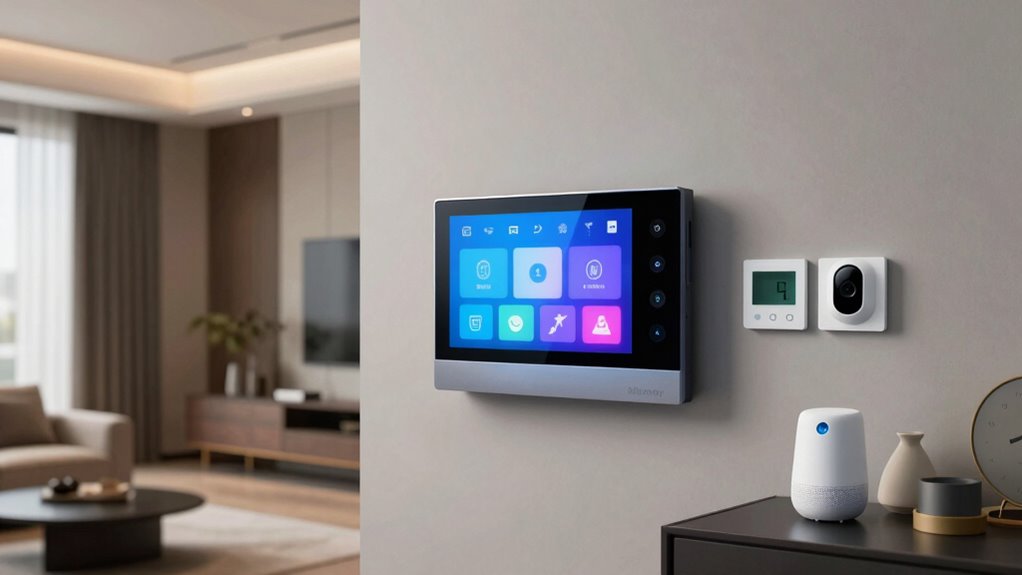

Managing a large smart home requires a hub that can handle multiple devices, protocols, and automations seamlessly. The Amazon Echo Hub stands out for its user-friendly interface and vast compatibility, making it ideal for most setups. The Home Assistant Green offers advanced customization for tech-savvy users, while the Hubitat Elevation C-8 Pro emphasizes local control for privacy-conscious homeowners. Each option balances performance, ease of use, and expandability differently, so your choice depends on your specific needs. Continue reading for a detailed comparison to help you find the perfect hub for your large smart home.

Get travel and outdoor gear delivered free with Prime
- Fast, free delivery on millions of items
- Prime Video, Amazon Music and more included
- Member-only deals all year
Complete the kit



Key Takeaways
- The top picks differentiate mainly by their protocol support, with Z-Wave, Zigbee, and Matter compatibility being key for large setups.
- Local control and automation complexity are crucial factors—more advanced hubs favor privacy and reliability.
- Ease of integration with voice assistants and existing ecosystems varies, impacting setup and daily use.
- Price ranges reflect the level of customization and protocol support, with premium options offering more future-proofing.
- Tradeoffs often involve balancing user-friendliness against advanced features and expandability.
| SwitchBot AI Hub with OpenClaw Support and Local Storage |  | Best Overall for Large Smart Homes with Local Storage Needs | OpenClaw Support: Yes | Camera Storage: 16GB MicroSD, expandable to 1TB or 16TB external | Supports Up To: 8 cameras | VIEW ON AMAZON | See Our Full Breakdown |
| Amazon Echo Hub (newest model), 8-inch Smart Home Control Panel with Alexa+ and Compatibility with Thousands of Devices |  | Best for Easy Large-Scale Management with Alexa Ecosystem | Display: 8-inch touch screen, 1280 x 800 | Power Requirements: USB-C PD or Power over Ethernet (sold separately) | Connectivity: Dual-band WiFi, Bluetooth, Zigbee, Thread, Matter | VIEW ON AMAZON | See Our Full Breakdown |
| YoLink Local Hub, Smart Home Gateway with LoRa, WiFi & Ethernet |  | Best for Reliable Local Automation with Long-Range Connectivity | Connectivity: WiFi & Ethernet | Range: Up to 1/4 mile | Technology: LoRa | VIEW ON AMAZON | See Our Full Breakdown |
| Aeotec Smart Home Hub, Works as a SmartThings Hub, Z-Wave, Zigbee, Matter Gateway, Compatible with Alexa, Google Assistant, WiFi |  | Best for Broad Protocol Compatibility and Seamless Automation | Connectivity: Wi-Fi and Ethernet | Protocols: Z-Wave, Zigbee, Matter | Compatibility: Alexa, Google Assistant | VIEW ON AMAZON | See Our Full Breakdown |
| Hubitat Elevation C-8 Pro Smart Home Hub, Local Control and Automations |  | Best for Advanced Users Prioritizing Local Processing and Customization | Processor: 2.0 GHz | RAM: 2 GB | Connectivity: Wi-Fi, Ethernet | VIEW ON AMAZON | See Our Full Breakdown |
| Homey Pro Mini | Smart Home Hub for Home Automation with Zigbee, Ethernet, Matter & Thread |  | Best Overall for Customizable, Multi-Protocol Smart Home Control | Protocols Supported: Zigbee, Matter, Thread, Ethernet | Compatibility: Apple Siri, Amazon Alexa, Google Home | Automation Features: Homey Flow, routines, local data processing | VIEW ON AMAZON | See Our Full Breakdown |
| SMLIGHT SMHUB Essential – Professional Smart Home Control Hub with Zigbee, Thread, Wi-Fi & Bluetooth |  | Best Value for Tech-Savvy Users Wanting Local Hosting and Flexibility | Radio Support: Zigbee, Thread, Wi-Fi, Bluetooth | Expansion Modules: Z-Wave, 4G LTE, POE | Includes: 2x 5dB gain antennas | VIEW ON AMAZON | See Our Full Breakdown |
| Aqara Smart Home Hub M3 with Matter Controller and IR |  | Best for Versatile Protocol Support and Local Automation with IR Control | Protocols Supported: Zigbee, Thread, Matter | Device Capacity: 127 Zigbee, 127 Thread devices | Connectivity: Wi-Fi 2.4/5 GHz, PoE, USB-C | VIEW ON AMAZON | See Our Full Breakdown |
| Lutron Caseta Deluxe Smart Dimmer Starter Kit with 2 Dimmers and Hub |  | Best for Reliable, No-Wi-Fi Dependency Smart Lighting Control | Number of Dimmers: 2 | Hub Included: Yes | Remote Controls: 2 Pico 3-button remotes | VIEW ON AMAZON | See Our Full Breakdown |
| Home Assistant Green – Official Smart Home Hub with Advanced Automation |  | Best for Simplified Setup with Powerful, Local Automation | Processor: Quad-core | Storage: 32GB | RAM: 4GB | VIEW ON AMAZON | See Our Full Breakdown |
| SONOFF Bridge Max Smart Home Hub (Bridge-M) |  | Best Versatile Multi-Protocol Hub for Large Setups | Compatible Devices: Smart Home Hub | Antenna Location: Home | Connectivity Technology: Wi-Fi, Ethernet, Zigbee | VIEW ON AMAZON | See Our Full Breakdown |
| Home Assistant Smart Home Hub with Advanced Automation (4G+64G) |  | Best for Customizable, Power-User Setups | Processor: 64-bit Quad-Core Cortex-A53 | RAM: 4GB SDRAM | Storage: 64GB eMMC | VIEW ON AMAZON | See Our Full Breakdown |
| smart home hubs for large smart home setup | Connectivity |
|---|---|
| SwitchBot AI Hub with OpenClaw | Dual-Band Wi-Fi |
| Amazon Echo Hub | Dual-band WiFi, Bluetooth, Zigbee, Thread, Matter |
| YoLink Local Hub | WiFi & Ethernet |
| Aeotec Smart Home Hub | Wi-Fi and Ethernet |
| Hubitat Elevation C-8 Pro Smar | Wi-Fi, Ethernet |
| Homey Pro Mini | Smart Home Hu | Ethernet, optional Z-Wave, Bluetooth, Infrared (with Homey Bridge) |
| SMLIGHT SMHUB Essential | — |
| Aqara Smart Home Hub M3 with M | Wi-Fi 2.4/5 GHz, PoE, USB-C |
| Lutron Caseta Deluxe Smart Dim | — |
| Home Assistant Green | USB expandability for Z-Wave, Zigbee, Thread |
| SONOFF Bridge Max Smart Home H | — |
| Home Assistant Smart Home Hub | WiFi, MQTT |
More Details on Our Top Picks
SwitchBot AI Hub with OpenClaw Support and Local Storage
This hub stands out for its emphasis on local storage and edge processing, making it ideal for large setups where data privacy and quick automation responses matter. Compared with the Hubitat Elevation C-8 Pro, it offers built-in support for cameras and video devices via OpenClaw, plus a microSD slot for local event recordings, which is a key advantage over hubs relying solely on cloud storage. However, its AI features depend on an extra subscription, and it doesn’t include IR control, limiting some device integrations. This makes it better suited for tech-savvy users who want local control over multiple cameras and smart devices without relying entirely on the cloud, but it may not be ideal for those seeking a plug-and-play experience or comprehensive IR device support.
Pros:- Supports local storage and expandable event recordings, ensuring data privacy
- Fast automations enabled by edge processing reduce latency
- Pre-installed Home Assistant simplifies integration with various devices
- Supports up to 8 cameras and multiple device types
Cons:- AI features require an additional subscription, adding ongoing costs
- Lacks IR control for TVs or air conditioners, limiting device compatibility
- Requires compatible cameras for AI functionalities to work
Best for: Large smart home owners who prioritize local storage and fast automations, especially those with camera-heavy setups.
Not ideal for: Homeowners who need built-in IR control or prefer a simple, subscription-free system without additional AI costs.
- OpenClaw Support:Yes
- Camera Storage:16GB MicroSD, expandable to 1TB or 16TB external
- Supports Up To:8 cameras
- Connectivity:Dual-Band Wi-Fi
- Pre-installed Software:Home Assistant
- Matter Bridge:Yes
Our verdict“This hub is ideal for tech-savvy users seeking local storage and quick automations in large, camera-rich setups.”
Amazon Echo Hub (newest model), 8-inch Smart Home Control Panel with Alexa+ and Compatibility with Thousands of Devices
This model shines for its user-friendly interface and broad protocol support, making it well-suited for large homes where family members want simple device control and voice interaction. Unlike the Hubitat Elevation C-8 Pro, it offers a large, colorful touch screen that can be customized for different user preferences, but it relies heavily on Wi-Fi or Ethernet for operation, with accessories like Power over Ethernet sold separately. While it doesn’t process automations locally like the Hubitat, its seamless Alexa+ integration simplifies voice commands and routines across thousands of compatible devices. It’s a strong choice for households seeking an intuitive, centrally located control panel without the need for technical setup, but less suited for users desiring advanced local automation or privacy-centric operation.
Pros:- Large, customizable 8-inch touchscreen for intuitive control
- Supports a wide array of protocols including Zigbee, Thread, Matter, and Bluetooth
- Integrates smoothly with Alexa and Ring for smart security and voice control
- Easy to install with wall mounting options
Cons:- Requires internet connection for setup and ongoing operation
- Power over Ethernet and in-wall pass-throughs are sold separately
- Limited portability—designed as a fixed control panel
Best for: Large households or families who want an easy-to-use, Alexa-integrated control panel for managing many devices.
Not ideal for: Power users who need local automation processing or a hub that works independently of the internet.
- Display:8-inch touch screen, 1280 x 800
- Power Requirements:USB-C PD or Power over Ethernet (sold separately)
- Connectivity:Dual-band WiFi, Bluetooth, Zigbee, Thread, Matter
- Audio:Stereo speakers
- Sensors:Passive IR, ambient light sensor
Our verdict“This hub is perfect for large homes where a user-friendly, voice-integrated control panel is a priority, and constant internet access is available.”
YoLink Local Hub, Smart Home Gateway with LoRa, WiFi & Ethernet
This hub excels in scenarios where internet outages are common or long-range device communication is necessary. Its support for LoRa technology allows it to connect devices over a quarter-mile, a feature that sets it apart from hubs like the AEOTec Smart Home Hub, which primarily relies on Z-Wave and Zigbee. However, initial setup requires an active internet connection, and ongoing operation depends on a powered network infrastructure, making it less plug-and-play than some cloud-centric options. Its open API facilitates integration with third-party systems, appealing to advanced users who want to customize their automation landscape. This makes it ideal for users prioritizing local responsiveness and long-range device connectivity, but less suitable for those seeking a simple, out-of-the-box setup or needing extensive protocol support.
Pros:- Ensures local automation execution even during internet outages
- Supports long-range communication up to 1/4 mile with LoRa technology
- Open Local API allows advanced integration with third-party systems
- Supports WiFi and Ethernet connections
Cons:- Requires internet for initial setup, which may be inconvenient in some scenarios
- Needs a powered network infrastructure for consistent operation during outages
- Limited to local automation once configured, no cloud fallback
Best for: Homeowners in rural or large properties who need long-range, reliable local automation, especially during internet outages.
Not ideal for: Urban dwellers with straightforward setups who don’t need LoRa’s long-range capabilities or open API support.
- Connectivity:WiFi & Ethernet
- Range:Up to 1/4 mile
- Technology:LoRa
- Initial Setup:Requires internet
- Local API:Supported
Our verdict“Best suited for large or rural properties where long-range, reliable local automation is essential, and users are comfortable with technical setup.”
Aeotec Smart Home Hub, Works as a SmartThings Hub, Z-Wave, Zigbee, Matter Gateway, Compatible with Alexa, Google Assistant, WiFi
This hub provides extensive device compatibility across Z-Wave, Zigbee, and Matter, making it suitable for large setups with diverse hardware. Unlike the Hubitat Elevation C-8 Pro, which emphasizes local processing, the Aeotec Hub leans on cloud-based SmartThings infrastructure, offering easier setup for users already in that ecosystem. Its support for multiple voice assistants enhances flexibility, but its primary regional support is North America, which could limit functionality elsewhere. While it simplifies device management through the SmartThings app, advanced users seeking full local control might find it less responsive during internet outages. Overall, it balances broad protocol support and ease of use, but may require reliance on cloud services for some features.
Pros:- Supports Z-Wave, Zigbee, and Matter for broad device compatibility
- Easy setup via Wi-Fi or Ethernet with the SmartThings app
- Integrates with popular voice platforms like Alexa and Google Assistant
- Compatible with a wide range of devices and regions
Cons:- Relies heavily on cloud services, impacting automation speed during outages
- Primarily designed for North American regions, limiting global use
- Requires the SmartThings app for management, which may add complexity
Best for: Large homes with mixed protocol devices needing simplified setup and integration with Alexa and Google Assistant.
Not ideal for: Users who prioritize privacy or local automation over cloud reliance, or those outside North America with limited regional support.
- Connectivity:Wi-Fi and Ethernet
- Protocols:Z-Wave, Zigbee, Matter
- Compatibility:Alexa, Google Assistant
- Supported Regions:North America
Our verdict“Ideal for households seeking broad protocol support with simplified setup and voice integration, especially within the SmartThings ecosystem.”
Hubitat Elevation C-8 Pro Smart Home Hub, Local Control and Automations
This hub excels at processing automations locally, providing fast responses and enhanced privacy, making it a top choice for tech-savvy users managing large, complex setups. Compared with the Amazon Echo Hub, it offers more comprehensive protocol support, including Z-Wave 800 Series, Zigbee 3.0, and Matter 1.5, along with Bluetooth, all managed through a powerful 2.0 GHz processor and 2 GB RAM. Its open-source approach and active community mean ongoing updates and customization, but the setup can be daunting for beginners and might require technical expertise. For users who want maximum control, privacy, and flexibility, this is a compelling option, though it’s less suitable for those who prefer plug-and-play solutions or have limited technical skills.
Pros:- Processes automations locally for speed and privacy
- Supports multiple protocols including Z-Wave 800, Zigbee 3.0, and Matter
- Active community with free updates and customization options
- Integrates well with voice assistants like Alexa, Google, and Apple HomeKit
Cons:- Setup and configuration can be complex for non-technical users
- Some advanced features may require technical knowledge
- Compatibility varies by device and may need additional configuration
Best for: Advanced users and automation enthusiasts seeking fast, local control with extensive protocol support and customization options.
Not ideal for: Beginners or users seeking a simple, out-of-the-box setup without the need for detailed configuration.
- Processor:2.0 GHz
- RAM:2 GB
- Connectivity:Wi-Fi, Ethernet
- Protocols:Z-Wave 800 Series, Zigbee 3.0, Matter 1.5, Bluetooth
- External Antennas:Yes
- Compatibility:Alexa, Google Home, Apple HomeKit, Ring
Our verdict“This hub is best for experienced users who want maximum control, privacy, and fast local automations in large setups.”
Homey Pro Mini | Smart Home Hub for Home Automation with Zigbee, Ethernet, Matter & Thread
The Homey Pro Mini stands out as the most versatile hub in this lineup, supporting Zigbee, Matter, and Thread protocols, making it ideal for large setups with diverse device ecosystems. Compared with the SMLIGHT SMHUB Essential, it offers more intuitive automation via Homey Flow and local control, though it requires a separate purchase of the Homey Bridge for Z-Wave and infrared. Its support for multiple voice assistants and no subscription fees underscore its flexibility, but the complexity of setup might challenge less experienced users. This hub is best suited for homeowners who want broad compatibility and robust automation without ongoing costs, willing to handle some initial configuration. However, those seeking a plug-and-play solution or with limited technical background may find it overwhelming.
Pros:- Supports multiple protocols (Zigbee, Matter, Thread) for broad device compatibility
- Local control enhances privacy and reduces reliance on cloud services
- No ongoing subscription fees for full feature access
- Custom routines with Homey Flow for tailored automation
Cons:- Requires additional purchase of Homey Bridge for Z-Wave, Bluetooth, and IR support
- Setup can be complex for users unfamiliar with smart home automation
- Compatibility limited without extra accessories
Best for: Large households with diverse smart device ecosystems and automation needs, who appreciate extensive customization
Not ideal for: Casual users or those seeking a simple, out-of-the-box setup without extra accessories or technical effort
- Protocols Supported:Zigbee, Matter, Thread, Ethernet
- Compatibility:Apple Siri, Amazon Alexa, Google Home
- Automation Features:Homey Flow, routines, local data processing
- Connectivity:Ethernet, optional Z-Wave, Bluetooth, Infrared (with Homey Bridge)
- Subscription:No subscription required
- Backups:Local and cloud backups
Our verdict“Ideal for tech-savvy homeowners with extensive smart device collections seeking customizable, protocol-rich control.”
SMLIGHT SMHUB Essential – Professional Smart Home Control Hub with Zigbee, Thread, Wi-Fi & Bluetooth
The SMLIGHT SMHUB Essential offers a compelling blend of protocol support—Zigbee, Thread, Wi-Fi, and Bluetooth—and the ability to host local apps like Zigbee2MQTT and MQTT broker, making it suitable for advanced users managing large smart homes. Unlike the Home Assistant Green, which is designed for simplified setup, this hub leans into technical customization, requiring familiarity with Linux-based systems. Its inclusion of expansion modules (sold separately) and peripherals like IR and ambient sensors provide a high degree of flexibility, but setup complexity and optional upgrades can be daunting. This model makes the most sense for users comfortable with Linux environments who want a centralized, expandable control platform.
Pros:- Supports multiple protocols (Zigbee, Thread, Wi-Fi, Bluetooth) and local app hosting
- Includes peripherals like IR receiver, IR transmitter, and ambient light sensor
- Expandable with optional modules like Z-Wave, 4G LTE, and POE
- Integrates seamlessly with Home Assistant, Google Home, and Apple Home
Cons:- Requires technical knowledge for setup and integration
- Expansion modules are additional costs and sold separately
- Setup may be complex for non-technical users
Best for: Experienced smart home enthusiasts who want a customizable, locally hosted hub with extensive protocol support
Not ideal for: Beginners or users seeking a straightforward, plug-and-play solution with minimal setup
- Radio Support:Zigbee, Thread, Wi-Fi, Bluetooth
- Expansion Modules:Z-Wave, 4G LTE, POE
- Includes:2x 5dB gain antennas
- Additional Features:IR receiver, IR transmitter, buzzer, service LEDs, audio out, ambient light sensor
Our verdict“Best suited for advanced users seeking a highly customizable, protocol-rich hub capable of local hosting and expansion.”
Aqara Smart Home Hub M3 with Matter Controller and IR
The Aqara M3 excels in offering support for Zigbee, Thread, and Matter protocols, making it a flexible choice for large setups that include a variety of smart devices. Its integrated smart IR blaster with feedback and learning capabilities adds a layer of convenience for controlling air conditioners and other IR-compatible appliances. Compared to the Homey Pro Mini, it leans more toward straightforward, local automation with added IR functionality, but it requires proximity to the router (6-19 feet) to maintain optimal connection, which can limit placement options. Its encrypted local storage and focus on privacy make it appealing for privacy-conscious users. However, the absence of included power adapters and the need for placement consideration are notable drawbacks.
Pros:- Supports Zigbee, Thread, and Matter for broad device compatibility
- Smart IR blaster with feedback and learning features
- Wired and wireless connectivity options including PoE and USB-C
- Encrypted local storage enhances privacy
Cons:- Placement within 6 to 19 feet of router needed for best performance
- Power adapter not included, requiring additional purchase
- Some cloud functions may still need internet access
Best for: Homeowners prioritizing multi-protocol support, IR control, and privacy, with flexible placement options
Not ideal for: Users with large, sprawling homes or those who prefer plug-and-play hubs that require minimal placement planning
- Protocols Supported:Zigbee, Thread, Matter
- Device Capacity:127 Zigbee, 127 Thread devices
- Connectivity:Wi-Fi 2.4/5 GHz, PoE, USB-C
- Storage:8GB encrypted local storage
- IR Blaster:360° with feedback and learning
Our verdict“Ideal for users wanting versatile protocol support and IR control with privacy in mind, willing to manage placement constraints.”
Lutron Caseta Deluxe Smart Dimmer Starter Kit with 2 Dimmers and Hub
The Lutron Caseta Deluxe Starter Kit offers a dependable lighting solution that operates independently of Wi-Fi, making it a strong choice for large homes where consistent performance is essential. Compared with hubs like the Home Assistant Green, it relies on a dedicated hub and Pico remotes, providing a more straightforward setup for lighting automation. Its no-neutral-wire installation expands compatibility into older homes, and the long-lasting Pico remote batteries reduce maintenance. However, the dimming capacity per unit is limited to 150W, and additional wall plates may be needed for multi-location setups. It’s a solid choice for homeowners prioritizing reliable lighting control over extensive protocol support or smart home integration beyond lighting.
Pros:- Reliable performance without Wi-Fi dependence
- No neutral wire required for installation
- Supports multiple voice platforms and smart home ecosystems
- Long-lasting Pico remote batteries
Cons:- Limited to 150W dimming per dimmer
- Additional wall plates needed for multi-location dimming
- Primarily focused on lighting, not multi-device automation
Best for: Large residences needing reliable, neutral-wire-free lighting automation with minimal fuss
Not ideal for: Homeowners seeking advanced multi-protocol integration or comprehensive automation beyond lighting
- Number of Dimmers:2
- Hub Included:Yes
- Remote Controls:2 Pico 3-button remotes
- Dimming Capacity:150W
- Compatibility:Alexa, Apple HomeKit, Google Home, Ring
- Installation:No neutral wire required
Our verdict“Best for those who need dependable, straightforward lighting control in large homes without reliance on Wi-Fi.”
Home Assistant Green – Official Smart Home Hub with Advanced Automation
The Home Assistant Green offers a streamlined, fanless design that appeals to large smart home enthusiasts who prefer a pre-installed platform. Its quad-core processor and 32GB storage enable robust automation and device management, especially when combined with USB expandability for Z-Wave, Zigbee, and Thread devices. Compared with the Homey Pro Mini, it provides a more straightforward setup but with less protocol diversity out of the box, relying on USB adapters for expansion. Its silent operation and local data processing enhance privacy, yet the limited storage might be a bottleneck for very large device networks. This hub suits users who want powerful automation without the complexity of extensive configuration or subscription fees.
Pros:- Pre-installed with Home Assistant for quick setup
- Supports multiple protocols via USB expansion
- Fanless, silent operation minimizes noise
- Keeps data local for enhanced privacy
Cons:- Limited internal storage for extensive device networks
- Initial Ethernet setup required for optimal performance
- Requires some familiarity with Home Assistant for advanced customization
Best for: Homeowners seeking a reliable, easy-to-setup hub with strong local automation capabilities
Not ideal for: Users needing extensive native protocol support without additional USB adapters or those requiring cloud-based features
- Processor:Quad-core
- Storage:32GB
- RAM:4GB
- Power Consumption:A few watts
- Connectivity:USB expandability for Z-Wave, Zigbee, Thread
Our verdict“Best suited for users who want a powerful, privacy-focused automation hub with straightforward setup and local control.”
SONOFF Bridge Max Smart Home Hub (Bridge-M)
The SONOFF Bridge Max shines for users seeking broad compatibility across multiple smart home ecosystems. Unlike the Home Assistant Hub, which excels in complex automation and integration, the Bridge Max offers seamless support for Zigbee, BTHome, and eWeLink devices, making it ideal for those who want to connect diverse device brands without extensive setup. Its local web console boosts privacy and control, appealing to security-conscious users. However, it requires some technical knowledge to optimize its features, and it doesn’t support as many advanced automation protocols as other hubs like the Homey Pro Mini. This pick is perfect for users who want a flexible, multi-protocol hub that doesn’t rely solely on cloud services but are comfortable with a bit of configuration.
Pros:- Supports multiple ecosystems including Zigbee, BTHome, and eWeLink for broad device compatibility
- Local web console enhances privacy and control without cloud dependency
- Compatible with third-party Zigbee sensors and security devices
- Integrates with major platforms like Alexa, Google Home, and Apple Home
Cons:- Requires technical setup and network configuration for optimal use
- Limited automation features compared to more advanced hubs
- No support for protocols beyond Zigbee, Wi-Fi, and Matter
Best for: Homeowners with mixed device ecosystems seeking seamless integration without relying heavily on cloud services.
Not ideal for: Non-technical users or those who prefer plug-and-play solutions with out-of-the-box automation features.
- Compatible Devices:Smart Home Hub
- Antenna Location:Home
- Connectivity Technology:Wi-Fi, Ethernet, Zigbee
- Voltage:5 volts
- Network Type:hybrid
- Connectivity Protocol:IEEE 802.11a/b/g/n/ac/ax, IEEE 802.15.4
Our verdict“This hub suits tech-savvy users who want flexible, multi-protocol support for large, diverse smart home setups.”
Home Assistant Smart Home Hub with Advanced Automation (4G+64G)
The Home Assistant Hub is designed for users who demand extensive automation capabilities and deep customization. Compared with the SONOFF Bridge Max, which emphasizes broad protocol support, this hub offers a powerful processor and generous RAM, enabling complex automations and large device support—over 100 devices supported. Its compact, fanless design ensures quiet operation, ideal for permanent installation in central locations. Nonetheless, its setup process can be challenging for less experienced users, and it focuses solely on automation without native integration for voice assistants or media control. This product makes the most sense for tech-savvy homeowners who want a reliable, highly configurable automation platform that can be tailored to specific needs.
Pros:- Supports over 100 devices and multiple protocols including MQTT and Wi-Fi
- Quad-core processor and 4GB RAM ensure fast, reliable automation responses
- Compact, fanless design reduces noise and allows discreet installation
- Highly customizable with support for numerous add-ons and integrations
Cons:- Requires technical skills for setup and ongoing configuration
- Limited to automation functions—no native voice assistant or media controls
- Lack of native Zigbee or Z-Wave support without additional hardware
Best for: Advanced smart home enthusiasts seeking a robust, expandable automation hub for large setups.
Not ideal for: Casual users or those seeking a simple, pre-configured smart home hub with minimal setup effort.
- Processor:64-bit Quad-Core Cortex-A53
- RAM:4GB SDRAM
- Storage:64GB eMMC
- Dimensions:85 × 85 × 15mm
- Power Consumption:Under 10W
- Connectivity:WiFi, MQTT
Our verdict“This hub is ideal for power users who want a flexible, high-performance automation platform for a large, complex setup.”

How We Picked
These products were evaluated based on their protocol support, automation capabilities, ease of use, build quality, and scalability for large setups. We prioritized hubs that can integrate multiple smart home protocols like Z-Wave, Zigbee, and Matter, as well as those offering local control to reduce dependency on cloud services. Compatibility with popular voice assistants and ecosystem support also influenced rankings, along with user interface and customization options. The goal was to identify hubs that suit both casual users and advanced smart home enthusiasts, highlighting those that excel in performance, reliability, and future-proofing for extensive systems.Factors to Consider When Choosing Smart Home Hubs For Large Smart Home Setups
Choosing the right smart home hub for a large setup involves understanding several key factors. Your decision should prioritize compatibility with your existing devices, support for multiple protocols, and automation complexity. Additionally, consider whether you prefer local control for security and speed or cloud-based solutions for ease of access. Expandability and future-proofing are vital, especially as your smart home grows. Finally, ease of use and ecosystem integration will determine how smoothly the hub fits into your daily routines.Protocol Support and Compatibility
For large smart home setups, broad protocol support is essential. Devices often use different standards such as Z-Wave, Zigbee, or Matter. A hub that supports multiple protocols ensures you can integrate diverse devices without compatibility issues. Relying on a hub with limited protocol support may lead to fragmentation and increased complexity as your system expands, so check compatibility before committing.
Local Control vs. Cloud Dependency
Local control offers faster response times and greater privacy, especially important in large setups where delays or outages could impact automation reliability. Cloud-dependent hubs might offer easier setup and remote access but can introduce latency and security concerns. Balancing these factors based on your priorities helps determine whether a local or cloud-based hub suits your large-scale needs better.
Ease of Use and Ecosystem Compatibility
The user interface, setup process, and ecosystem compatibility influence daily usability. A hub that integrates seamlessly with your preferred voice assistants (like Alexa, Google Assistant, or Siri) simplifies control. Conversely, overly complex interfaces or limited ecosystem support can hinder automation management, especially as your device count grows.
Expandability and Future-Proofing
Large setups require a hub that can grow with your needs. Check for support for new protocols, firmware updates, and modular add-ons. A future-proof hub minimizes the need for replacements or complicated upgrades later, saving time and money in the long run. Consider hubs with strong community support and regular updates to stay ahead of evolving standards.
Price and Value
While premium hubs often offer extensive protocol support and advanced features, they come at a higher cost. More affordable options can still deliver solid performance but may lack certain protocols or automation flexibility. Assess your budget against your system’s scale and complexity to find a hub that offers the best value without compromising critical features.
Frequently Asked Questions
Can I add more devices to my smart home hub over time?
Yes, most smart home hubs designed for large setups support adding new devices over time. Look for hubs that support multiple protocols and have a growing ecosystem, ensuring your system can scale without requiring a replacement. Compatibility with standard protocols like Z-Wave, Zigbee, and Matter is essential for seamless expansion. Also, check if the hub firmware can be updated easily to support new device types and features, which is vital for long-term growth.
Is local control necessary for a large smart home setup?
Local control becomes increasingly important as your system grows, because it offers faster response times and reduces reliance on internet connectivity. For large setups, delays or outages can disrupt automations, making local control a reliable fallback. Some hubs prioritize local processing, which enhances privacy and security, while others depend more on cloud services. Consider your priorities: if reliability and privacy are paramount, opt for a hub with strong local control features.
Do I need a smart home hub if I already use voice assistants like Alexa or Google?
While voice assistants can control many devices directly, a dedicated hub provides centralized management, automation, and expanded device support. For extensive setups with numerous protocols and devices, a hub simplifies integration and automates routines across different ecosystems. It also improves system stability and reduces latency, especially when managing complex automations or large device counts. If your setup is simple, voice assistants alone might suffice, but for large, multi-protocol systems, a hub is often essential.
What’s the difference between cloud-based and local smart home hubs?
Cloud-based hubs rely on internet connectivity and cloud servers for processing and control, offering easy setup and remote access but potential latency and privacy concerns. Local hubs process automations on-site, providing faster response times, enhanced privacy, and increased reliability independent of internet status. For large setups where automation speed and security matter, local control is generally preferred, though it might require more technical setup and maintenance.
How do I ensure my smart home hub supports future device standards?
Choosing a hub that supports emerging standards like Matter is key to future-proofing your system. Many recent hubs include support for multiple protocols and firmware updates that enable compatibility with new devices. Pay attention to the hub’s update policy, community support, and whether it’s designed to accommodate upcoming standards. Investing in a hub with broad protocol support and active development reduces the need for costly replacements as technology evolves.
Conclusion
For most users seeking a reliable, feature-rich experience, the Amazon Echo Hub offers excellent compatibility and ease of use, making it ideal as a best overall choice. Those prioritizing privacy and local control should consider the Hubitat Elevation C-8 Pro, which excels in automation complexity without relying heavily on cloud services. The Home Assistant Green is best suited for advanced users who want deep customization and future-proofing. Beginners or smaller large setups will find simple, integrated options like Lutron Caseta or the YoLink Hub sufficient, while power users aiming for maximum flexibility can opt for hubs like the Aqara M3 or Homey Pro Mini. Your decision should align with your current system, expansion plans, and technical comfort level.
As an affiliate, we earn on qualifying purchases.Halloween Picks
halloween