
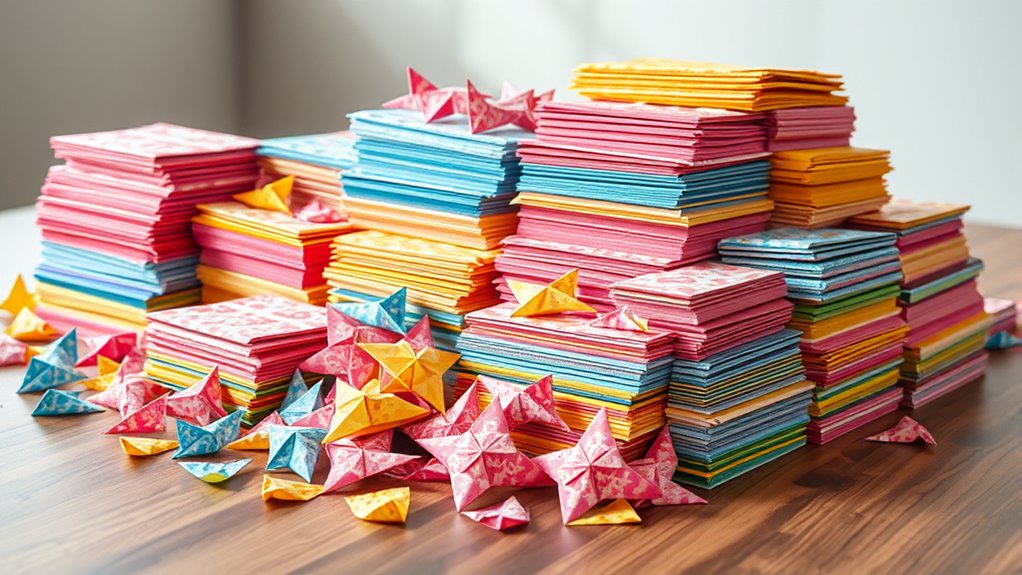

For a value pack of origami paper with around 1,000 sheets, I’d start with the IOOLEEM 1,000-sheet, 20-color pack for its balance of quantity, standard 6-inch size, and color variety. The Umikk 1,500-sheet pack suits high-volume folding, while the Senbazuru 7 cm pack is a better match for small traditional cranes and other miniatures. The main tradeoffs are sheet size, color selection, double-sided printing, and whether a kit includes guidance. A large count can be less useful if the paper is too small for your models or the assortment does not fit your projects. Read on for the full comparison and buyer advice.

Get travel and outdoor gear delivered free with Prime
- Fast, free delivery on millions of items
- Prime Video, Amazon Music and more included
- Member-only deals all year
Complete the kit


Key Takeaways
- IOOLEEM is the most balanced general-purpose pick: its 1,000 sheets, 20 colors, and 6-inch squares suit a wider range of standard folding projects than the 7 cm crane-focused packs.
- Umikk prioritizes volume over a strict 1,000-sheet target: 1,500 sheets make it the standout for classrooms and group activities, though buyers should confirm that its color assortment fits their plans.
- Small paper serves a different purpose: Senbazuru’s 7 cm format and Toyo’s 7 cm, 50-color assortment favor cranes and miniatures over larger models.
- Pack count does not tell the whole value story: the 25 × 25 cm sheets offer far more working area per sheet than 4-inch or 6-inch squares, which matters for large folds but changes the kind of projects the pack suits.
- Double-sided color and included guidance solve different needs: printed faces can add visual interest to finished models, while Praisebank’s guide is more relevant to learners who want help getting started.


| value pack origami paper 1000 ct | Shape | Material | Sheet count | Finish |
|---|---|---|---|---|
| 100 Sheets Double-Sided Origam | Square | — | — | — |
| TG153 Origami Paper Crane Fold | Square | Paper | 1,000 sheets | Smooth |
| Senbazuru 20-1279 Origami Pape | Square | — | — | — |
| Praisebank White Origami Paper | Square | — | — | — |
| IOOLEEM Origami Paper | Square | Paper | — | — |
| Home Pro Shop Origami Paper | — | Paper | 1,100 | — |
| Origami Paper 1000 Sheets 6×6 | Square | Paper | 1,000 | Smooth |
| Umikk 1500 Sheets Origami Pape | Square | Eco-friendly paper | 1,500 | Smooth |
| Toyo Thousand Paper Cranes Ori | — | Paper | 1,000 | Matte |
| 300 Sheets Origami Paper | — | Paper | 300 | Smooth |
| 1000 Sheets Origami Paper | Square | Premium paper | 1,000 | Uncoated |
| SenseYo 1000 Sheets Origami Pa | Square | Paper | 1,000 | Uncoated |
More Details on Our Top Picks
100 Sheets Double-Sided Origami Paper, 25×25 cm, 20 Colors, 70gsm
The larger 25 × 25 cm sheets give this pack a different job from the 6-inch, 1,000-sheet options such as IOOLEEM: they leave more room for big models, classroom demonstrations, and decorative pieces. Its 70 gsm weight offers a sturdier feel for handling, while double-sided color can make folds look finished from either side. I’d choose it when sheet size and paper heft matter more than reaching the roundup’s 1,000-sheet target. That is the central tradeoff: 100 sheets run out far sooner during group projects or repeated practice, and the 20-color selection is narrower than packs offering more variety. The single listed size also limits flexibility for small-scale folding.
Pros:- Large 25 × 25 cm sheets suit bigger models and demonstrations
- 70 gsm paper provides a sturdier folding surface
- Double-sided color can show on both sides of a finished model
- 20 colors support a range of projects
Cons:- 100-sheet count is much lower than the roundup’s 1,000-sheet packs
- Only one sheet size is listed
- 20 colors may offer less variety than larger assortments
Best for: Crafters and teachers who need larger, sturdier sheets for display models or guided demonstrations
Not ideal for: Families or workshop leaders who need 1,000 sheets for repeated practice or large groups
- Quantity:100 sheets
- Sheet size:25 × 25 cm
- Color options:20 colors
- Paper weight:70 gsm
- Double-sided:Yes
- Shape:Square
Our verdict“Choose this pack when larger, heavier sheets matter more than getting 1,000 pieces.”
TG153 Origami Paper Crane Folding Colored Paper – 1000 Sheets (Random)
A thousand 2 × 2-inch squares make this pack suited to compact crane folding and other small repeated models. Its scale is far smaller than Praisebank’s 6-inch sheets, so each piece uses less table space and can fit projects where a full-size square would be awkward. The pink-and-blue random mix adds simple color contrast, but buyers should expect a limited palette rather than the broad choices offered by IOOLEEM’s 20 colors. The smooth paper is described as durable, though the small dimensions leave little margin for large hands or complex patterns. I’d pick TG153 for quantity at miniature scale; for versatile models, classroom demonstrations, or decorations that need more visual presence, the larger sheets are the safer fit.
Pros:- 1,000 sheets support repeated small-scale folding
- Compact 2 × 2-inch size suits miniature projects
- Smooth finish is specified
- Pink and blue provide a simple two-color mix
Cons:- Small sheets are restrictive for larger models and many patterns
- Only pink and blue are listed, with a random mix
- The listing gives no paper weight
Best for: Crafters making many miniature cranes or other small folded decorations
Not ideal for: Beginners learning larger patterns or anyone making models that need broad sheets and varied colors
- Sheet count:1,000 sheets
- Sheet size:2 × 2 inches
- Shape:Square
- Color:Pink and blue, random mix
- Material:Paper
- Finish:Smooth
- Pack count:1
Our verdict“Choose TG153 for high-volume miniature folding; choose a 6-inch pack for broader project flexibility.”
Senbazuru 20-1279 Origami Paper – Asa no ha, 7 cm, 1005 Sheets
The asa no ha hemp-leaf pattern gives this 1,005-sheet pack a more traditional, decorative look than plain double-sided choices such as IOOLEEM. At 7 cm square, it suits small cranes and compact models, while the white reverse provides contrast when folds expose the back. The 15-color selection is more restrained than a 20-color 6-inch assortment, and the patterned face sets a distinct visual style rather than serving every craft equally well. Compared with TG153’s tiny 2-inch sheets, Senbazuru offers more working area, though it remains far smaller than Praisebank’s 6-inch format. I’d choose it for small models where Japanese origin and a repeating motif are part of the appeal; larger projects and broad decorative use call for bigger plain sheets.
Pros:- 1,005 sheets support extensive small-model folding
- Asa no ha pattern adds a decorative traditional look
- White backside creates contrast in exposed folds
- Japanese origin is specified
Cons:- 7 cm sheets limit model size
- 15 colors provide less range than 20-color assortments
- Patterned paper may not suit projects that call for plain colors
Best for: Origami enthusiasts folding small cranes and models with a traditional patterned finish
Not ideal for: Crafters who need large sheets, plain colors, or paper for a broad range of non-origami projects
- Number of sheets:1,005
- Sheet size:7 × 7 cm
- Colors:15
- Pattern:Asa no ha hemp leaf
- Backside:White
- Origin:Japan
- Shape:Square
Our verdict“Pick Senbazuru for small, patterned origami; choose a 6-inch plain pack for larger or more flexible craft work.”
Praisebank White Origami Paper, 1000pcs 6×6 inch, Double Sided Color, Origami Kit with Guide
The included step-by-step guide gives Praisebank an advantage for beginners over IOOLEEM, which lists the same 1,000-sheet, 6-inch scale but no guide. Those 6 × 6-inch double-sided sheets provide room to learn common folds and make larger animals or ornaments than Senbazuru’s 7 cm paper. A thousand sheets also leave plenty of material for repeated attempts, which can matter more to a new folder than having a named color count. The listing describes the sheets as colored but does not specify how many colors, so buyers seeking a defined palette may prefer IOOLEEM’s 20-color assortment. There are no additional tools or accessories listed, and its stated use is focused on origami. I’d pick this kit when paper plus basic instruction is the deciding combination.
Pros:- 1,000 sheets allow repeated practice and group activities
- 6 × 6-inch size works for many standard models
- Double-sided color gives folds visible color on both sides
- Step-by-step guide offers a starting point for beginners
Cons:- Number of colors is not specified
- No additional tools or accessories are listed
- Origami-focused contents may be limiting for mixed-media craft use
Best for: Beginners, families, and activity leaders who want a large supply of standard-size sheets with folding guidance
Not ideal for: Buyers who need a specified color count or a kit with tools and materials for varied crafts
- Quantity:1,000 sheets
- Sheet size:6 × 6 inches
- Color:Double-sided colored
- Guide:Step-by-step guide included
- Shape:Square
- Additional tools:None listed
Our verdict“Choose Praisebank if a beginner-friendly guide matters more than a specified color assortment.”
IOOLEEM Origami Paper, 1000 Sheets, 20 Colors, 6 Inch Square, Double Sided Colored Paper for Crafts, DIY, Party & Decoration
IOOLEEM pairs 1,000 sheets with 20 named color options, making its assortment easier to assess than Praisebank’s listing, which does not state a color count. The 6-inch square format is a versatile middle ground for standard origami and larger decorations; it gives more room than Senbazuru’s 7 cm sheets without moving to the 25 cm scale of the 100-sheet option. Double-sided color can help finished models look complete from multiple angles, and the product description also names crafts, parties, and decoration as uses. I’d place it ahead of narrower-purpose or small-format packs for broad use. The tradeoff is incomplete paper detail: no thickness or weight is provided, so buyers who need a specific folding feel have less information than they do for the 70 gsm pack.
Pros:- 1,000 sheets support extended projects and group activities
- 20 colors are specified
- 6-inch squares suit many origami models and decorations
- Double-sided color can show on both sides of folds
Cons:- Paper thickness and weight are not specified
- A 20-color assortment may not cover every color-specific project
- No folding guide or extra tools are listed
Best for: Families and party crafters who want a large 6-inch supply with a stated 20-color selection
Not ideal for: Folders who need a specified paper weight or a particularly broad palette for color-sensitive projects
- Quantity:1,000 sheets
- Sheet size:6 × 6 inches
- Shape:Square
- Colors:20
- Double-sided:Yes
- Material:Paper
- Listed uses:Crafts, DIY, parties, decoration
Our verdict“Choose IOOLEEM for a defined 20-color, 1,000-sheet supply in a versatile 6-inch format.”
Home Pro Shop Origami Paper – 1100 Sheets
Home Pro Shop’s 1,100 sheets give folders a little more paper than a standard 1,000-sheet pack, while keeping the useful 6 × 6-inch size for familiar models and classroom crafts. Its double-sided colors make folded shapes look finished on both sides, and the included tutorials give beginners a starting point that the Umikk 1500 Sheets set does not provide. That guidance is the main reason to choose this pack over a larger bulk option. The tradeoff is that the product data gives no paper weight or thickness, so buyers cannot gauge how it will handle especially intricate folds. It also has no stated storage solution, and 1,100 sheets may be more than a first-time folder wants to keep organized.
Pros:- 1,100 sheets provide a little more material than a 1,000-sheet pack
- Double-sided color gives finished models color on both faces
- Included tutorials offer beginners a way into the hobby
- Paper is described as holding creases well
Cons:- Paper thickness is not specified, making performance on intricate folds harder to judge
- No storage solution is included
- The large quantity may be cumbersome for someone trying origami for the first time
Best for: Families or activity leaders who want a high sheet count plus tutorials to help beginners start folding
Not ideal for: Experienced folders choosing paper for delicate models, since the paper thickness is unspecified
- Sheet count:1,100
- Sheet size:6 × 6 inches
- Material:Paper
- Coloring:Double-sided
- Skill level:Beginners to advanced crafters
- Included guidance:Tutorials
Our verdict“Choose this pack if tutorials and a modestly larger-than-1,000-sheet supply matter more than detailed paper-weight information.”
Origami Paper 1000 Sheets 6×6 Inch Colored Craft Paper Double Sided
This 1,000-sheet pack is the clearest choice here for folders who want paper described as 70 gsm and tear-resistant. That weight can help it stand up to repeated creasing and general craft use, though the same sturdiness may make very delicate models harder to fold than with lighter paper. Compared with Home Pro Shop Origami Paper, it offers a stated weight and smooth finish but has no tutorials listed. Its 6 × 6-inch double-sided sheets work for standard-sized projects, but the fixed size limits larger designs. The combination of color variety and a durable feel suits mixed craft sessions; buyers focused on elaborate, fine-detail origami may prefer a thinner, more specialized paper.
Pros:- 70 gsm weight is specified
- Tear-resistant paper suits repeated handling
- Double-sided multicolor sheets add color to both faces of models
- Smooth finish supports crisp folding
Cons:- The thicker paper may resist very delicate folds
- Only one sheet size is listed
- No instructional material is specified
Best for: Crafters and classroom organizers who need standard-size, tear-resistant sheets for repeated folding and varied projects
Not ideal for: Folders making delicate, multi-layer models or large designs that need thinner or bigger paper
- Sheet count:1,000
- Paper size:6 × 6 inches
- Weight:70 gsm
- Material:Paper
- Finish:Smooth
- Color:Multicolor
- Shape:Square
- Coloring:Double-sided
Our verdict“Pick this pack for durable, standard-size craft paper, while delicate-model specialists should look for thinner sheets.”
Umikk 1500 Sheets Origami Paper 6×6 Inch, 20 Colors
Umikk’s 1,500 sheets make it the high-capacity pick in this group, with 20 colors and a familiar 6 × 6-inch square that fits common folding projects. Its 70 gsm smooth paper is described as easy to fold without tearing, giving buyers more technical detail than the Home Pro Shop pack. Compared with that 1,100-sheet option, Umikk offers substantially more paper but omits its tutorials. The double-sided vivid colors can add depth to finished models, while the eco-friendly, odorless material is a practical detail for shared craft sessions. The tradeoff is straightforward: this is a supply-focused set, with no instructional guide or pattern booklet for learners who need project ideas.
Pros:- 1,500 sheets provide the largest stated quantity among these five products
- 20 colors offer variety across repeated projects
- 70 gsm smooth paper is described as folding easily without tearing
- Double-sided coloring adds depth to folded designs
Cons:- No instructional guide or pattern booklet is included
- Only 6 × 6-inch sheets are listed
- The bulk quantity may be more than occasional folders need
Best for: Teachers, clubs, and frequent folders who want a large supply of 6 × 6-inch paper in many colors
Not ideal for: New folders who want included instructions or patterns to guide their first projects
- Sheet count:1,500
- Paper size:6 × 6 inches
- Colors:20
- Weight:70 gsm
- Material:Eco-friendly paper
- Finish:Smooth
- Shape:Square
- Coloring:Double-sided
Our verdict“Choose Umikk when a large, color-varied supply matters more than included folding guidance.”
Toyo Thousand Paper Cranes Origami 7cm, 50 Colors, 1000 Sheets
Toyo’s 1,000 sheets trade the standard 6-inch format for compact 7 cm squares and a wide choice of 50 colors. That combination suits paper cranes and other small projects where color variety matters more than working area. Compared with the 6 × 6-inch sheets in the Origami Paper 1000 Sheets 6×6 Inch pack, Toyo’s sheets are much smaller, which limits larger folds but can be handy for small hands or tightly grouped displays. The matte finish is described as providing folding grip, and the product is recommended for ages 3 and up. It comes as loose sheets and has no booklet, so buyers looking for larger projects or guided lessons should choose another set.
Pros:- 50 colors give the broadest stated color selection in this batch
- 1,000 sheets support extended small-scale projects
- Compact 7 cm squares suit miniature cranes and displays
- Matte finish is described as providing folding grip
Cons:- The 7 cm format limits the size and complexity of models
- No instruction booklet is included
- Loose sheets have no listed storage solution
Best for: Families and crane makers who want many colors for small-scale folding projects
Not ideal for: Folders making medium or large models, since 7 cm sheets provide little working area
- Sheet count:1,000
- Paper dimensions:7 cm square
- Colors:50
- Finish:Matte
- Material:Paper
- Format:Loose sheets
- Recommended age:3 years and up
Our verdict“Pick Toyo for colorful miniature cranes and skip it if your projects need standard-size origami paper.”
300 Sheets Origami Paper – 25 Colors, Double-Sided, 6×6 inches
This 300-sheet set is the outlier for buyers who want to sample colors and fold standard-size models without storing a thousand sheets. It offers 25 colors across smooth, double-sided 6 × 6-inch paper, with 70 gsm weight described as thin enough for crisp creases yet durable for repeated use. Compared with the Origami Paper 1000 Sheets 6×6 Inch pack, it gives more stated color options but less than a third of the sheets. That smaller quantity makes it a more manageable choice for a beginner, gift, or short classroom activity, but a poor match for the roundup’s high-volume purpose. The product data also notes that color absorption may vary slightly, which could mean a less consistent feel from sheet to sheet.
Pros:- 25 colors offer variety in a smaller pack
- 6 × 6-inch sheets fit common origami projects
- 70 gsm smooth paper is described as supporting crisp creases
- Double-sided coloring gives models color on both faces
Cons:- 300 sheets fall well short of the 1,000-sheet roundup target
- Color absorption may vary, causing slight differences in feel
- Only one sheet size is specified
Best for: Beginners, gift buyers, and small-group activity leaders who want many colors in a manageable quantity
Not ideal for: Teachers, clubs, or frequent folders who need close to 1,000 sheets for ongoing projects
- Sheet count:300
- Paper size:6 × 6 inches
- Colors:25
- Weight:70 gsm
- Material:Paper
- Finish:Smooth
- Coloring:Double-sided
Our verdict“Choose this set to try a broad palette in a manageable quantity, but pick a 1,000-sheet option for sustained bulk folding.”
1000 Sheets Origami Paper – Assorted Sizes, Double‑Sided Squares in 10 Colors
Three sheet sizes give this 1,000-count pack more project flexibility than SenseYo’s 4-by-4-inch-only set. Its mix of 600 small sheets and 200 each in medium and large sizes lets children practice compact folds, then move to larger models without buying a second pack. Double-sided color adds visual variety to each design, while the uncoated paper is described as easy to crease and resistant to tearing. That makes this a practical choice for family craft sessions where projects vary in scale. The tradeoff is that its 10 colors offer less color variety than SenseYo’s 20, and most sheets are the smallest size. The included scissors are a minor convenience, but one pair may not suit a group working at once.
Pros:- Three square sizes accommodate projects with different folding and display needs
- Double-sided sheets provide two visible colors for designs that expose both sides
- 1,000 sheets support repeated practice and group crafting
- Uncoated paper is described as easy to fold and resistant to tearing
Cons:- Only 10 colors, fewer than SenseYo’s 20-color assortment
- Most sheets are 3-inch squares, limiting options for larger models
- Only one small pair of scissors is included
Best for: Families and beginner groups who want one high-count pack for small practice folds and larger projects
Not ideal for: Crafters who want many color choices or mostly large sheets; 600 of the 1,000 sheets are 3-inch squares
- Sheet count:1,000
- Sizes included:600 sheets at 3 × 3 in; 200 at 4 × 4 in; 200 at 6 × 6 in
- Colors:10 assorted colors
- Sides:Double-sided
- Material:Premium paper
- Finish:Uncoated
- Shape:Square
- Item weight:14.08 oz
Our verdict“Choose this pack if you want 1,000 double-sided sheets in several sizes and can work with a 10-color palette.”
SenseYo 1000 Sheets Origami Paper Kit, 20 Colors, 4×4 Inch Square
Twenty colors in a uniform 4-by-4-inch size make this SenseYo kit a straightforward pick for color-led projects, classroom sorting, and designs that need a broad palette. With 1,000 sheets, there is plenty for repeated practice, and its uncoated paper with moderate hardness is described as easy to fold without tearing. Compared with the assorted-size 1000 Sheets Origami Paper set, SenseYo gives you twice the listed color count but loses the option to switch to 3-inch or 6-inch sheets. That fixed format can simplify planning when every participant needs matching paper, though it limits larger models. No guide or instructions are listed, so a beginner who needs folding prompts may be better served by a kit that includes them.
Pros:- 1,000 sheets provide a substantial supply for practice and group activities
- 20 colors offer more palette variety than the 10-color assorted-size pack
- Uniform 4 × 4-inch sheets simplify projects that use a consistent format
- Moderate-hardness, uncoated paper is described as easy to fold without tearing
Cons:- Only one sheet size is included, limiting larger project options
- No beginner guide or folding instructions are listed
Best for: Teachers and crafters who want a large supply of matching 4-inch sheets in a wide range of colors
Not ideal for: Beginners seeking included folding instructions or makers whose projects need larger sheets
- Sheet count:1,000
- Paper size:4 × 4 in
- Colors:20
- Material:Paper
- Finish:Uncoated
- Shape:Square
- Paper hardness:Moderate
Our verdict“Pick SenseYo if color variety and consistent 4-inch sheets matter more to your projects than multiple sizes or included instructions.”

How We Picked
I compared the 12 listings by sheet count, paper dimensions, color variety, double-sided design, and included kit features, then considered how those details affect real folding projects. A 1,000-sheet pack is not automatically the best fit: 7 cm sheets are suited to compact models, 4-inch paper limits the scale of many folds, and 25 cm sheets use more material per piece but support larger work. I also looked at whether the listing suggests an assortment for practice, decoration, or traditional crane folding.
The ranking gives the most weight to useful quantity paired with versatile dimensions and a clear project fit. That puts balanced 6-inch assortments ahead for general use, while higher-count, miniature, mixed-size, and guide-included packs earn places for specific buyers. Product names and listed specifications do not establish paper thickness, exact color distribution, or folding performance, so I treat those as details to verify before purchase rather than assume.
| value pack origami paper 1000 ct | Material | Finish |
|---|---|---|
| 100 Sheets Double-Sided Origam | — | — |
| TG153 Origami Paper Crane Fold | Paper | Smooth |
| Senbazuru 20-1279 Origami Pape | — | — |
| Praisebank White Origami Paper | — | — |
| IOOLEEM Origami Paper | Paper | — |
| Home Pro Shop Origami Paper | Paper | — |
| Origami Paper 1000 Sheets 6×6 | Paper | Smooth |
| Umikk 1500 Sheets Origami Pape | Eco-friendly paper | Smooth |
| Toyo Thousand Paper Cranes Ori | Paper | Matte |
| 300 Sheets Origami Paper | Paper | Smooth |
| 1000 Sheets Origami Paper | Premium paper | Uncoated |
| SenseYo 1000 Sheets Origami Pa | Paper | Uncoated |
Factors to Consider When Choosing Value Pack Origami Paper 1000 Ct
Before choosing a large pack, match the paper to the models you plan to fold and the people who will use it. Count, size, and assortment work together: an impressive sheet total cannot compensate for paper that is awkward for your projects or too small for a learner’s hands.
Match Sheet Size to the Finished Model
Start with the size of the models you expect to make, rather than the sheet count on the package. Six-inch squares are a familiar middle ground for many standard projects, while 7 cm sheets are better suited to cranes and compact decorations. Four-inch paper can save table space and suit small folds, but intricate steps may be harder to manage, especially for beginners. The 25 × 25 cm sheets in this group give folds more room and can work for larger models, though each finished piece uses more paper. A common mistake is buying the smallest sheets for an ambitious model and finding that the finished result is too small to handle or display. If your project list varies, standard 6-inch squares are usually the more flexible starting point.
Compare Useful Sheets, Not Just the Headline Count
A higher count matters most when you have a steady use for the paper, such as a classroom activity or a group craft session. The 1,500-sheet Umikk pack provides more pieces than the many 1,000-sheet options, while the 1,100-sheet Home Pro Shop pack offers a smaller count increase. Extra sheets have limited value if colors are repeated in ways that do not suit your project or if the format is wrong. Consider how many finished models you want and whether practice folds will consume a meaningful portion of the pack. For a one-time activity, a smaller assortment may be easier to store and use up. For recurring sessions, a larger count can reduce the need to restock mid-project.
Choose Colors for the Models You Make
Color variety affects how easily a pack supports coordinated displays, themed crafts, or individual experimentation. A 50-color assortment offers more options for visual variation than a 20-color pack, but more colors do not guarantee more sheets in each shade. Random assortments can also make it harder to plan a matched set of models. If you are folding cranes for a display, decide whether you want a broad palette or repeated colors that can produce a consistent look. For practice, a mixed selection can make it easier for participants to identify their own paper. Check the product details for how colors are distributed when that matters to your project.
Decide Whether Both Sides Should Show Color
Double-sided color can change the appearance of folds where the reverse side becomes visible, such as models with layered points or flaps. It may also help a finished piece look intentional from more angles, which matters for ornaments and party decorations. For models that mostly show one face, single-sided paper can be sufficient and may keep the selection simpler. Do not assume that a product described as colored paper has different colors on both faces; listings may use that wording in different ways. Confirm whether the two sides are contrasting, matching, or both white if that detail affects your design. This feature is most useful when you already know how the finished model will be displayed.
Check What a Kit Adds for New Folders
A guide can help a beginner get started, but its presence does not tell you how many models it covers or how clearly it explains each fold. If you are buying for a class or family activity, consider whether learners need printed steps or will follow instructions from another source. A guide is less useful if it does not match the group’s reading level or the models they want to make. Also think about the amount of support needed: very small sheets can make early folds harder to see and repeat. For a first project, accessible paper dimensions may matter more than a large color count. Check the listing for details about the guide’s format and contents before treating it as a complete learning kit.
Look for Paper Details That Listings Leave Open
Sheet count and dimensions are often clearer in a listing than paper weight, surface finish, or how sharply the paper holds a crease. Those details can affect the feel of a finished model, particularly when folds have several layers. The 70 gsm specification on the 25 cm pack gives buyers a concrete thickness reference, while many of the other product names do not state a weight. If you need paper for repeated folding or detailed models, check the full product description for weight and material information. For casual practice, color and size may be enough to make a choice. When those details are missing, avoid assuming that two packs with the same dimensions will handle exactly alike.
Frequently Asked Questions
Is a 1,000-sheet pack a good choice for a beginner?
It can be, particularly if you expect to practice often or share the paper with a group. A large assortment gives you room to repeat folds, but a beginner may get more use from manageable 6-inch squares than from very small 7 cm sheets. If you are unsure whether origami will become a regular activity, a smaller pack can help you learn what sizes and colors you prefer before storing a large supply. An included guide may be useful, though check what projects it covers. For ongoing practice, choose a pack whose dimensions fit the models you plan to learn.
Should I choose 7 cm paper or standard 6-inch squares for cranes?
Both can work, but they suit different outcomes. The 7 cm Senbazuru and Toyo packs are aimed at small folding, making them a natural fit when you want compact cranes or a large number of miniatures. Six-inch squares give you a larger model that is easier to see and handle, especially for newer folders. If the cranes will be part of a display, decide first whether you value a compact look or a more visible finished piece. The intended display size is a better guide than sheet count alone.
Does a larger assortment mean I will get more of each color?
Not necessarily. A listing that names 20 or 50 colors describes variety, but it may not state how evenly sheets are divided among them. Random assortments can be convenient for casual crafting and less predictable for coordinated sets. If you need repeated colors for a decoration or group project, check the listing for color quantities or distribution details. When the seller does not specify them, plan around variety rather than a precise number of sheets in any shade.
Is double-sided origami paper worth choosing?
It is useful when your model shows both faces of the sheet or when you want contrasting colors to appear in the folds. For simple models that display mostly one side, double-sided printing may add little to the finished result. Check what “double-sided” means in the product details, since it may refer to colored faces rather than two different colors. Think about the models and display angles you have in mind before making it a deciding factor. Paper size and suitability for the project can matter more than the print on the reverse.
What should I check if I need paper for a classroom or group activity?
Estimate how many sheets each person may use, then check the pack count, dimensions, and whether the color mix can support the activity. A larger pack such as Umikk’s 1,500-sheet option may suit repeated sessions, while a 6-inch size can be easier to work with across mixed skill levels. For younger or newer folders, a guide may help, but verify that it includes projects suitable for the group. Random colors can keep an activity playful but may complicate plans that require matching pieces. Storage space matters too: a large pack is only convenient if you can keep the sheets flat and accessible.
Conclusion
For most buyers seeking a flexible, roughly 1,000-sheet supply, I’d choose IOOLEEM as the best overall because its 6-inch squares and 20 colors suit a broad mix of projects. Umikk is my best value for high-volume use when the extra sheets are useful; the 25 cm, 70 gsm pack is my premium pick for buyers who want larger paper and a stated weight. Beginners may prefer Praisebank for its included guide, while crane makers should look at Senbazuru or Toyo for their 7 cm format. For very small models, SenseYo’s 4-inch sheets offer a compact option; for varied model sizes, the assorted-size pack deserves a closer look. Pick based on the paper dimensions and project needs first, then use color range and extras to narrow the choice.