


Cruise ship Wi-Fi feels slow because it’s mainly reliant on satellite internet, which has inherent limitations. The signals have to travel hundreds of miles, causing delays and latency issues. Heavy user demand, weather conditions, and equipment alignment further reduce speeds. Unlike land-based networks, bandwidth is limited and shared among many passengers, leading to congestion. If you want to understand why these problems persist and what’s being done about them, keep exploring the details.
Key Takeaways
- Satellite signals experience delays due to long travel distances and weather interference, increasing internet latency.
- Limited onboard satellite bandwidth is shared among many passengers, causing network congestion and slower speeds.
- Ship movement and obstructions can disrupt satellite signals, reducing connection stability and quality.
- Satellite technology and equipment require precise alignment; misalignments weaken signal strength.
- Overall technological constraints mean cruise ship Wi-Fi prioritizes essential services over fast, reliable internet.
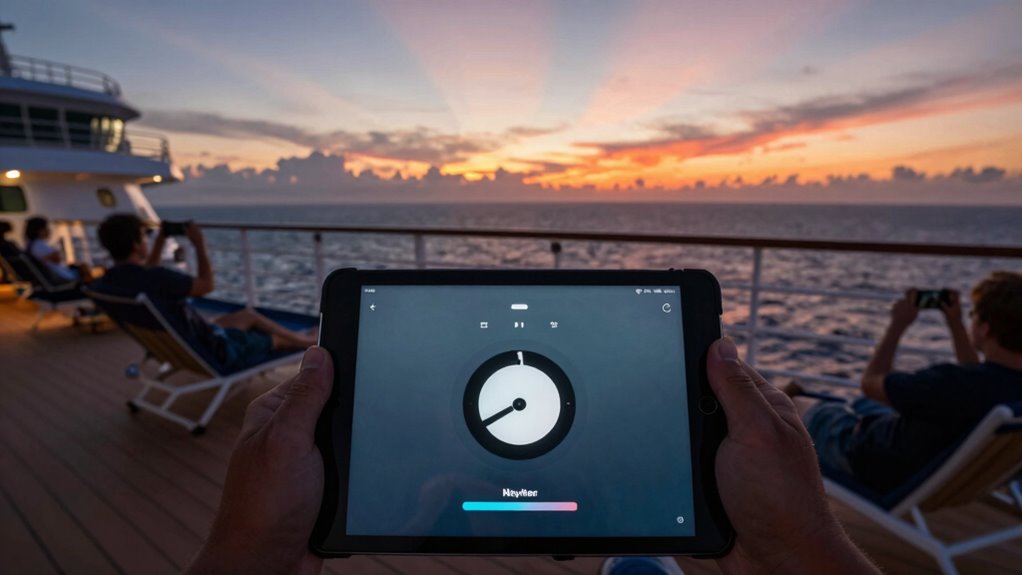
Have you ever tried to check your email or stream a movie only to be frustrated by painfully slow Wi-Fi on a cruise ship? If so, you’re not alone. The primary reason for these sluggish connections boils down to how maritime connectivity works. Unlike land-based internet, which relies on fiber optic cables and cell towers, cruise ships depend heavily on satellite communication to stay connected. This setup introduces a host of challenges that slow down your browsing experience. Satellite limitations, for one, are a major factor. Satellites orbit hundreds of miles above Earth, and signals must travel vast distances, resulting in increased latency. This delay makes real-time activities like video calls or streaming frustratingly slow. Additionally, satellite bandwidth is limited and shared among hundreds or thousands of passengers, so when everyone tries to go online simultaneously, the network gets congested. As a result, your attempts to load a webpage or download an email attachment may take much longer than usual.
Maritime connectivity is inherently more complex than typical internet setups because ships are constantly moving across open waters. This movement complicates maintaining a stable satellite link. The connection is often interrupted by weather conditions like storms or heavy cloud cover, which can weaken satellite signals further. Even on clear days, the bandwidth you get is relatively narrow compared to terrestrial networks. This means that, despite the high speeds advertised by many cruise lines, your actual experience tends to fall short. The technology used on ships often involves multiple satellites and ground stations, but these systems are still limited in capacity. As a result, the available bandwidth is constrained, and the network must prioritize essential communications over streaming or browsing. Additionally, the satellite technology onboard often requires precise alignment and can be affected by obstructions, further impacting connection quality.
Another factor to take into account is the technology onboard. Many ships use satellite antennas that need to be manually aligned or automatically track satellites, but this process isn’t perfect. Misalignments or obstructions, like the ship’s superstructure, can further degrade the signal. The bottom line is that maritime connectivity is inherently more limited than what you’re used to on land, and satellite limitations play a vital role in that. So, when your Wi-Fi feels slower than normal on a cruise, remember that it’s not just your device — it’s the nature of satellite-based communication at sea. Despite advances in technology, the fundamental constraints of satellite limitations and the unique challenges of maritime connectivity mean that fast, reliable internet on a cruise ship remains a work in progress.
WiFi Extender, 2026 WiFi Repeater,Internet Booster, Long Range WiFi Extenders Signal Booster for Home, WiFi Repeater with Ethernet Port Covers Up to 9800 sq. ft and 40 Devices,Quick Setup-Medium
EXTEND WIFI COVERAGE : The wifi extenders to bring you wide coverage of signals,Coverage up to 9789Sq. ft,Eliminating…
As an affiliate, we earn on qualifying purchases.
As an affiliate, we earn on qualifying purchases.
Frequently Asked Questions
How Does Satellite Technology Impact Cruise Ship Internet Speeds?
Satellite technology affects your cruise ship internet speeds because of satellite latency and bandwidth limitations. Satellite latency causes delays in data transmission, making your connection feel sluggish. Limited bandwidth means fewer data can be transferred at once, slowing down streaming and browsing. As a result, even with the best equipment, your internet feels slow because the satellite’s inherent delays and capacity restrictions hinder fast, reliable connectivity at sea.
Can Passengers Upgrade to Faster Wi-Fi Packages Onboard?
Yes, you can upgrade to faster Wi-Fi packages onboard. Think of it like upgrading from a bicycle to a sports car—your internet speed gets a serious boost with upgrade options. Cruise lines offer a variety of internet packages, so you can choose the one that fits your needs. Simply visit the onboard Wi-Fi desk or your cabin’s app to explore upgrade options and enjoy smoother, quicker browsing during your voyage.
What Are the Best Times to Use Cruise Ship Wi-Fi?
You should use cruise ship Wi-Fi during off-peak hours, such as early mornings or late evenings, when bandwidth limitations are less severe and connection latency is lower. Avoid busy times like midday when many passengers are online, which can slow your connection. By timing your activities, you can enjoy a smoother experience, making the most of the limited bandwidth and reducing the frustration caused by high connection latency.
How Do Weather Conditions Affect Satellite Internet Connectivity?
Imagine the sky as a vast canvas, but stormy marine weather can cast dark clouds over your satellite connection. When marine weather worsens, it causes satellite disruptions, making your cruise ship Wi-Fi slow or unreliable. Rain, storms, or rough seas interfere with the signals, blocking or weakening the satellite link. As a result, your internet speed drops, and connectivity becomes choppy—weather truly has a way of tampering with your onboard internet experience.
Are There Alternative Ways to Stay Connected During a Cruise?
Yes, you can stay connected during a cruise using maritime communication systems or shipboard networks. Many ships offer satellite phones, radio communication, or dedicated onboard Wi-Fi networks that don’t rely solely on satellite internet. These options provide more reliable and faster connections for essential communication and entertainment. Just ask the crew about available alternatives, so you can choose the best method to stay in touch while enjoying your voyage.

WiFi Extender Signal Booster, Dual Band 5.8GHz&2.4GHz, WiFi Booster Covers Up to 10000 Sq.ft, WiFi Repeater 1.2Gbps with Ethernet Port, One-tap Setup, Made for USA
4X Faster Than Ever – Powered by an Advanced 2-Core Central Processor and supporting Dual-Band (2.4GHz & 5.8GHz),…
As an affiliate, we earn on qualifying purchases.
As an affiliate, we earn on qualifying purchases.
Conclusion
Think of cruise ship Wi-Fi like a tiny river trying to carry a flood of data. It can’t keep up with your needs, no matter how much you wish it would. Just like a small stream, it struggles to flow fast and steady beneath the weight of everyone’s demands. So, next time it feels slow, remember: it’s not just your device, but the ship’s internet river itself trying to handle a storm of connections.

Generic TV Antenna Signal Strength Meter, Satellite Finder, White on Black
【Effortless Alignment】The tv antenna signal strength meter is engineered to quickly align satellite dishes, enabling an effortless setup…
As an affiliate, we earn on qualifying purchases.
As an affiliate, we earn on qualifying purchases.

TP-Link Ultra-Portable Wi-Fi 6 AX1500 Travel Router TL-WR1502X | Easy Public WiFi Sharing | Hotel/RV/Travel Approved | Phone WiFi Tether | USB C Powered | Multi-Mode | Tether App | Durable Design
𝐀𝐗𝟏𝟓𝟎𝟎 𝐃𝐮𝐚𝐥-𝐁𝐚𝐧𝐝 𝐖𝐢-𝐅𝐢 𝟔 𝐓𝐫𝐚𝐯𝐞𝐥 𝐑𝐨𝐮𝐭𝐞𝐫 – TL-WR1502X delivers fast wireless speed (1201 Mbps on 5 GHz, 300…
As an affiliate, we earn on qualifying purchases.
As an affiliate, we earn on qualifying purchases.