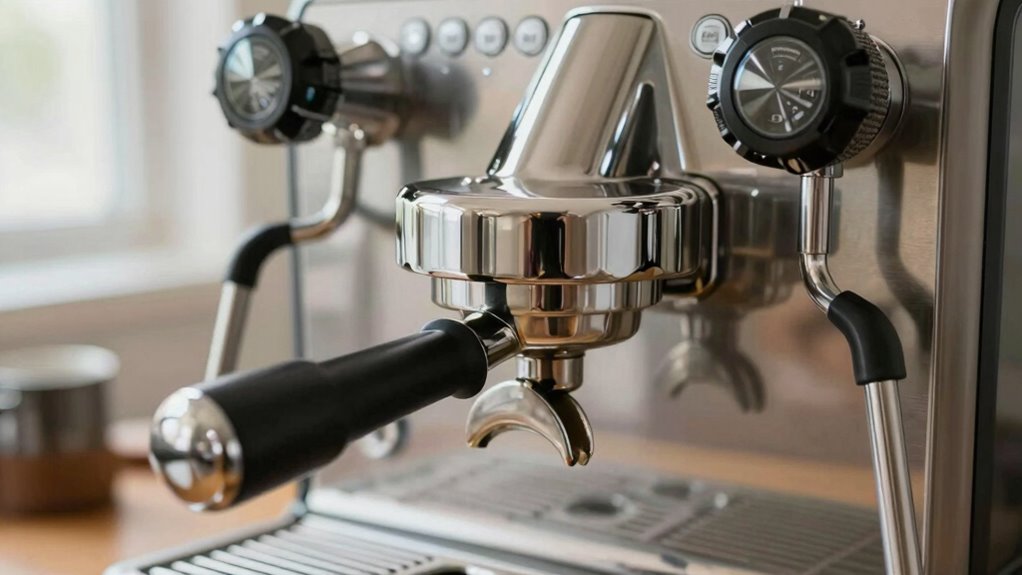

For new espresso buyers, focusing on grind consistency and temperature stability matters more than the number of boilers. A machine that offers precise grind settings and maintains stable heat ensures each shot is balanced and flavorful. These factors directly influence the comfort and reliability of your brewing experience. Higher boiler counts won’t guarantee better results if your machine lacks stable temperature control and consistent grind support. Keep exploring to discover how these features can elevate your espresso game.

Get travel and outdoor gear delivered free — and shop member deals
- Fast, free delivery on millions of items
- Access to Prime Big Deal Days deals on October 6–7
- Prime Video, Amazon Music and more included
Key Takeaways
- Consistent grind quality and machine performance are more crucial for reliable espresso than boiler count.
- Temperature stability and pressure control directly impact shot quality, surpassing the significance of multiple boilers.
- Build quality and durability ensure long-term satisfaction, often more than the number of boilers.
- Proper grind settings and machine integration influence flavor consistency more than boiler quantity.
- For beginners, ease of use, reliability, and stable performance outweigh the benefits of a multi-boiler setup.

Are you overwhelmed by the variety of espresso machines on the market? With so many options, it’s easy to get caught up in features like boiler count or fancy settings. But as a new buyer, there’s one factor that truly makes a difference in your daily coffee experience: the machine’s ability to produce consistent, high-quality espresso over time. This comes down to two key aspects—grind consistency and machine durability—that often get overlooked in favor of flashy features but are essential for your long-term satisfaction.
First, let’s talk about grind consistency. No matter how advanced your machine is, if your grind isn’t consistent, your espresso will suffer. When your grind is uneven, some grounds become over-extracted, pulling bitter shots, while others are under-extracted, resulting in weak, sour flavors. A machine that supports grind consistency—either through precise grind settings or by integrating with a high-quality grinder—helps you maintain uniform particles. This consistency ensures each shot tastes just as good as the last, making your mornings more reliable and enjoyable. It also means you won’t waste beans or spend extra time troubleshooting flavor issues, which can be frustrating for a new espresso enthusiast. Additionally, selecting a machine with reliable performance can significantly enhance your brewing experience by maintaining optimal temperature and pressure throughout each shot. Proper temperature stability is crucial for achieving consistent extraction and flavor, making it a vital consideration for long-term satisfaction. Moreover, understanding the importance of machine build quality can help you choose a model that withstands daily use and maintains performance over time. Investing in a machine with robust construction ensures it remains durable even with frequent use.
espresso machine with precise grind settings
As an affiliate, we earn on qualifying purchases.
As an affiliate, we earn on qualifying purchases.
Frequently Asked Questions
How Does Machine Size Affect Daily Usage?
Your machine size directly impacts daily usage by affecting portability and countertop space. If you prefer a compact, portable machine, it’s easier to move around and store, making your daily routine more flexible. Larger machines need more countertop space, which might limit placement options and make your workspace feel cluttered. Consider your available space and portability needs when choosing a machine size, ensuring it fits seamlessly into your daily coffee routine.
Are Higher Wattage Machines More Energy-Efficient?
Think of wattage as the heart’s beat—higher wattage doesn’t necessarily mean more energy-efficient. While a more powerful machine might heat up faster, it can consume more energy, reducing overall power efficiency. Energy consumption depends on how you use it, not just its wattage. So, a lower wattage machine, used wisely, can be more efficient, saving you energy and money in the long run.
What Maintenance Is Required for Different Espresso Machines?
You need to follow specific maintenance routines for your espresso machine. Regular cleaning schedules are vital—clean the brew head, steam wand, and drip tray frequently. Descaling procedures are necessary to prevent mineral buildup, especially if you have hard water. Check the manufacturer’s instructions for descaling frequency and use the recommended descaling agents. Proper maintenance guarantees your machine stays in top shape, delivers great espresso, and lasts longer.
Can I Upgrade Parts Later On?
Absolutely, you can upgrade parts later on—if you choose an espresso machine with flexible component compatibility. Ironically, many assume they’re stuck with factory settings, but upgrade options exist, allowing you to enhance performance or customize your setup. Just check compatibility first; not all parts fit every machine. Being aware of upgrade options guarantees you can improve your espresso experience without buying a new machine prematurely.
How Important Is Brand Reputation When Choosing a Machine?
Brand reputation really matters when choosing an espresso machine because it influences your confidence in quality and support. You should consider brand loyalty and read customer reviews to see how others feel about their experiences. A reputable brand often offers better durability, parts availability, and customer service. This guarantees you get a machine that performs well over time and makes your investment worthwhile, giving you peace of mind with every brew.
Conclusion
So, next time you’re eyeing that shiny new espresso machine, don’t get caught up in boiler count. Ironically, it’s often the simpler factor—like your machine’s size or ease of use—that truly makes or breaks your coffee game. After all, more boilers might sound fancy, but they won’t turn you into a barista overnight. Sometimes, the best espresso comes from understanding the basics, not just ticking off features on a checklist. Happy brewing!
Fall Picks
fall essentials
As an affiliate, we earn on qualifying purchases.