
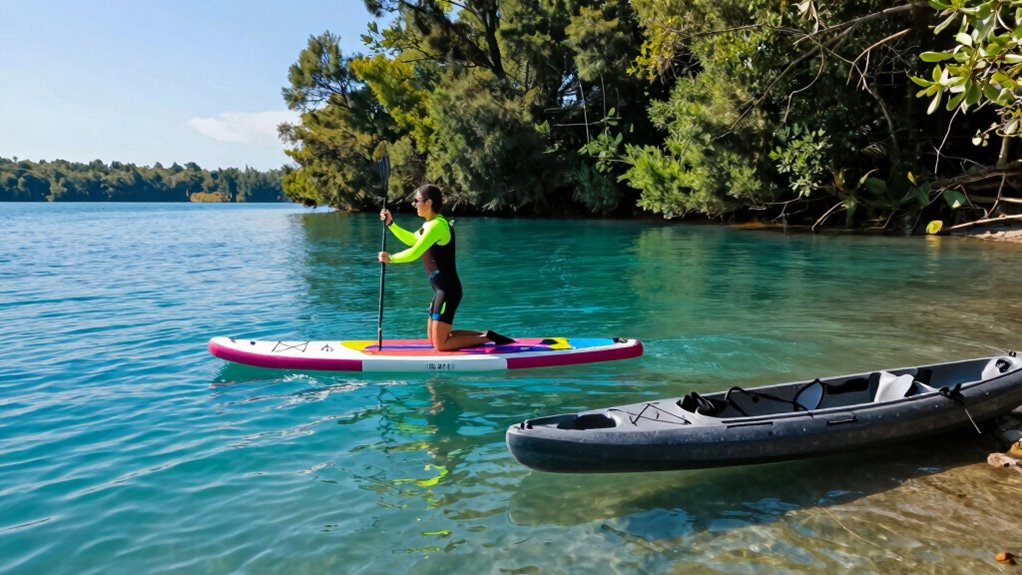

Inflatable paddle boards work better for some travelers because they’re lightweight, easy to carry, and don’t need roof racks or large vehicles. You can deflate them and pack them into a small bag, making transportation simple—even to remote spots. They’re versatile for lakes, rivers, or coastal waters and withstand various weather conditions. Plus, they require minimal maintenance and last for years if cared for properly. Keep exploring—there’s more to discover about their many advantages.

Get travel and outdoor gear delivered free with Prime
- Fast, free delivery on millions of items
- Prime Video, Amazon Music and more included
- Member-only deals all year
Key Takeaways
- Inflatable paddle boards are lightweight and easily portable, making them ideal for travelers with limited space or transportation options.
- They are versatile, suitable for various water environments without needing specialized gear or equipment.
- Inflatable boards are durable and require minimal maintenance, enduring diverse weather conditions and rough handling.
- Their compact design allows for easier packing, storage, and multi-day trips in remote or hard-to-access locations.
- They offer stability and better environmental observation, enhancing safety and exploration for less experienced or casual travelers.
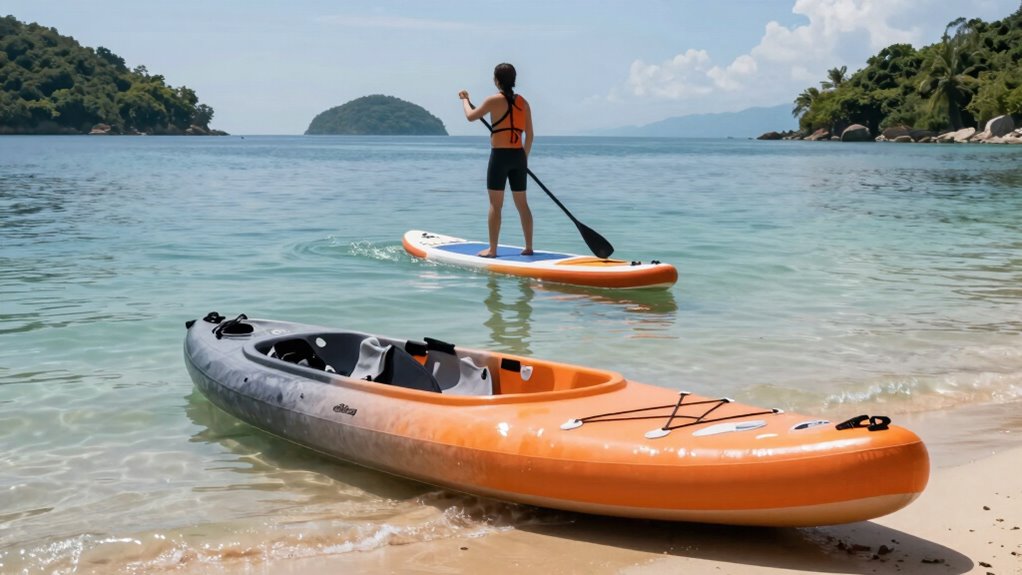
Wondering whether inflatable paddle boards or kayaks are better for your outdoor adventures? When you’re deciding, it’s essential to consider how inflatable paddle boards fit into your plans, especially when it comes to marine navigation and climate considerations. These boards are lightweight, portable, and easy to transport, making them perfect for travelers who want flexibility and simplicity. Unlike kayaks, which often require a roof rack or a larger vehicle for transport, inflatable paddle boards can be deflated and packed into a backpack or small bag. This ease of transport means you’re more likely to explore remote or less accessible areas, giving you the freedom to steer various marine environments without the hassle of bulky gear.
In terms of marine navigation, inflatable paddle boards offer a significant advantage because you can easily carry them onto different types of water—lakes, rivers, or coastal waters—without needing specialized equipment. Their stability and wide decks provide a good platform for observing your surroundings, making it easier to read currents, identify hazards, or spot wildlife. Plus, since they’re inflatable, you can adjust the pressure for different conditions, increasing your control and stability when steering tricky waters. This adaptability is especially useful when you’re exploring unfamiliar areas or engaging in multi-day trips where you might need to pack efficiently and adapt to changing water conditions. Additionally, their portability makes them an excellent choice for travelers with limited space or those seeking to minimize transportation effort. Moreover, the climate-resistance of inflatable paddle boards ensures they can withstand various weather conditions, extending their usability across seasons and environments. Proper maintenance is also crucial to ensure longevity and optimal performance, and the minimal maintenance requirements of inflatable paddle boards make them a practical choice for adventurous travelers. Furthermore, the weather-resistant qualities of inflatable paddle boards make them suitable for diverse climates, ensuring durability and performance in various environments.
inflatable paddle board with pump
As an affiliate, we earn on qualifying purchases.
As an affiliate, we earn on qualifying purchases.
Frequently Asked Questions
Are Inflatable Paddle Boards Suitable for Rough Ocean Conditions?
Inflatable paddle boards can handle rough ocean conditions if you’re experienced and use proper safety considerations. They’re more stable than rigid models and easier to transport, but you should check the board’s durability and make certain you wear a life jacket. Always assess the ocean’s state before heading out, and avoid rough conditions if you’re a beginner. Safety considerations are key to making your paddleboarding experience enjoyable and safe in challenging environments.
How Long Does It Take to Learn to Paddleboard Effectively?
You can typically learn to paddleboard effectively in just a few hours, but mastering it takes about 8-10 sessions. Interestingly, 80% of beginners find their paddleboard balance improves considerably within the first hour. The learning curve might seem steep at first, but with consistent practice, you’ll gain confidence and stability. Focus on proper stance and paddle technique, and you’ll be gliding smoothly in no time.
Can Inflatable Paddle Boards Be Used in Saltwater Environments?
Yes, inflatable paddle boards can be used in saltwater environments. They’re designed with corrosion resistance in mind, which helps prevent damage from salt exposure. However, you might face maneuverability challenges due to water conditions like currents or waves. Regular rinsing with fresh water after each use helps maintain your board’s durability, ensuring it stays in good shape for future adventures.
Do Inflatable Paddle Boards Require Special Storage Conditions?
Inflatable paddle boards need proper storage conditions to stay in top shape. You should follow storage techniques like deflating the board completely, keeping it in a cool, dry place, and avoiding direct sunlight. Climate considerations matter too—store it indoors during extreme temperatures and humidity to prevent damage. By maintaining these best practices, you guarantee your paddle board remains durable, portable, and ready for your next adventure.
Are Inflatable Paddle Boards More Eco-Friendly Than Kayaks?
Yes, inflatable paddle boards are generally more eco-friendly than kayaks. They have a lower eco footprint because they’re made from fewer materials and are lightweight, reducing transportation emissions. Plus, their manufacturing impact is smaller since they don’t require heavy machinery or extensive resources. When you choose an inflatable paddle board, you’re making a greener choice that minimizes environmental harm, making it a better option for eco-conscious travelers.
Conclusion
So, next time you’re choosing between an inflatable paddle board and a kayak, ask yourself: do you want something more versatile and easier to carry, or are you after a stable, traditional experience? Inflatable paddle boards work better for travelers who crave convenience, portability, and a fun challenge on the water. With less hassle and more flexibility, isn’t it worth trying an inflatable paddle board to see the world from a new perspective?
Halloween Picks
halloween
As an affiliate, we earn on qualifying purchases.