
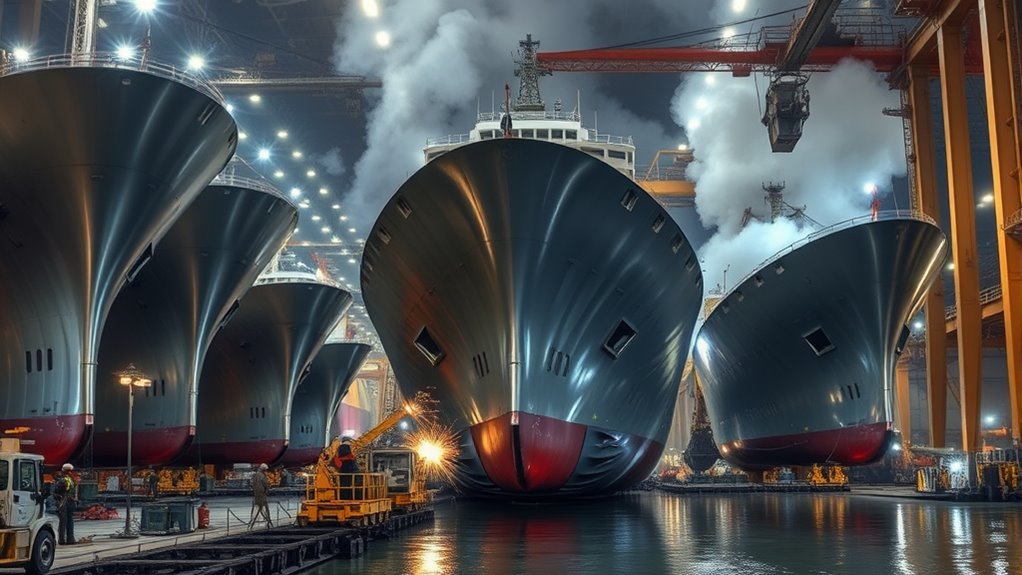

In shipbuilding, your journey begins with detailed design plans, ensuring the vessel’s safety and performance. Next, skilled workers cut and assemble steel plates in large fabrication facilities, shaping the hull. Once the hull is completed and tested, it’s launched into the water. Internal systems like engines and navigation are then installed during the fitting-out phase. Finally, all-encompassing sea trials assess the ship’s capabilities. Continuing will reveal how each step contributes to creating a seaworthy masterpiece.
Key Takeaways
- Naval architecture and detailed design set the foundation before steel is cut.
- Steel plates are cut, shaped, and assembled in fabrication facilities, ensuring precision.
- The hull is constructed, tested, and then launched into water, marking the transition to fitting-out.
- Internal systems like engines and navigation are installed during the fitting-out phase.
- Sea trials evaluate performance and safety, with adjustments made before the ship’s deployment.
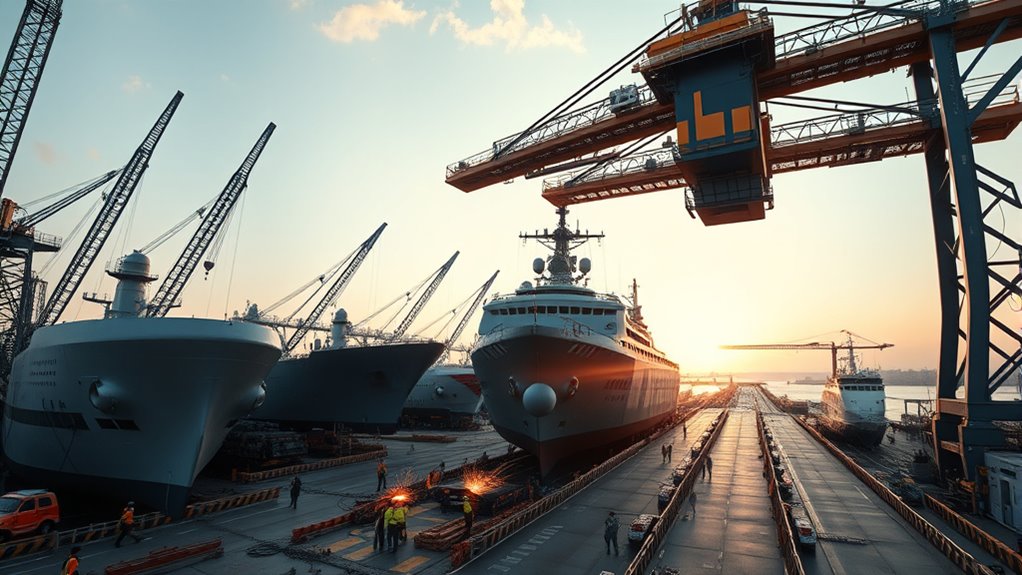
Have you ever wondered how massive ships are built from scratch? The process begins long before steel is cut or welds are made. It all starts with naval architecture and ship design, where engineers and designers work closely to plan every detail. Naval architecture involves understanding how a ship will perform in the water, ensuring it’s safe, efficient, and meets all regulatory standards. During the ship design phase, you’ll see engineers create detailed blueprints and 3D models that outline the vessel’s structure, systems, and layout. This step is critical because it sets the foundation for the entire construction process.
Once the design is finalized, the focus shifts to translating those plans into reality. Large shipyards have massive dry docks and fabrication facilities where steel plates and sections are cut, shaped, and assembled. Precision is key here—your team of skilled welders and fabricators follow the ship design specifications meticulously to guarantee every piece fits perfectly. Throughout this phase, you’ll see a lot of back-and-forth between design teams and construction crews, making adjustments as needed to account for practical considerations or unforeseen challenges.
Shipbuilding transforms detailed plans into reality with precise steel fabrication and constant teamwork.
As the hull begins to take shape, the next step involves launching the vessel into the water. Before this, you’ll see extensive testing and inspections to confirm that the ship’s structure is sound. Once launched, the ship undergoes fitting-out, where all the internal systems are installed, including engines, electrical wiring, navigation equipment, and safety systems. This stage requires careful coordination because each component must integrate seamlessly with the overall ship design. It’s a complex puzzle, but one that’s essential for ensuring the vessel’s operational efficiency.
After construction is complete, the ship enters sea trials. These are rigorous tests where the vessel is put through its paces—speed tests, maneuverability assessments, and stability checks—to verify that it performs as intended. During sea trials, you’ll observe engineers and captains evaluating every aspect of the ship’s operation, making adjustments as needed. It’s the final step before the ship joins its commercial fleet or becomes part of a navy. The entire process, from naval architecture to sea trials, requires precision, expertise, and teamwork. When it’s all said and done, you’ll realize that building a ship is as much an art as it is a science—transforming detailed plans into a seaworthy giant that’s ready to conquer the seas. Shipbuilding process

Tie Down – 4 Pack – 3" x 3" x 3/16" Steel Plates – 7 Gauge A36 Carbon Steel – Made in USA – Weldable Steel for Mounting, Bracing, and Fabrication
[Heavy-Duty A36 Steel Plates] – Includes 4 precision-cut plates, each measuring 3" x 3" x 3/16" thick, made…
As an affiliate, we earn on qualifying purchases.
As an affiliate, we earn on qualifying purchases.
Frequently Asked Questions
How Do Shipbuilders Select the Right Materials for Different Vessels?
You select materials based on their ability to guarantee structural integrity and meet the vessel’s specific needs. Consider factors like strength, weight, corrosion resistance, and durability. You also evaluate how materials perform under environmental conditions and regulatory standards. By analyzing these aspects, you choose the best materials for different vessel parts, ensuring safety, longevity, and ideal performance throughout the ship’s lifespan.
What Innovations Are Currently Shaping Modern Shipbuilding Techniques?
You’re seeing innovations like autonomous navigation and modular construction revolutionize shipbuilding. Autonomous navigation systems allow ships to operate with minimal human input, enhancing safety and efficiency. Modular construction speeds up assembly, reduces costs, and enables easier upgrades. These advancements make vessels more adaptable, environmentally friendly, and cost-effective, transforming how ships are designed and built. Embracing these innovations helps you stay ahead in a competitive industry focused on smarter, faster, and more sustainable maritime solutions.
How Is Environmental Sustainability Incorporated Into Ship Design?
Imagine a sleek vessel gliding smoothly through turquoise waters, powered by eco-friendly propulsion systems. You incorporate renewable energy sources like solar panels and wind turbines into ship designs, reducing emissions and preserving marine life. By choosing sustainable materials and optimizing fuel efficiency, you make each voyage greener. This focus on environmental sustainability transforms ships into eco-conscious travelers, ensuring our oceans stay vibrant and healthy for generations to come.
What Are the Biggest Challenges Faced During Sea Trials?
During sea trials, you face challenges like guaranteeing marine safety and verifying vessel performance. Unexpected issues may arise, requiring quick adjustments. You also need to confirm crew training is effective, as it directly impacts safety and operation. Managing equipment testing under real conditions can be tricky, but thorough preparation helps. Staying vigilant and adaptable ensures the ship meets all standards, paving the way for successful deployment.
How Do Shipbuilders Ensure Compliance With International Maritime Regulations?
You guarantee compliance with maritime safety and regulatory standards by thoroughly understanding international maritime regulations like SOLAS and MARPOL. You implement strict quality control during construction, conduct extensive testing, and document all procedures. Regular training keeps your team updated on safety protocols, and you collaborate with classification societies for inspections. By prioritizing safety and adhering to standards, you ensure your vessel’s compliance with global maritime regulations before sea trials.

Computational Ship Design (Springer Series on Naval Architecture, Marine Engineering, S)
As an affiliate, we earn on qualifying purchases.
As an affiliate, we earn on qualifying purchases.
Conclusion
As you now see, building a ship is like crafting a vessel of dreams, where every steel plate and seam brings your vision closer to reality. Just as Daedalus shaped wings for flight, you’ve learned how each step from steel to sea trials sets the stage for greatness. With patience and precision, you’re ready to set sail on your own voyage, guiding your creation across the vast, open ocean of possibilities.

Dunzoom 3 Pcs Marine Navigation Kit, Basic Navigation Set Include 18" Marine Parallel Ruler with Clear Scales, 8" Diameter Nautical Plotter Protractor, 6" Fixed Point Divider for Boat Accessories
Complete Essentials Navigation Kit: the package includes a marine parallel ruler, a fixed point divider, and a nautical…
As an affiliate, we earn on qualifying purchases.
As an affiliate, we earn on qualifying purchases.

Red Sea Fish Pharm ARE21525 Marine Care Test Kit for Aquarium
Marine care test kit includes all of the main kits you need to run a healthy marine aquarium
As an affiliate, we earn on qualifying purchases.
As an affiliate, we earn on qualifying purchases.