
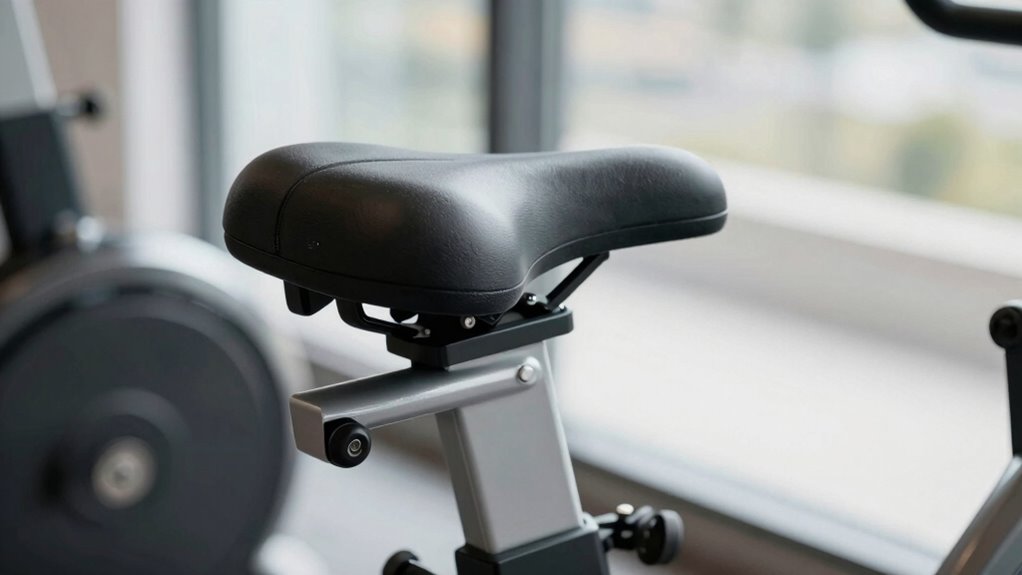
To guarantee knee comfort on an exercise bike, set your seat height so that when seated and pedaling at the lowest point, your leg is almost fully extended with a slight bend of 25-35°. Your knees should move smoothly without strain, and your saddle must be level side-to-side for proper support. Small adjustments can make a big difference in comfort and efficiency, so if you keep fine-tuning, you’ll discover even better setup tips.

Get travel and outdoor gear delivered free with Prime
- Fast, free delivery on millions of items
- Prime Video, Amazon Music and more included
- Member-only deals all year
Key Takeaways
- Adjust the saddle so that your leg is almost fully extended with a slight knee bend (~25-35°) at the pedal’s lowest point.
- Ensure the saddle is level from side to side to prevent discomfort and maintain proper alignment.
- Perform test rides after adjustments to check for smooth knee movement and absence of strain.
- Avoid saddle positions that cause excessive knee bend or overextension to reduce joint stress.
- Regularly re-evaluate and fine-tune saddle height for ongoing knee comfort during workouts.
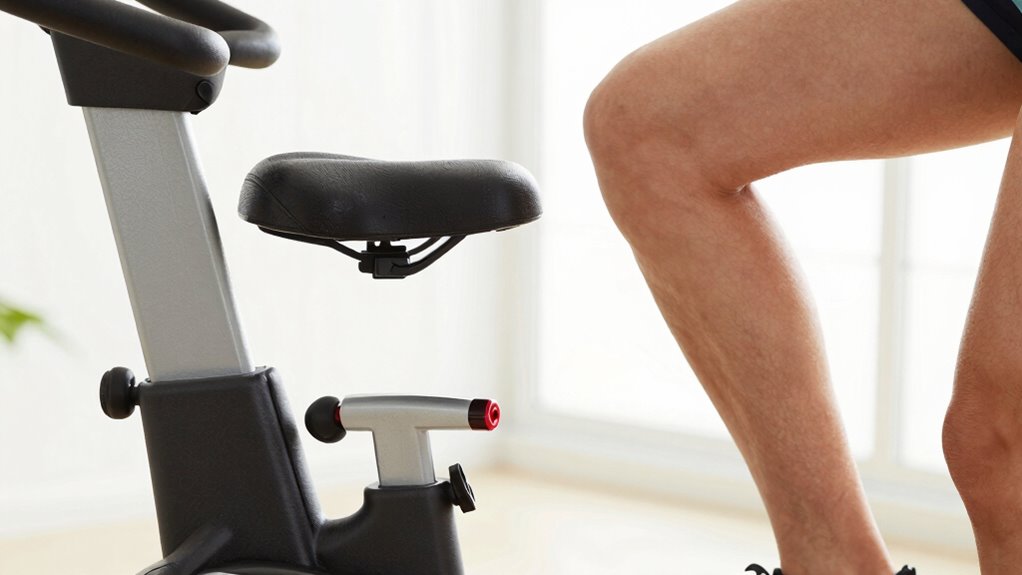
Adjusting the seat height on your exercise bike is essential for comfort and effective workouts. When it comes to proper saddle positioning, ensuring your seat is at the right height makes a significant difference in how your body responds during exercise. The goal is to find a position that supports your legs and prevents strain, especially on your knees. To do this, you need to adjust for leg length. Your leg length, which is the distance from your hip to your foot, directly influences how high or low your saddle should be.
Start by sitting on the bike with your feet clipped into the pedals. Position the pedals at the lowest point in the pedal stroke, usually at the 6 o’clock position. Your leg should be almost fully extended at this point but not locked out. A slight bend in your knee—about 25 to 35 degrees—is ideal to avoid putting excessive pressure on your joints. If your knee is too straight or feels strained, you need to raise or lower the saddle accordingly. If it’s bent too much, lower the seat so your leg extends more comfortably, aligning with your natural leg length. Conversely, if your knee is overly bent, you should raise the saddle to allow for a more natural extension.
Sit on the bike, pedal at 6 o’clock, and adjust for a slight 25-35° knee bend for optimal comfort.
Proper saddle positioning also involves ensuring that the saddle is level from side to side. A tilted saddle can cause discomfort and imbalance, which could lead to improper pedaling technique and possible injury over time. When you’re adjusting for leg length, don’t forget to check that the saddle’s height matches your body’s proportions. This tailored adjustment minimizes knee pain and maximizes power transfer during each pedal stroke. Additionally, understanding natural body proportions can help fine-tune your saddle height for optimal comfort.
Once you’ve set the saddle height, perform a few test rides, paying attention to how your knees feel. They should move smoothly through the pedal stroke without feeling strained or overly tight. If you notice any discomfort or if your knees feel sore afterward, revisit the saddle height adjustment. Small tweaks can make a big difference in both comfort and workout effectiveness.
exercise bike saddle height adjustment
As an affiliate, we earn on qualifying purchases.
As an affiliate, we earn on qualifying purchases.
Frequently Asked Questions
How Often Should I Adjust My Bike Seat Height?
You should adjust your bike seat height whenever you notice discomfort or your form isn’t proper. Check for proper saddle alignment and make certain your knee has a slight bend at the bottom of each pedal stroke. Regular adjustments help maintain seat cushion comfort and avoid strain. Typically, once every few weeks or after significant weight changes, reassess your seat height to stay comfortable and prevent injury.
Can Seat Height Affect My Overall Cycling Posture?
Yes, your seat height can greatly influence your overall cycling posture. If it’s too high or low, it can cause improper knee alignment, leading to strain or discomfort. A misaligned seat may also increase pelvic tilt, which affects your core stability and can cause back pain. Proper seat height guarantees you maintain a neutral spine, supporting efficient pedaling and reducing the risk of injury. Always adjust your seat for ideal posture and comfort.
What Are Signs of an Improperly Adjusted Seat?
If your knees ache or your saddle feels uncomfortable, your seat might be improperly adjusted. You may notice knee pain during or after riding, or feel saddle discomfort that doesn’t go away. Other signs include limited pedal stroke, uneven weight distribution, or feeling unstable on the bike. These issues indicate your seat height needs adjustment. Proper seat height helps prevent discomfort and promotes a smooth, pain-free ride.
Does Seat Height Impact the Bike’s Resistance Levels?
Yes, seat height ergonomics directly impact the resistance level interaction on your exercise bike. When your seat is too high or low, it can cause inefficient pedaling and uneven force exertion, making it harder to control resistance smoothly. Proper seat height guarantees ideal biomechanics, allowing you to adjust resistance levels comfortably and effectively. This helps prevent strain and maximizes your workout efficiency, keeping your cycling experience safe and effective.
Is Seat Height Adjustment Different for Recumbent Bikes?
Imagine you’re stepping into the future, but even then, seat height adjustment on recumbent bikes differs from upright ones. You’ll find that recumbent ergonomics emphasize correct seat positioning to guarantee comfort and ideal performance. You should focus on adjusting the seat so your knees stay slightly bent at the bottom of the pedal stroke, which helps prevent strain. Unlike upright bikes, the seat height on recumbent bikes is tailored more for comfort and less for resistance.
Conclusion
Getting your seat height right is like finding the perfect groove on a vinyl record—it makes all the difference. When you set your exercise bike seat correctly, you’ll pedal with comfort and efficiency, turning your workout into a smooth ride rather than a bumpy journey. So, take the time to adjust, feel the difference, and enjoy every pedal stroke. After all, a well-aligned bike is your best partner on the road to fitness.
Halloween Picks
halloween
As an affiliate, we earn on qualifying purchases.