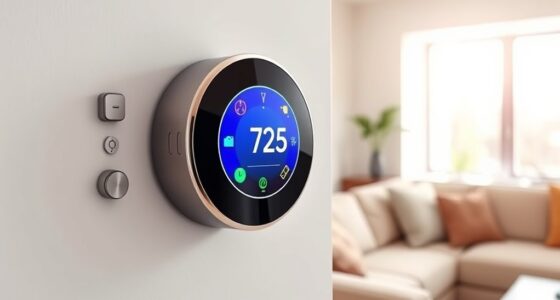

By 2025 and beyond, your smart home will become even more intuitive with advanced voice control, allowing seamless management of devices, energy, and routines. Expect AI to anticipate your needs, automatically adjusting settings for comfort and efficiency while reducing waste. Energy management will integrate with solar and smart grids, making homes more eco-friendly and cost-effective. If you stay informed, you’ll discover how these trends will transform your everyday life into a smarter, greener experience.
Key Takeaways
- Increased integration of AI for proactive, personalized home management and anticipatory adjustments.
- Enhanced voice control capabilities enabling more natural, seamless interactions with smart home systems.
- Smarter energy management through real-time monitoring, automation, and integration with renewable sources.
- Greater interconnectivity of devices creating unified, adaptive ecosystems for convenience and efficiency.
- Homes becoming more sustainable and cost-effective via automated energy optimization and environmental responsiveness.
Smart homes are rapidly transforming the way we live, blending convenience, security, and energy efficiency into everyday life. One of the most noticeable shifts is how voice control has become an integral part of home automation. Instead of clicking through apps or manually adjusting devices, you can simply speak commands to control lights, thermostats, or even appliances. This hands-free approach makes managing your home more intuitive and seamless. As voice assistants become more sophisticated, they’ll better understand natural language, accents, and context, making interactions feel more human. You might find yourself asking your smart speaker to start your coffee maker in the morning or turn off the lights without lifting a finger. This evolution simplifies routines, saving you time and effort while enhancing your overall comfort.
Voice control in smart homes makes managing devices effortless and more natural, simplifying routines and enhancing comfort.
Alongside voice control, energy management is gaining prominence in smart home technology. Future systems will more proactively optimize energy consumption based on your habits and preferences. Imagine your smart thermostat learning when you’re typically home or away, adjusting temperatures for maximum comfort and efficiency. These systems will also integrate with solar panels, energy storage, and smart grids, allowing your home to become more self-sufficient. You’ll be able to monitor your energy use in real-time through user-friendly dashboards, helping you identify ways to reduce waste and lower utility bills. Automated lighting and appliances will turn off when not needed, and sensors will detect occupancy to ensure energy isn’t wasted in empty rooms. As a result, your home won’t just be smart; it will be more sustainable. Incorporating vegetable juices into your wellness routine can also support your energy levels and overall health.
Looking ahead, voice control and energy management will become even more intertwined. You might find yourself asking your voice assistant to optimize energy settings based on the weather forecast or time of day. For example, during a heatwave, your system could automatically lower cooling costs by adjusting settings without you needing to intervene. These advancements will make your home more adaptable and responsive, aligning comfort with efficiency. Furthermore, as artificial intelligence advances, your smart home will anticipate your needs, adjusting settings proactively rather than reactively. The combination of voice control and energy management will help you create a home environment that’s not only more convenient but also environmentally friendly and cost-effective.
In essence, the future of smart homes hinges on making daily life smoother and more sustainable. Voice control will continue to evolve into a natural extension of your daily routines, while energy management will become more intelligent and integrated. Together, these trends promise a home experience that’s effortless, efficient, and tailored to your lifestyle—making smart homes not just a convenience but a necessity for the modern household.
smart voice control home automation system
As an affiliate, we earn on qualifying purchases.
As an affiliate, we earn on qualifying purchases.
Frequently Asked Questions
How Will AI Personalize Smart Home Experiences Further?
AI will further personalize your smart home experiences through advanced personalization algorithms that learn your habits and preferences over time. Adaptive learning will enable your devices to anticipate your needs, adjusting lighting, temperature, and entertainment automatically. You’ll find your environment becomes more intuitive and tailored to your routines, making daily life more comfortable and efficient as AI continuously refines its understanding of what works best for you.
What Are the Privacy Implications of Expanding Smart Home Devices?
Imagine your entire life stored in tiny devices! As smart homes expand, you face colossal privacy risks. Your data privacy and data security are on the line, and hackers could access your most personal moments. Every new device increases vulnerability, making it essential to stay vigilant. Protect your information by demanding robust security measures, because in this smart world, your privacy shouldn’t be the price you pay for convenience.
Will Smart Homes Be Accessible for People With Disabilities?
You’ll find that smart homes are increasingly designed for universal accessibility, making life easier for people with disabilities. Assistive technologies like voice control, automated doors, and customizable interfaces help you manage your environment effectively. As developers focus on inclusive design, smart homes become more accessible, ensuring you can control devices effortlessly, regardless of physical limitations. This trend promotes independence and enhances your overall quality of life at home.
How Will Energy Efficiency Improve in Future Smart Homes?
You’ll see energy efficiency improve as smart homes prioritize energy conservation and renewable integration. Advanced sensors and AI optimize energy use, reducing waste and lowering bills. Solar panels, wind turbines, and battery storage become more seamless, allowing your home to harness renewable sources effortlessly. These innovations make your home greener, more sustainable, and cost-effective, helping you contribute to a healthier environment while enjoying smarter, more efficient living.
What Role Will Blockchain Play in Smart Home Security?
Oh, fantastic—your smart home’s security will now depend on blockchain authentication, because nothing screams peace of mind like a decentralized security system that’s so complex, even hackers get lost. Blockchain’s role in smart homes guarantees data integrity and tamper-proof records, making unauthorized access nearly impossible. You’ll enjoy a safer, smarter environment, knowing your home’s security isn’t just a password but a fortress built on decentralized security principles.
energy monitoring smart thermostat
As an affiliate, we earn on qualifying purchases.
As an affiliate, we earn on qualifying purchases.
Conclusion
As you look ahead, it’s clear that smart homes will become even more intuitive and personalized, seamlessly blending technology with daily life. Some experts believe that AI will anticipate your needs before you even realize them, transforming your home into a true assistant. While this might sound like science fiction, recent innovations suggest it’s within reach. Stay curious and keep exploring—your future smart home could be smarter than you ever imagined.
solar compatible smart home devices
As an affiliate, we earn on qualifying purchases.
As an affiliate, we earn on qualifying purchases.
AI-powered smart home hub
As an affiliate, we earn on qualifying purchases.
As an affiliate, we earn on qualifying purchases.