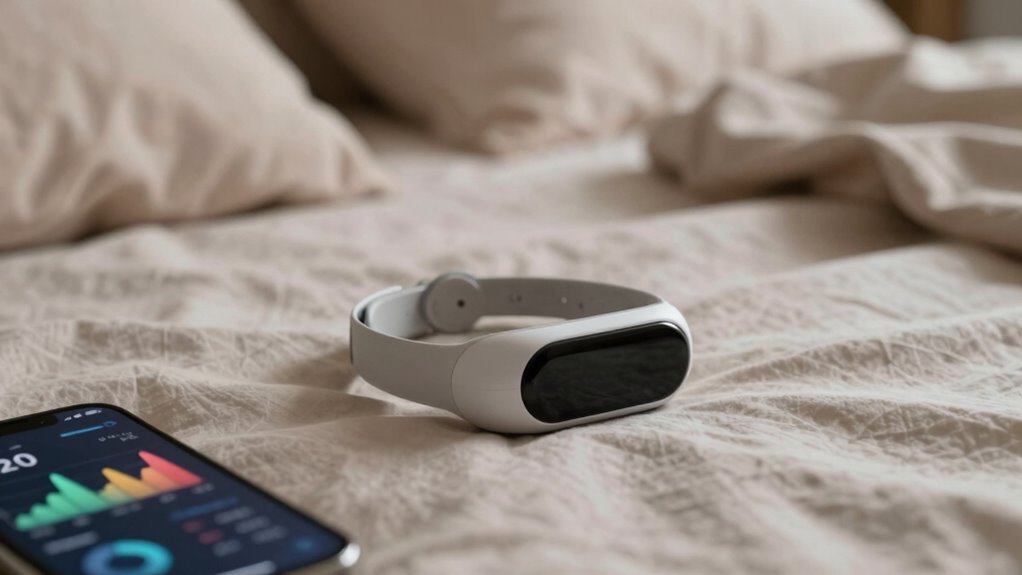

Sleep trackers can give you a general idea of your sleep patterns, but they can’t accurately measure your sleep cycle details or account for environmental factors like noise, temperature, or lighting that affect your rest. They rely on movement and heart rate data, which can misinterpret restlessness or stillness. If you want a clearer picture of your sleep quality, you need to contemplate their limitations and explore what else influences your sleep. Keep going to learn more about what these devices can’t tell you.
Key Takeaways
- Sleep trackers cannot accurately measure sleep cycle dynamics or differentiate subtle changes in sleep architecture.
- They fail to assess external environmental factors like temperature, noise, and lighting that impact sleep quality.
- Movement data alone can misrepresent sleep efficiency, as stillness or restlessness may be misclassified.
- Devices do not provide insights into the physiological processes underpinning restorative sleep.
- Relying solely on trackers can lead to false conclusions; professional assessment offers more precise sleep insights.
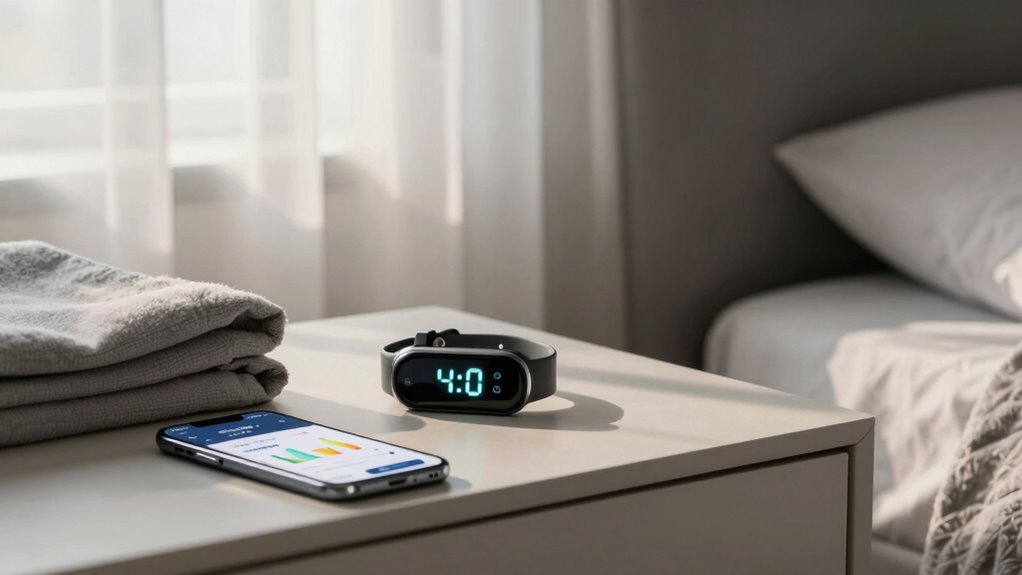
Have you ever wondered how well you’re actually sleeping each night? Many people turn to sleep trackers, hoping to get a clear picture of their sleep quality. These devices often claim to provide detailed insights into your sleep patterns, but they can’t measure everything that affects how well you rest. One key aspect they miss is sleep cycle dynamics—the natural progression through different sleep stages like light sleep, deep sleep, and REM. While trackers can estimate when you’re in REM or deep sleep based on movements or heart rate, they lack the precision of clinical tools like polysomnography. As a result, they can misinterpret subtle shifts in sleep architecture, leading you to believe your sleep is better or worse than it truly is.
Sleep trackers miss sleep cycle details, offering only rough estimates rather than precise insights.
Another factor that sleep trackers don’t fully grasp is sleep environment factors. Your bedroom’s temperature, noise levels, lighting, and even your bedding play a vital role in how easily you fall asleep and how restorative your sleep is. If you’re sleeping in a room that’s too warm or too bright, you might wake up feeling tired, but your tracker won’t be able to identify these environmental issues. It simply records your movements and heart rate, missing the external influences that could be disrupting your sleep. Even if your device reports that you got a solid amount of sleep, it doesn’t tell you whether your environment was conducive to restful sleep.
Furthermore, sleep trackers tend to rely heavily on movement data, assuming that less movement equals better sleep. However, this isn’t always true. Some people are very still even when awake or restless during sleep without much movement, making it easy to misjudge sleep quality. Conversely, tossing and turning might be recorded as wakefulness, even if you’re merely adjusting positions. This means the data can be misleading, giving you a skewed view of your sleep efficiency.
In addition, sleep trackers are limited in their ability to monitor sleep cycle dynamics, which are crucial for restorative sleep. They don’t measure the complex physiological processes behind sleep—like sleep cycle dynamics—and they overlook external environmental factors that profoundly influence sleep quality. Relying solely on a device’s data might lead you to false conclusions about your sleep health. For a more accurate assessment, consider consulting a sleep specialist or conducting a detailed sleep study, especially if you suspect underlying issues. Remember, these devices are helpful tools, but they don’t tell the whole story of your nightly rest.
sleep environment thermometer
As an affiliate, we earn on qualifying purchases.
As an affiliate, we earn on qualifying purchases.
Frequently Asked Questions
Can Sleep Trackers Diagnose Sleep Disorders?
Sleep trackers can’t diagnose sleep disorders. While they provide useful data, they lack the medical accuracy needed for clinical diagnosis. You shouldn’t rely solely on them to identify issues like sleep apnea or insomnia. Instead, if you suspect a sleep disorder, see a healthcare professional who can perform proper tests and offer a definitive diagnosis. Sleep trackers are helpful tools, but they’re not substitutes for medical expertise.
Do Sleep Trackers Accurately Measure Sleep Stages?
They say “trust, but verify,” and that’s true for sleep trackers. While they attempt to measure sleep stages, their accuracy in sleep architecture and sleep cycle detection isn’t perfect. They use movement and heart rate data, but these signals can be misleading, so your device might not always accurately reflect your actual sleep stages. Don’t rely solely on them—use them as a guide, not a definitive answer.
Are Sleep Trackers Suitable for Children or Elderly?
Sleep trackers can be suitable for children and the elderly, especially for monitoring sleep patterns and guaranteeing overall health. However, you should prioritize child safety by choosing devices with secure straps and non-toxic materials. For elderly monitoring, select trackers that offer reliable data without compromising comfort or privacy. Always check device features and consult healthcare professionals to ensure it meets safety standards and your loved ones’ specific needs.
How Do Sleep Trackers Affect Sleep Quality?
They say “you are what you eat,” but sleep trackers show how your sleep environment and user behavior influence quality. Using one can motivate you to improve habits, like maintaining a consistent schedule or optimizing your room’s darkness and noise. However, they might cause stress if you obsess over metrics. Ultimately, they can enhance your sleep by encouraging better choices, but don’t let data overshadow listening to your body’s natural signals.
Can Sleep Trackers Predict Future Sleep Problems?
Sleep trackers can’t predict future sleep problems directly. They monitor your current sleep quality and duration, giving you insights into patterns. However, they don’t diagnose or forecast issues like insomnia or sleep disorders. If your tracker shows poor sleep consistently, it signals you should consult a healthcare professional. Use the data as a tool to improve your sleep habits, but don’t rely solely on it to predict future sleep problems.
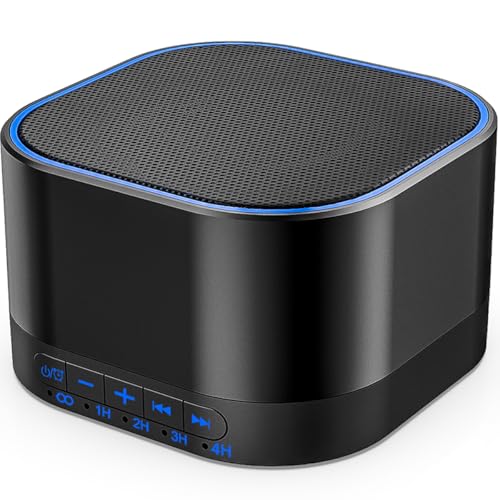
Magicteam Sound White Noise Machine with 20 Non Looping Natural Soothing Sounds and Memory Function 32 Levels of Volume Powered by AC or USB and Sleep Sound Timer Therapy for Baby Kids Adults
❤20 Non-Looping Sleep Sounds: White noise ,Brown noise, pink noise, blue noise, fan,brook, rain, ocean,bird and Bonfire,suitable for…
As an affiliate, we earn on qualifying purchases.
As an affiliate, we earn on qualifying purchases.
Conclusion
While sleep trackers can offer helpful insights, they can’t measure everything accurately—like sleep quality or underlying issues. Many people assume these devices give a complete picture, but studies show they can misclassify sleep stages up to 30% of the time. So, don’t rely solely on your tracker for health decisions. Use it as a guide, but trust your body’s signals and consult a professional for real sleep concerns. After all, your sleep is more than just data.
light blocking sleep mask
As an affiliate, we earn on qualifying purchases.
As an affiliate, we earn on qualifying purchases.
bedroom temperature control device
As an affiliate, we earn on qualifying purchases.
As an affiliate, we earn on qualifying purchases.