
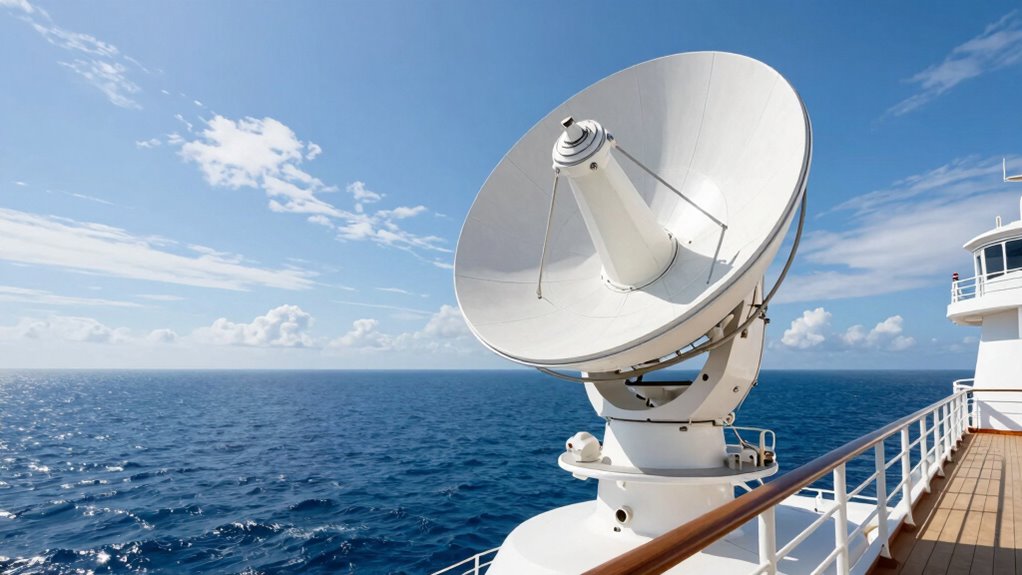

Your internet changes mid-cruise because traditional satellite systems struggle with inconsistent coverage, high latency, and signal drops due to changing sea conditions. Starlink at Sea uses a constellation of low Earth orbit satellites that dynamically adjust to your vessel’s location and movement. This keeps your connection stable and fast, even far from land. If you want to understand how Starlink maintains reliable connectivity at sea, there’s more to discover.
Key Takeaways
- Satellite handovers occur as the vessel moves between different satellite coverage areas, causing temporary connection changes.
- Sea conditions and vessel movement can influence satellite signal strength, leading to fluctuations in internet quality.
- Dynamic network adjustments optimize connectivity, which may result in periodic shifts in internet performance during a cruise.
- Starlink’s low Earth orbit satellites regularly reposition to maintain coverage, impacting the connection momentarily.
- Environmental factors like weather and obstacles can interfere with signal stability, causing your internet to change mid-cruise.

For sailors and maritime travelers, reliable internet has long been a challenge. You’ve likely experienced the frustration of losing connection mid-cruise or struggling to access essential information while out at sea. Traditional satellite communications often fall short due to limited bandwidth, high latency, and inconsistent coverage, making maritime connectivity a persistent concern. As a result, staying connected during your voyage can feel like a constant battle against the elements and the limitations of older technologies.
Enter Starlink at Sea, a game-changer designed specifically for maritime environments. This satellite-based internet system leverages a constellation of low Earth orbit satellites, providing faster, more reliable connectivity even when you’re far from land. Unlike conventional satellite systems that rely on high-altitude satellites with larger footprints and higher latency, Starlink’s low orbit satellites deliver high-speed internet with remarkably low latency, making streaming, video calls, and navigation updates seamless. This innovation means your onboard experience dramatically improves, and you can stay in touch with the world or access critical maritime information without interruption.
One of the key advantages of Starlink at Sea is its ability to enhance maritime connectivity across the entire vessel. Whether you’re cruising along remote coastlines or venturing into open ocean, you’ll notice a consistent, stable connection. This stability is essential for real-time communications, weather updates, and even satellite navigation systems that depend on reliable data links. Satellite navigation, in particular, benefits from this improved connectivity because it ensures your GPS signals are accurate and up-to-date, reducing the risk of errors or delays that could compromise safety or navigation precision.
The unpredictable nature of the sea can cause traditional satellite signals to fluctuate or drop altogether, but Starlink’s network adapts dynamically to changing conditions. This means fewer dropped signals and fewer moments of complete disconnection, which are indispensable for safety and operational efficiency. As a sailor, you’ll appreciate how this technology minimizes the frustration of losing internet just when you need it most, like during critical navigation or communication with port authorities.
In essence, Starlink at Sea transforms your experience by bridging the gap between land-based internet speeds and the challenges of maritime environments. It ensures your vessel stays connected, your satellite navigation remains accurate, and your overall maritime connectivity is more robust than ever before. With these advancements, the sea no longer means isolation—you’re empowered with reliable, high-speed internet that keeps you informed, safe, and connected no matter where your journey takes you.

Starlink Gen 3 Standard Satellite Internet Kit – Dish with Wi-Fi 6 Router + Extra 150FT Cable – High-Speed, Low-Latency Internet for Rural and Remote Homes
Next-Generation Satellite Internet Kit – Gen 3 satellite dish and Wi-Fi 6 router deliver faster speeds, stronger signal…
As an affiliate, we earn on qualifying purchases.
As an affiliate, we earn on qualifying purchases.
Frequently Asked Questions
How Does Starlink Maintain Connectivity During Rough Ocean Conditions?
Starlink maintains connectivity during rough ocean conditions through antenna stabilization, which keeps the dish steady despite movement. When the ship shifts or tilts, the system performs signal handoff seamlessly between satellites, ensuring your internet stays connected. This combination of stabilized antennas and smart handoff technology helps you enjoy continuous internet access, even in choppy waters. You can stay connected and productive without interruptions, no matter how rough the sea gets.
Can Starlink Be Used on Smaller Boats or Only Large Ships?
Yes, you can use Starlink on a small boat, but it requires a compact satellite dish designed for limited space. These smaller dishes are portable and easier to install, making them ideal for small boats. Keep in mind, the signal might be less stable in rough weather or when the boat moves considerably. Still, with the right equipment, you’ll enjoy high-speed internet even on your small vessel.
What Is the Latency Like When Using Starlink at Sea?
When using Starlink at sea, you’ll notice satellite latency that’s like a quick ripple across a calm pond—generally around 20 to 40 milliseconds. This internet delay is much lower than traditional satellite systems, giving you smoother video calls and faster browsing. While it’s not as instant as fiber, it’s a significant leap forward, making your maritime experience feel more like land-based surfing than a distant echo across the waves.
Are There Any Special Costs or Subscriptions for Maritime Starlink Service?
You’ll need a maritime subscription for Starlink at sea, which covers the specialized service costs. This subscription is different from the standard one and is tailored for maritime environments, often involving higher costs due to the equipment and connectivity demands. The service costs vary depending on your vessel size and data needs, so it’s best to check with Starlink directly to get an accurate quote.
How Does Starlink Handle Signal Interference From Weather or Obstacles?
Starlink handles signal interference from weather or obstacles by automatically adjusting antenna alignment to maintain a strong connection. When weather causes signal degradation, the system detects it and recalibrates to optimize signal strength. Obstacles like ships or structures can temporarily disrupt service, but Starlink’s technology works to minimize impact by quickly readjusting, ensuring your internet remains as stable as possible despite adverse conditions.

Starlink Mini Kit – Portable Satellite Internet System with Built-in WiFi Router, Compact Travel Dish, High-Speed Low-Latency Internet for RV, Camping, Remote Work & Off-Grid Use
Compact portable satellite internet kit, and Works in rural and hard-to-reach areas
As an affiliate, we earn on qualifying purchases.
As an affiliate, we earn on qualifying purchases.
Conclusion
As you sail across the ocean, remember that Starlink at Sea connects you to the world, even amid the vast blue. Did you know that Starlink can provide internet speeds up to 150 Mbps? That’s enough to stream your favorite show or join a video call from hundreds of miles offshore. So, next time your connection flickers, think of the technology working tirelessly to keep you connected, no matter where your voyage takes you.
low Earth orbit satellite router for boats
As an affiliate, we earn on qualifying purchases.
As an affiliate, we earn on qualifying purchases.

Arridioter VHF Marine Radio Antenna Boat Fiberglass Antenna Waterproof 156-163MHz 43.5in with 22.9ft/7m RG58 Cable,PL259 Adapter,Adjustable Ratchet Fixed Mount Base Compatible for Cobra Uniden
FREQUENCY RANGE: Operates in the marine VHF band of 156-163 MHz, perfect for ship-to-ship and ship-to-shore communications
As an affiliate, we earn on qualifying purchases.
As an affiliate, we earn on qualifying purchases.