
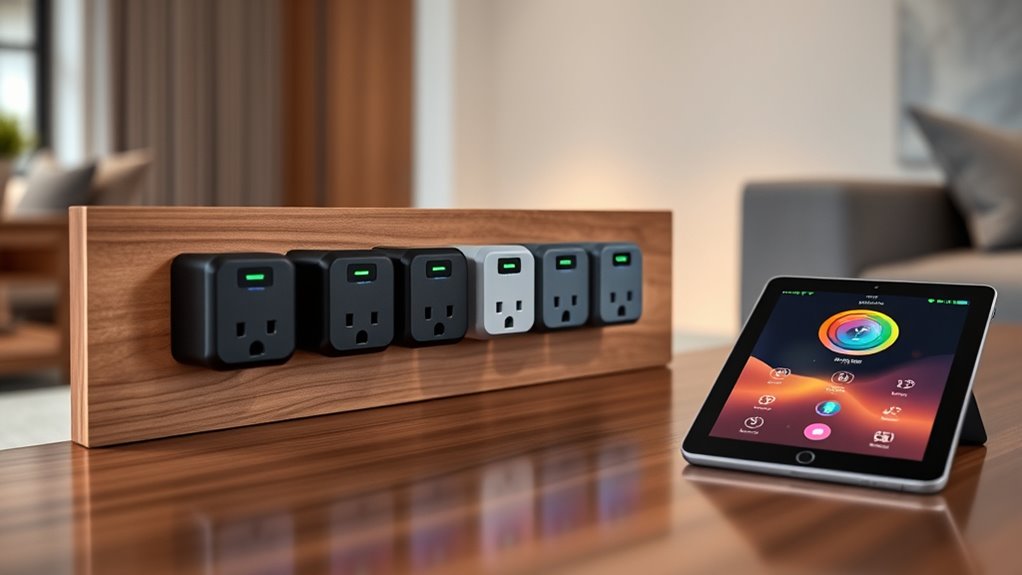

If you want to cut wasted electricity, premium smart plugs with energy monitoring are the easiest place to start, but the gap between the best and the rest is wider than most buyers expect. The TP-Link Tapo P115 earns my best overall pick for combining accurate energy tracking with a mature app, reliable scheduling, and a four-pack price that undercuts pricier rivals. For a whole-home approach, the Emporia Super Bundle pairs a 16-sensor panel monitor with four plugs, giving you circuit-level data no single plug can match. The main tradeoff in this category is between platform polish and hardware flexibility: Matter-certified plugs like the Eve Energy and Kasa KP125MP4 future-proof your setup but sometimes sacrifice reporting depth, while ZigBee options like the THIRDREALITY require a hub yet extend your mesh network for free. Keep reading for the full breakdown of all twelve models.

Get travel and outdoor gear delivered free with Prime
- Fast, free delivery on millions of items
- Prime Video, Amazon Music and more included
- Member-only deals all year
Complete the kit



Key Takeaways
- Matter compatibility was the single biggest differentiator in 2026: plugs like the Kasa KP125MP4, Tapo P110M, Eve Energy, and SONOFF S61s support the standard natively, while Wi-Fi-only models like the Tapo P115 and AiSeek offer richer historical energy data in exchange for platform lock-in.
- The Emporia Super Bundle is the only option here that measures energy beyond the outlet itself — its 16 clamp sensors capture whole-home and circuit-level usage, making every other pick better suited to appliance-level tracking only.
- In-wall options (the ELEGRP 6-pack) trade portability for a cleaner installation and tamper-resistant design, which matters more for landlords and permanent installs than for renters.
- The Power Pal is an outlier: it monitors power and outages rather than functioning as a full smart plug, so it belongs on a shopping list only if outage alerts are the priority, not automation.
- App quality varied more than hardware quality — TP-Link‘s Kasa/Tapo ecosystem and Eve’s app offered the most usable energy dashboards, while budget four-packs from AiSeek and SONOFF delivered solid hardware with clunkier reporting.






| premium smart plugs with energy monitoring | Connectivity | Quantity |
|---|---|---|
| GE Cync Smart Plug | Wi-Fi | 3-pack |
| ELEGRP Smart In-Wall Outlet wi | Wi-Fi, 2.4GHz | 6-pack |
| Tapo P110M Smart Plug | — | 4-pack |
| THIRDREALITY ZigBee Smart Plug | — | 4-pack |
| AiSeek Smart Plug with Energy | 2.4GHz Wi-Fi | 4-pack |
| Eve Energy | Thread, Matter | — |
| TP-Link Tapo P115 Smart Wi-Fi | Wi-Fi (2.4 GHz) | — |
| Emporia Energy Monitor with 16 | Wi-Fi | — |
| Kasa Matter Smart Plug with En | — | — |
| Emporia Energy Monitoring Smar | 2.4 GHz Wi-Fi | — |
| SONOFF S61s Matter Smart Plug | Matter over Wi-Fi (2.4GHz) | 4-pack |
| Power Pal Power Outage Monitor | Wi-Fi | — |
More Details on Our Top Picks
GE Cync Smart Plug (3 Pack), WiFi Smart Outlet with Matter Compatibility
The GE Cync 3-pack suits buyers who want Matter compatibility and plugs that leave the neighboring outlet open. It works with Apple Home, Alexa, Google Assistant, and SmartThings, giving it broader stated platform coverage than the AiSeek Smart Plug, which lists Alexa and Google only. Scheduling, scenes, and out-of-home app control add useful ways to manage lamps and small appliances. The key gap for this roundup is that the supplied product details do not specify energy monitoring, so I can’t rank it alongside plugs with confirmed usage tracking as a monitoring pick. It also relies on Wi-Fi and the Cync app for full setup and schedules. Choose it for a slim, flexible smart home accessory; skip it if measured energy data is the reason you’re shopping.
Pros:- Matter support across Apple Home, Alexa, Google Assistant, and SmartThings
- Slim design leaves the second wall outlet available
- App scheduling, scenes, and remote control
- Built-in Wi-Fi enables out-of-home control without a separate hub
Cons:- Provided product details do not confirm energy monitoring
- Full setup and scheduling rely on the Cync app
- Wi-Fi control depends on a stable network
Best for: Smart home owners who need slim plugs with Matter support across Apple Home, Alexa, Google Assistant, and SmartThings
Not ideal for: Buyers who need confirmed per-plug energy readings to track appliance consumption
- Quantity:3-pack
- Connectivity:Wi-Fi
- Protocol:Matter
- Compatible platforms:Amazon Alexa, Google Assistant, Samsung SmartThings, Apple Home
- Control:App, voice, and remote
- App features:Scheduling and scene setting
- Design:Slim; keeps the second wall outlet available
Our verdict“Choose the GE Cync if broad Matter support and a slim profile matter more to you than confirmed energy monitoring.”
ELEGRP Smart In-Wall Outlet with Energy Monitoring, Alexa & Google Assistant Compatible, UL Listed, White, 6 Pack
The ELEGRP is the lineup’s fixed-install option: each receptacle provides two independently controlled sockets and built-in energy monitoring, while the six-pack can cover multiple rooms in one wiring project. Compared with the plug-in Tapo P110M, it frees wall outlets from bulky adapters and makes control part of the receptacle itself. That permanence is also the tradeoff: installation involves wiring, so renters and anyone seeking a quick setup should look elsewhere. Its Wi-Fi connection is limited to 2.4GHz, and voice support is listed for Alexa and Google Assistant rather than the wider Matter ecosystem supported by Tapo. UL, cUL, and CSA certifications, fire-resistant materials, and surge protection suit buyers prioritizing a built-in upgrade, but this choice makes less sense if flexibility is more valuable than a clean installed finish.
Pros:- Two independently controllable sockets per receptacle
- Built-in energy monitoring
- UL, cUL, and CSA certifications, with fire-resistant materials and surge protection
- Six-pack supports a multi-room installation
Cons:- In-wall wiring makes installation more involved than using plug-in smart outlets
- Requires a 2.4GHz Wi-Fi network
- Listed voice assistant support is limited to Alexa and Google Assistant
Best for: Homeowners planning a wired upgrade across several rooms who want two separately monitored and controlled sockets at each location
Not ideal for: Renters or buyers who need a plug-in device, Matter support, or compatibility beyond Alexa and Google Assistant
- Quantity:6-pack
- Outlets per receptacle:2 independently controlled sockets
- Connectivity:Wi-Fi, 2.4GHz
- Energy monitoring:Built-in
- Compatible assistants:Amazon Alexa, Google Assistant
- Hub required:No
- Certifications:UL, cUL, CSA
- Material:Brass and polycarbonate
Our verdict“Pick the ELEGRP for a multi-room wired upgrade with monitored sockets, provided you’re comfortable with installation and its narrower platform support.”
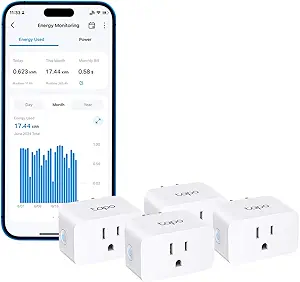
Tapo P110M Smart Plug (4-Pack), Matter Compatible, Energy Monitoring, 15A
The Tapo P110M earns my top spot among these five because it combines confirmed energy monitoring, a 15A rating, and Matter support across the major platforms listed. Its real-time readings, usage statistics, and bill estimates help turn monitoring into a practical way to spot power-hungry devices; scheduling can shift operation to off-peak periods. Compared with the THIRDREALITY ZigBee Smart Plug, it doesn’t require a ZigBee hub, though full Matter functionality does call for a compatible hub or platform. The four-pack is a flexible plug-in solution, unlike the ELEGRP’s permanent in-wall installation. Overcharge prevention and overcurrent protection add another layer of utility. One caveat: bill estimates depend on billing integration, so treat them as estimates rather than guaranteed cost totals.
Pros:- Matter-certified support for major smart home platforms
- Real-time monitoring, usage statistics, and bill estimates
- 15A maximum current rating
- Overcharge prevention and overcurrent protection
Cons:- Full Matter functionality requires a compatible hub or platform
- Bill estimates depend on integration with billing systems
Best for: Households using Apple Home, Alexa, Google Home, or SmartThings that want monitored plug-in outlets and Matter flexibility
Not ideal for: Buyers who want monitoring estimates without platform setup or who need to avoid a compatible Matter hub
- Model:P110M
- Quantity:4-pack
- Protocol:Matter-certified
- Maximum current:15A
- Compatible platforms:Amazon Alexa, Apple HomeKit, Google Home, Samsung SmartThings
- Energy features:Monitoring, usage statistics, and bill estimates
- Safety features:Overcharge prevention and overcurrent protection
- App:Tapo
Our verdict“Choose the Tapo P110M for the strongest balance here of confirmed energy tracking, Matter support, and plug-in convenience.”
THIRDREALITY ZigBee Smart Plug 4-Pack with Real-Time Energy Monitoring, 15A Outlet & ZigBee Repeater
The THIRDREALITY set does more than switch appliances: each 15A plug also acts as a ZigBee repeater, so it can help extend a compatible network while reporting real-time energy use. That makes it a better fit for an established ZigBee home than the Wi-Fi-based AiSeek Smart Plug, especially where network reach matters. The compact body is designed not to block adjacent outlets, and customizable power restoration states give users more control after an outage. The tradeoff is platform dependence: a ZigBee hub is required, and monitoring and safety settings work only with select hubs. It won’t suit a Wi-Fi-only household or an Echo without a built-in ZigBee hub. Buyers choosing between this and the Matter-ready Tapo P110M should favor THIRDREALITY for repeater value, not broad plug-and-play platform reach.
Pros:- Real-time energy monitoring
- Built-in ZigBee repeater can extend network range
- 15A rating and space-saving design
- Customizable power restoration states and ETL certification
Cons:- Requires a compatible ZigBee hub and does not work standalone
- Monitoring and safety settings depend on select hubs
- Not suited to Wi-Fi-only setups or Echo devices without ZigBee hubs
Best for: Smart home owners with a compatible ZigBee hub who want energy readings and better network reach from their plug locations
Not ideal for: Wi-Fi-only households or buyers without a supported ZigBee hub
- Quantity:4-pack
- Protocol:ZigBee 3.0
- Maximum current:15A
- Energy monitoring:Real-time
- Hub required:Yes
- Repeater:Built-in ZigBee repeater
- Certification:ETL
- Compatible hubs:Echo with built-in ZigBee, Home Assistant, SmartThings, Aeotec, Hubitat, Homey, Third Reality Hub
Our verdict“Choose THIRDREALITY if your home already runs ZigBee and you can use the repeater function alongside energy monitoring.”
AiSeek Smart Plug with Energy Monitoring, 15A, 2.4GHz Wi-Fi, 4-Pack
AiSeek is the straightforward Wi-Fi choice for buyers who want four monitored 15A outlets without adding a hub. Its SmartLife app supports scheduling, timers, and group control, while Alexa and Google Assistant provide voice access. Compared with the Tapo P110M, it omits Matter and lists fewer platforms, but it keeps the setup centered on 2.4GHz Wi-Fi and SmartLife. Short-circuit and overload protection and a compact design round out the essentials. Its place in a premium roundup is narrower: the supplied details list FCC certification but give no extra networking role or cross-platform Matter option like Tapo or THIRDREALITY’s ZigBee repeater. Choose it for a simple multi-plug monitoring setup; skip it if you need 5GHz Wi-Fi, broader ecosystem support, or want to avoid linking through SmartLife.
Pros:- Four-plug set with real-time energy monitoring
- No hub required
- 15A maximum current and 1800W maximum power
- Scheduling, timers, group control, and overload protection
Cons:- Works on 2.4GHz Wi-Fi only
- Requires the SmartLife app and its Alexa linking flow
- Lists Alexa and Google Assistant compatibility but not Matter support
Best for: Alexa or Google Assistant households seeking four app-controlled, monitored plugs without a separate hub
Not ideal for: Buyers who need Matter, 5GHz Wi-Fi, a direct Alexa connection, or an alternative to the SmartLife app
- Quantity:4-pack
- Maximum current:15A
- Maximum power:1800W
- Connectivity:2.4GHz Wi-Fi
- Hub required:No
- App:SmartLife
- Compatible assistants:Amazon Alexa, Google Assistant
- Certification:FCC
Our verdict“Pick AiSeek for hub-free Wi-Fi monitoring across four outlets if SmartLife and 2.4GHz are a fit for your home.”
Eve Energy (Matter) 2-Pack – Smart Plug & Power Meter
Where most plugs in this roundup lean on cloud servers, the Eve Energy flips the script entirely: no cloud, no registration, no tracking. Every command and every watt measured stays on your local network, which matters if you’re uneasy about your energy habits living on someone else’s server. Its Thread radio also gives it a responsiveness edge over Wi-Fi plugs like the Tapo P115, since Thread devices mesh together rather than competing for router bandwidth. Power metering is accurate and feeds into presence-based automations — turn things off when you leave, on when you return. The tradeoff is structure: you need a compatible hub (HomePod mini, Echo 4th gen, Nest Hub, or similar) for Thread to work, and only two plugs come in the box versus four in similarly priced competing packs. This pick makes the most sense for buyers already invested in a Matter ecosystem who value privacy over per-plug value.
Pros:- 100% local operation with no cloud account or tracking
- Thread networking for a stable, self-healing mesh connection
- Cross-platform Matter support across all four major ecosystems
- Presence-based automation plus accurate power metering
Cons:- Requires a Thread/Matter-compatible hub for each platform you use
- Only two plugs per pack — higher cost per outlet than 4-pack rivals
Best for: Apple Home or SmartThings users who want local, private control and already own a Thread-capable hub
Not ideal for: Buyers without any smart home hub, or anyone wanting maximum plugs per dollar — the 2-pack is thin compared to 4-packs like the Kasa KP125MP4
- Pack Size:2 plugs
- Connectivity:Thread, Matter
- Compatibility:Apple Home, Alexa, Google Home, SmartThings
- Required Hub:Apple TV 4K, HomePod mini, SmartThings Hub v3, Echo (4th gen), or Nest Hub
- Required OS:iOS/iPadOS 16.4+ or Android 8.1+
- Certification:UL-certified
- Features:Voice control, remote control, presence automation, power metering
Our verdict“Choose Eve Energy if privacy and Thread reliability are your priorities and you already have the hub to support them.”
TP-Link Tapo P115 Smart Wi-Fi Plug with Energy Monitoring, 4-Pack, 15A
If the Eve Energy is the privacy purist’s pick, the Tapo P115 is the pragmatist’s. You get four 15A plugs for roughly what premium two-packs cost, each with genuinely useful energy tools: consumption stats, visual charts, and scheduling that lets you shift loads to off-peak hours. Two safety features separate it from cheaper options like the AiSeek 4-pack — smart charging limits that protect batteries on devices left plugged in, and automatic overload shutoff that cuts power before a circuit gets stressed. Setup over Wi-Fi is straightforward with no hub needed, which is one less box on the shelf compared to Thread-based rivals. The compromises are modest but real: it lacks Matter support, so platform switching later means re-pairing everything, and translating raw energy data into dollar figures requires hooking it into your billing setup rather than working out of the box. For most households, that’s a fair exchange for the price.
Pros:- Four full 15A plugs at a strong per-plug price
- Energy statistics and charts with off-peak scheduling
- Smart charging limits and automatic overload shutoff
- Simple hub-free Wi-Fi setup with Alexa and Google voice control
Cons:- No Matter support, limiting future platform flexibility
- Energy cost estimates require billing-system integration rather than native dollar tracking
Best for: Budget-conscious households outfitting multiple rooms who want full 15A capacity and safety features without buying a hub
Not ideal for: Buyers deep in Apple Home or planning to switch ecosystems — no Matter support means less flexibility than the Kasa KP125MP4
- Model:Tapo P115
- Pack Size:4 plugs
- Connectivity:Wi-Fi (2.4 GHz)
- Energy Monitoring:Yes, with statistics and charts
- Voice Assistants:Amazon Alexa, Google Assistant
- Max Load:15A
- Safety Features:Smart charging limits, automatic overload shutoff
Our verdict“The P115 4-pack is the smart buy when you need coverage of several outlets and solid monitoring without hub overhead.”
Emporia Energy Monitor with 16 Sensors + 4 Smart Plugs Super Bundle
This bundle isn’t really competing with the other plugs here — it’s playing a different game entirely. Alongside four smart plugs, you get the Emporia Vue monitor with 16 circuit sensors, which clips into your electrical panel and delivers second-by-second data on your entire home, circuit by circuit. Where the Tapo P115 or Kasa KP125MP4 only tell you what’s happening at individual outlets, the Vue reveals the HVAC draw, the water heater, the dryer — the big energy consumers no plug can ever reach. Solar owners get net metering support, a feature nothing else in this roundup offers. The tradeoffs are real: installation means opening your main panel, which many buyers will (and should) hand to an electrician, and the system depends on a cloud account and Wi-Fi for full functionality — the opposite philosophy of the locally-run Eve Energy. Think of the plugs here as a bonus layer of control on top of a serious monitoring platform.
Pros:- Whole-home monitoring with up to 16 individual circuit sensors
- Second-by-second real-time data with free cloud storage
- Solar net metering support for tracking production and draw
- Four included smart plugs add remote control and scheduling
Cons:- Panel installation typically requires an electrician
- Cloud account and Wi-Fi connection required for full functionality
Best for: Homeowners with high electric bills or solar installations who want circuit-level visibility into their entire home, not just individual outlets
Not ideal for: Renters and apartment dwellers — panel sensor installation isn’t feasible, and a plug-only 4-pack like the Emporia standalone set covers the same basics for far less
- Circuit Sensors:16
- Smart Plugs Included:4
- Connectivity:Wi-Fi
- Compatibility:iOS, Android, Alexa, solar systems
- Real-Time Monitoring:Yes, second-by-second
- Data Storage:Cloud, free app access
- Solar Net Metering:Supported
Our verdict“Buy this if you’re serious about understanding your home’s total energy picture; skip it if you just need a few monitored outlets.”
Kasa Matter Smart Plug with Energy Monitoring (KP125MP4)
The Kasa KP125MP4 hits the sweet spot nearly every buyer actually needs. It carries Matter certification across Apple Home, Alexa, Google Home, and SmartThings like the Eve Energy, but comes in a four-pack instead of two and runs over your existing network without demanding Thread infrastructure. Its standout trick is LAN-based control that keeps working when your internet drops — a reliability feature the cloud-dependent Tapo P115 can’t match, and one you’ll appreciate the first time your ISP has a bad night. Real-time energy monitoring is built in, and the compact, UL-certified flame-retardant housing leaves adjacent outlets usable, unlike chunkier designs. A 2-year warranty rounds out the package. It isn’t flawless: full functionality requires a Matter-compatible hub or controller, so it’s not a pure plug-and-play affair for first-time smart home dabblers. Still, balancing platform freedom, offline resilience, safety certification, and per-plug value, this is the pick I’d point most people toward first.
Pros:- Matter-certified across Apple Home, Alexa, Google Home, and SmartThings
- LAN control keeps working during internet outages
- Compact UL-certified flame-retardant body doesn’t block adjacent outlets
- Four-pack with 2-year limited warranty
Cons:- Requires a Matter-compatible hub or controller for full functionality
- No Thread radio, so it lacks the mesh redundancy of the Eve Energy
Best for: Multi-platform households who want Matter flexibility, offline reliability, and a full 4-pack without the premium pricing of boutique brands
Not ideal for: Complete beginners with no smart home hub or controller — Matter setup will be a hurdle the simpler Tapo P115 avoids
- Model:KP125MP4
- Pack Size:4 plugs
- Max Load:15A / 1800W
- Protocol:Matter
- Compatible Platforms:Apple Home, Amazon Alexa, Google Home, Samsung SmartThings
- Energy Monitoring:Yes, real-time
- Certification:UL certified, flame retardant
- Warranty:2-year limited
Our verdict“If you want one purchase that balances ecosystem flexibility, safety, and offline dependability at a sensible per-plug price, this is it.”
Emporia Energy Monitoring Smart Plug, 4-Pack
Think of the Emporia 4-pack as the on-ramp to energy monitoring: four plugs, app control, scheduling, and Alexa and Google voice support at the most accessible entry point in this lineup. Compared with the Tapo P115, it covers the same monitoring and scheduling basics but trims the extras — no overload shutoff, no smart charging — to keep costs down. It also pairs naturally with the full Emporia Vue system if you later want whole-home monitoring, sharing one app and one ecosystem, which the Tapo and Kasa options can’t offer. The key limitation is capacity: a 10A continuous limit (1200W) means high-draw appliances like space heaters, kettles, or hair dryers are off the menu, where the 15A Kasa KP125MP4 handles them easily. And with 2.4 GHz-only Wi-Fi, owners of mesh networks that unify bands may hit pairing friction. For lamps, chargers, media gear, and small appliances, though, it does the core job cleanly.
Pros:- Four monitored plugs at the lowest entry cost in the lineup
- App, voice, touch, and push-button control options
- Scheduling for automatic on/off routines
- Integrates with the larger Emporia Vue ecosystem via one shared app
Cons:- 10A continuous / 1200W maximum — can’t handle high-wattage appliances
- 2.4 GHz Wi-Fi only, which can complicate setup on unified-band mesh networks
Best for: First-time smart home buyers who want low-cost energy monitoring for lamps, chargers, and small electronics — especially those eyeing the Emporia ecosystem later
Not ideal for: Anyone running space heaters, air conditioners, or other 1200W+ appliances — the 10A continuous cap is a hard ceiling
- Pack Size:4 plugs
- Operating Voltage:120V
- Max Continuous Current:10A
- Max Peak Current:15A (up to 1 hour/day)
- Max Wattage:1200W
- Connectivity:2.4 GHz Wi-Fi
- Control Methods:App, remote, touch, voice, push button
- Voice Assistants:Amazon Alexa, Google Assistant
Our verdict“A sensible, low-commitment way to start tracking energy on light-load devices, as long as you keep heavy appliances away from it.”
SONOFF S61s Matter Smart Plug 15A Wi-Fi Outlet with Energy Monitoring (4-Pack)
The SONOFF S61s makes the most sense for buyers who want four monitored outlets that can join different smart home ecosystems. Matter over Wi-Fi supports Apple Home, Alexa, Google Home, and SmartThings, while the eWeLink app adds real-time usage and electricity cost tracking. Compared with the Tapo P110M, it offers a similar hub-free Matter approach, but the SONOFF’s listed safety features include overload protection and fire-resistant housing. Its 15A rating suits many everyday appliances, though it does not make the plug appropriate for every high-draw device. Setup also depends on 2.4GHz Wi-Fi, so homes relying on 5GHz-only networks will need another option. I’d choose it for broad compatibility and a multi-room rollout, while buyers who need Zigbee or a dedicated energy-monitoring system should compare other picks in this roundup.
Pros:- Matter support works with Apple Home, Alexa, Google Home, and SmartThings.
- Tracks real-time power use and electricity cost.
- Overload protection and fire-resistant housing are listed safety features.
- Four plugs support a broader room-by-room setup.
Cons:- Works only on 2.4GHz Wi-Fi.
- The 15A, 1875W ceiling rules out some high-power appliances.
Best for: Smart home owners using Apple Home, Alexa, Google Home, or SmartThings who want to monitor several everyday appliances across rooms.
Not ideal for: Households with only 5GHz Wi-Fi or buyers planning to control appliances that exceed the plug’s 15A, 1875W limit.
- Connectivity:Matter over Wi-Fi (2.4GHz)
- Voltage:120 volts
- Maximum power:1875 watts
- Control:App, physical, and remote control
- Compatible platforms:Apple Home, Alexa, Google Home, SmartThings, eWeLink
- Energy monitoring:Real-time usage and electricity cost tracking
- Safety certification:ETL Listed
- Quantity:4-pack
Our verdict“Choose the SONOFF S61s if you want a four-plug Matter setup with energy and cost tracking across major smart home ecosystems.”
Power Pal Power Outage Monitor with Text and Email Notifications
Power Pal is the lineup’s outlier: it monitors whether power is present and sends text or email outage alerts, rather than measuring the energy use of appliances plugged into it. That makes it useful for owners who need to know when power fails at a second home or another location, even with no device connected. By comparison, the SONOFF S61s is the better fit for tracking appliance consumption and automating a smart home; Power Pal focuses on notifying you about an outage. Basic setup needs a standard outlet and does not require an app or notification fees, but its connectivity features still depend on 2.4GHz Wi-Fi. Some smart home and cloud functions also require the Keep Connect app and an account. I’d pick it for remote outage awareness, but skip it if energy monitoring is the reason you’re shopping.
Pros:- Sends outage notifications by text or email.
- Can monitor power without a device connected to it.
- Basic setup does not require an app or notification fees.
- Compact design takes up little space.
Cons:- Does not provide the appliance energy monitoring promised by this roundup.
- Connectivity features require 2.4GHz Wi-Fi.
- Some app and cloud features require a Keep Connect account.
Best for: Owners of vacation homes, remote properties, or equipment locations who want a text or email alert when local power goes out.
Not ideal for: Shoppers seeking appliance-level energy readings, electricity cost tracking, or a smart plug for switching connected devices.
- Connectivity:Wi-Fi
- Wi-Fi frequency:2.4 GHz
- Wireless compatibility:802.11n
- Notifications:Text or email
- Setup:Standard outlet; no app required for basic setup
- Monitoring:Power outage monitoring, including with no device connected
- Control:App
- LAN port bandwidth:100 Mbps
Our verdict“Choose Power Pal for remote outage alerts, but pick the SONOFF S61s or another energy-monitoring plug to track appliance consumption.”

How We Picked
I evaluated each plug against five criteria, weighted by what actually determines long-term satisfaction. Energy monitoring quality came first: I looked at whether a plug reports real-time wattage, keeps historical data (daily, monthly, and yearly views), and supports cost calculations based on your utility rate. Connectivity and compatibility came second — Matter support, hub-free operation, and reliable performance across Alexa, Google Home, and HomeKit all influenced placement. App experience was the third filter, because a plug with inaccurate or hard-to-read energy data defeats the purpose of buying a monitoring model at all.
From there, I weighed build quality and safety certifications (UL or ETL listing, 15A handling for high-draw appliances) and value per unit across multi-packs, since most buyers outfit several outlets at once. Products were then ranked by how cleanly they solve the specific problem of energy-aware control: the top picks combine accurate metering with polished software, mid-tier picks excel on one dimension while compromising on another, and the bottom entries made the list for niche strengths rather than all-around performance.
Factors to Consider When Choosing Premium Smart Plugs With Energy Monitoring
Before settling on a specific model, it helps to understand the broader landscape of energy-monitoring smart plugs — the differences between protocols, the limits of plug-level metering, and the mistakes that commonly sour buyers on the category.Wi-Fi, ZigBee, or Matter: Choosing the Right Protocol
The protocol your plug speaks determines everything about your daily experience. Wi-Fi plugs like the Tapo P115 and AiSeek work with no extra hardware, which is why they dominate this category — but each one adds a device to your router’s load, and a crowded 2.4GHz band can cause delayed responses. ZigBee plugs like the THIRDREALITY require a hub (SmartThings, Home Assistant, or similar) but form a mesh network where each plug strengthens the signal for nearby sensors, a real advantage if you plan to expand into a full smart home. Matter-compatible plugs — the Kasa KP125MP4, Tapo P110M, Eve Energy, and SONOFF S61s — are the safest long-term bet because the standard works across Apple, Google, and Amazon ecosystems simultaneously. The mistake to avoid is mixing protocols casually: energy data scattered across three different apps is far less useful than consolidated reporting in one place. Choose one ecosystem first, then buy plugs that fit it.
How Accurate Plug-Level Energy Monitoring Actually Is
Buyers often expect lab-grade accuracy from a $20 device, and managing that expectation matters. Most quality monitoring plugs report wattage within a few percent of a dedicated meter, which is accurate enough to identify a dying refrigerator compressor or a space heater running all night. Where plugs fall short is low-draw devices: anything under roughly one watt (phone chargers, LED standby loads) often reads as zero or gets rounded unpredictably. Historical data matters more than real-time numbers for most people — a plug that only shows current wattage can’t answer “what did this cost me this month?” That’s why I prioritized models with daily, monthly, and yearly logging in the rankings. If your goal is measuring your whole home rather than individual appliances, a panel-level system like the Emporia monitor is the honest answer; plug-level tracking is for finding the culprits, not auditing the utility bill.
Outlet Style: Plug-In Versus In-Wall
The ELEGRP in this lineup represents a category many buyers overlook: replacing the outlet itself rather than plugging into it. In-wall smart outlets look cleaner, can’t be knocked loose, and keep both receptacles usable on a duplex plate, which matters for kitchens and living rooms where smart plugs create bulky protrusions. The tradeoff is installation — you’ll need to shut off the breaker and do basic wiring, and renters generally can’t do this at all. In-wall units also cost more per position and lock you into fixed locations, whereas plug-in four-packs can migrate wherever your needs shift. My general guidance: use plug-in monitors for discovery (finding which appliances waste energy) and in-wall outlets for permanent placements once you know what you want to automate. Also check depth before buying — some in-wall models need a deeper electrical box than older homes have.
Power Handling and Safety Margins
Every plug in this roundup handles 15A, but that rating hides real differences in how safely each one manages sustained loads. A 1500W space heater running for hours generates heat inside the plug body, and cheaper units with thin relay contacts can buzz, discolor, or fail early under that stress. Look for UL or ETL listing rather than just a CE mark — the ELEGRP’s UL certification is a genuine differentiator here, and it’s why I weigh safety listings heavily for anyone monitoring heaters, air conditioners, or pumps. Another overlooked factor is the physical design: plugs with side-mounted buttons work in tight outlets and behind furniture, and those with a slim profile leave the second receptacle free. If you plan to monitor a high-draw appliance continuously, prioritize build quality over software features, because a failure mode on a heater circuit is a safety issue, not an inconvenience.
Automation Features That Make Monitoring Useful
Energy data alone changes nothing — the value comes from acting on it, and that’s where automation features separate a good purchase from a great one. The features worth paying for are away modes that randomize lamp schedules, timed auto-off for devices like irons and heaters, and threshold alerts that notify you when a device draws more than expected. The KP125MP4 and Tapo line handle all three well, while budget plugs often support only basic schedules. A genuinely useful pattern is setting an alert for when your dryer or dishwasher finishes (power draw drops to near zero), turning the plug into an appliance completion sensor for free. Outage notification, which the Power Pal specializes in, deserves a mention too: if you travel or own a chest freezer full of food, knowing the power went out is worth more than any wattage chart. Match the automation depth to how you actually plan to use the plug, not the feature count on the box.
Multi-Pack Value and Ecosystem Lock-In
Almost every option here ships as a multi-pack because energy monitoring only reveals patterns when you cover several devices at once — but comparing pack prices per unit can mislead if you’re not comparing ecosystems too. A cheap four-pack from a brand with a mediocre app delivers worse long-term value than a pricier set with excellent software, since you’ll interact with that app every day for years. Ecosystem lock-in is the quieter cost: buying four Wi-Fi plugs that only work through one vendor’s cloud means an app redesign, acquisition, or shutdown can degrade your setup overnight. Matter-native plugs hedge against this, which is part of why they rank highly despite sometimes thinner energy-reporting features. My advice is to start with one pack from a single brand, live with the app for a couple of weeks, and only then expand — buyers who mix brands on day one almost always end up replacing half of them.
Frequently Asked Questions
Are Matter smart plugs better for energy monitoring than regular Wi-Fi plugs?
Not necessarily, and this is one of the most common misconceptions in the category. Matter guarantees that a plug works across Apple, Google, and Amazon ecosystems, which protects you from platform lock-in — but the Matter specification’s energy reporting is less detailed than what first-party apps can offer. The Kasa KP125MP4 and Eve Energy handle this by exposing rich data through their own apps while remaining Matter-compatible, giving you the best of both approaches. Cheaper Matter plugs sometimes offer only basic on/off reporting through the standard with fuller data locked to the vendor app. If you’re deeply invested in one ecosystem and don’t plan to switch, a well-made Wi-Fi plug with a polished app like the Tapo P115 may actually serve you better day to day.
Can energy-monitoring smart plugs tell me my whole home’s electricity usage?
No single plug can, because a plug only sees what flows through its own outlet. To measure whole-home consumption, you need a panel-level monitor like the Emporia Energy Monitor, which clamps onto the circuits in your electrical panel and tracks every load at once. That’s exactly why the Emporia Super Bundle made this lineup — it combines circuit-level monitoring with four smart plugs, so you get both the big picture and appliance-level detail in one app. A practical strategy for budget-conscious buyers is to start with plug-level monitoring to identify the biggest offenders (space heaters, old refrigerators, always-on entertainment systems), then graduate to a panel monitor if you want utility-bill accuracy. Plugs are diagnostic tools; panel monitors are accounting tools.
Do I need a hub for these smart plugs to work?
It depends entirely on the protocol. Wi-Fi and Matter-over-Wi-Fi plugs — the Tapo P115, Kasa KP125MP4, AiSeek, GE Cync, and SONOFF — connect directly to your 2.4GHz network with no hub required, which is the simplest path for most households. The THIRDREALITY ZigBee plug is the exception: it needs a ZigBee coordinator such as SmartThings, Home Assistant, or an Amazon Echo with a built-in hub. In exchange, it doubles as a ZigBee repeater, extending your mesh network to distant sensors. Choose the hub-free route if simplicity is the priority; choose ZigBee if you already run a hub-based smart home or plan to, because the mesh reliability is genuinely better in larger homes.
Can a smart plug pay for itself through energy savings?
Yes, but usually indirectly rather than through phantom-load elimination alone. Standby power from chargers and idle electronics is real but small — typically a few dollars per month across a whole house — so a four-pack bought purely to cut vampire draw may take a long time to recoup its cost. The bigger savings come from behavior changes the data reveals: discovering a dehumidifier running at full tilt, an old freezer drawing double what a modern one would, or a heater running in an empty room. Scheduling and auto-off features also prevent genuinely expensive mistakes, like an electric blanket or iron left on all day. Buyers who actively review the energy charts and act on what they see routinely find savings worth far more than the plugs; buyers who install them and never open the app won’t.
Is the Power Pal a good alternative to an energy-monitoring smart plug?
Only if outage detection is your main concern rather than automation. The Power Pal is built around one job: alerting you by text and email when power fails at a location, which matters enormously for chest freezers, sump pumps, aquariums, and vacation homes. It does monitor power draw, but it lacks the scheduling, scenes, and voice-control depth of plugs like the Tapo or Kasa models, so it’s not a replacement for a true smart plug. The smart approach is to treat them as complements: put a Power Pal on the circuit that matters most for outage alerts, and use energy-monitoring plugs elsewhere for automation and tracking. If you can only buy one and remote control matters to you, skip the Power Pal; if a silent power failure could cost you hundreds in spoiled food, it’s the more valuable device.
Conclusion
The right choice here depends less on specs and more on how you plan to use energy data. For most buyers, the TP-Link Tapo P115 is the best overall pick — it balances accurate monitoring, a genuinely good app, and dependable hardware, and it’s the model I’d point a first-time buyer toward. The Kasa KP125MP4 takes the best value slot for anyone who wants Matter compatibility without paying a premium for it, while the Eve Energy earns the best premium designation for Apple Home users who want flawless HomeKit integration and elegant design. Renters and smart-home beginners should start with the Tapo P110M or GE Cync for dead-simple setup, and existing SmartThings or Home Assistant owners will get more from the THIRDREALITY ZigBee pack than from any Wi-Fi option. Two niche picks round things out: the Emporia Super Bundle for whole-home energy insight no plug can provide, the ELEGRP in-wall outlets for permanent installations where aesthetics matter, and the Power Pal for anyone whose real worry is outages rather than wattage. Whatever you choose, buy one pack first, confirm the app works for you, and expand from there.
Halloween Picks
halloween
As an affiliate, we earn on qualifying purchases.