
TL;DR

Get travel and outdoor gear delivered free with Prime
- Fast, free delivery on millions of items
- Prime Video, Amazon Music and more included
- Member-only deals all year
Building your own AI workstation used to save money, but recent shortages and price hikes tip the scales toward prebuilt options. The right choice depends on your budget, technical skill, and need for support or customization.
Think building your own AI workstation is always cheaper? Think again. In 2026, the old rule no longer holds. Shortages, demand spikes, and bulk buying have shifted the AI hardware market landscape. Now, you’re faced with a real tradeoff: do you want maximum control and upgradeability, or do you prefer quick deployment and support? This article cuts through the hype to show you what really matters when choosing between building and buying for AI workloads.
Whether you’re training models, fine-tuning, or running local inference, your decision impacts cost, performance, and how much hassle you’re willing to handle. Let’s break down the specifics — from component choices to support — so you can make the smartest move today.
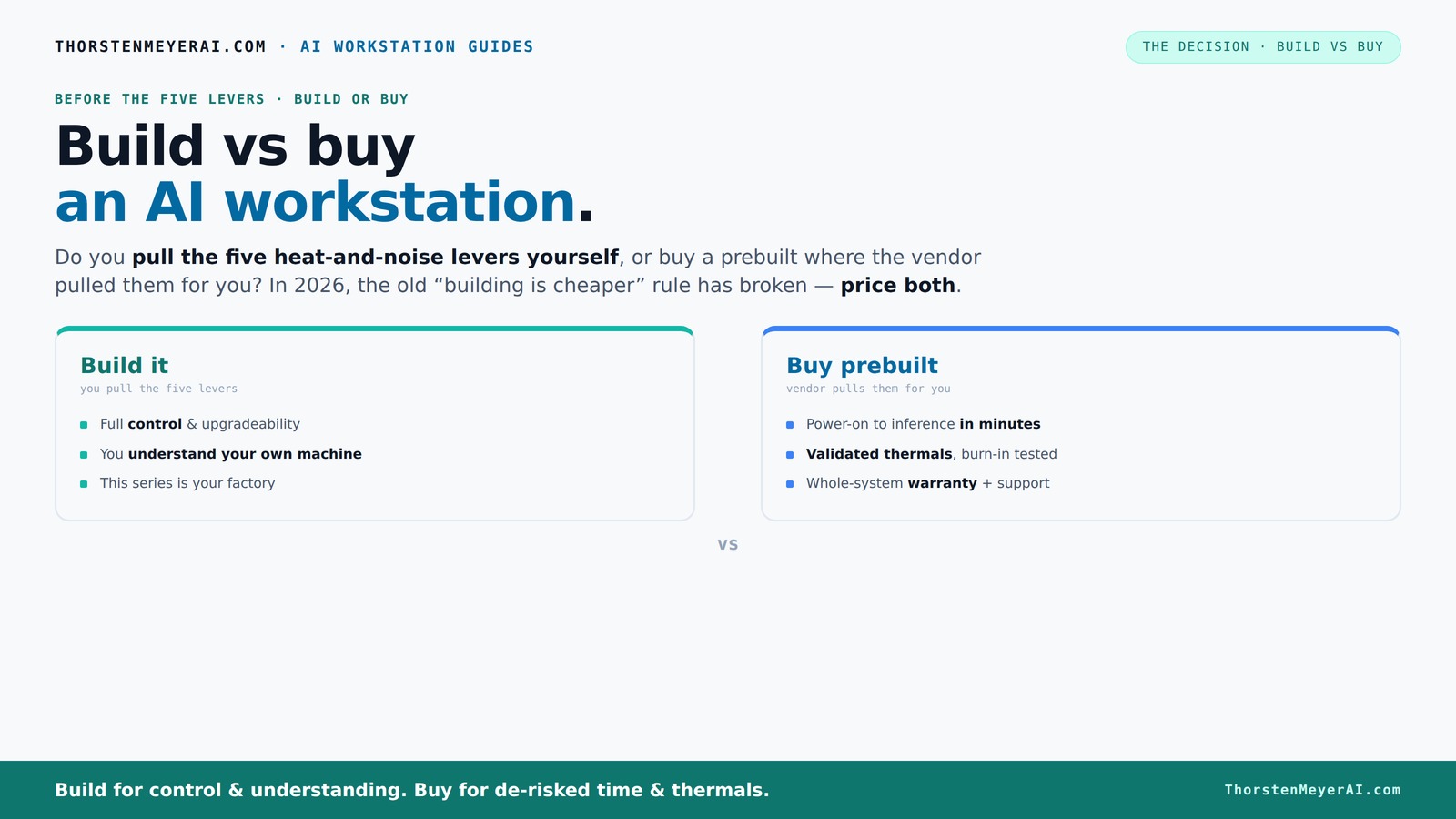
Build vs buy
an AI workstation.
The real question behind this whole series: do you pull the five heat-and-noise levers yourself, or buy a prebuilt where the vendor pulled them for you? And in 2026, the old “building is cheaper” rule has broken. Match your situation in Part 3.
Key Takeaways
- 2026 market shifts mean prebuilts are often just as cost-effective as DIY, especially for high-end AI workstations.
- Thermal management and noise control depend on who pulls the levers — factory tuning or DIY customization.
- For quick deployment and support, prebuilt systems save hours and reduce risk.
- Building your own offers control over GPU, cooling, and upgrade paths, plus potential long-term savings.
- Consider your technical skills, upgrade needs, and support preferences before choosing.
high performance AI workstation prebuilt
As an affiliate, we earn on qualifying purchases.
As an affiliate, we earn on qualifying purchases.
Why 2026 Changed Everything About Building vs Buying
Building a PC yourself used to be the gold standard for saving money. Not anymore. Learn more about build vs buy options. In 2026, component shortages and price spikes have made DIY rigs often pricier than prebuilt systems. For example, a DIY AI workstation that once cost under $1,000 now easily hits $1,250+ because of GPU, RAM, and SSD shortages. Check out this guide for component tips. Meanwhile, big vendors bulk-buy components early, locking in lower prices and passing those savings to you.
This means the choice isn’t just about saving a few bucks — it’s about weighing how much time and effort you want versus the support, warranty, and reliability of a prebuilt. The old rule that building always saves money? It’s broken — at least for now.
Who Pulls the Levers? The Heat and Noise Control Story
High-power AI workstations are furnace-like machines. Managing heat and noise depends on five levers: undervolting GPUs, matching coolers, optimizing airflow, tuning fans, and proper placement. When you buy a prebuilt, the vendor does this heavy lifting — validating thermals and noise levels in the factory.
If you build, you control these levers yourself: choosing quiet GPUs, installing specialized coolers, and tuning fan curves. For instance, a custom setup with a quiet GPU and water cooling can run 30% cooler and quieter than a stock build, but it takes time, expertise, and patience. The choice boils down to: do you want a factory-optimized system or do you enjoy tuning your own?
Cost vs Convenience: When Does Prebuilt Win?
Prebuilts shine when you want a ready-to-go system. Visit our waterpark resources for more on quick setup and support. They come with the OS, drivers, and AI stack preinstalled — just power on and start training. For busy professionals, that saves hours of setup and troubleshooting. Plus, reputable vendors run 24–48 hours of stress testing, so you get a machine that’s already validated for sustained workloads.
Consider a system from Lambda or Puget: they include a warranty, support, and often water-cooling for quieter operation. If your time is more valuable than the slight premium, prebuilt is the smart pick. It’s about avoiding the hassle and risk of troubleshooting hardware issues yourself.
When Building Makes Sense: Control, Upgrades, and Customization
Building your own AI workstation is about control. You pick every component — from GPU VRAM to motherboard slots. That way, you ensure the parts meet your exact needs. For example, if you’re training large language models, a GPU with 24GB or more VRAM makes a huge difference. DIY lets you optimize cooling, power, and future upgrades.
Plus, custom builds are easier to upgrade later. You can add more RAM, swap GPUs, or expand storage without proprietary restrictions. If you love tinkering and want a machine that can evolve, building is the way to go.
The Real Cost of Components and Configuration
| Aspect | Prebuilt | Build Your Own |
|---|---|---|
| Cost | Often competitive due to bulk buying; sometimes more expensive for high-end configs | Potentially cheaper for mid-range but riskier for high-end due to shortages and markup |
| Customization | Limited options, often fixed configs | Full control over GPU, RAM, cooling, case, PSU |
| Support & Warranty | System-level warranty, support, and support for entire machine | Component-level support; need to coordinate multiple vendors |
| Upgradeability | Limited by OEM proprietary parts | Flexible; designed for upgrades |
What Really Matters for AI: GPU Power and Cooling
For AI workstations, GPU choice dominates. A GPU with 24GB VRAM like the RTX 4090 or A100 delivers serious performance for training large models. Cooling and power delivery are equally critical — a high-end GPU under load can generate enough heat to throttle performance if not managed properly.
For example, choosing a GPU with factory water cooling or a custom airflow setup can keep temperatures below 70°C, ensuring sustained performance. This is especially true for multi-GPU setups, where thermal bottlenecks become even more pronounced.
In the end, your GPU and cooling system are the most critical factors — more than CPU or RAM, in many cases.
Upgrade Paths and Longevity: Building for the Future
Building your own rig typically offers better upgrade paths. Motherboard slots for RAM, PCIe, and storage mean you can expand as your AI needs grow. For instance, a motherboard with multiple M.2 slots and PCIe 4.0 support allows future upgrades without replacing the entire system.
Prebuilts often use proprietary parts or limited expansion options, which can lock you in. If you plan to train bigger models or add faster storage later, a DIY setup gives you more options.
However, that requires planning and some technical know-how. If you’re comfortable with that, building pays off long-term.
Support, Warranty, and Hidden Costs
Prebuilts come with support plans, warranties, and on-site repairs in some cases. That means if a GPU fails, you call support and get a replacement quickly. DIY builds rely on individual component warranties, which can be a hassle if something breaks.
Don’t forget hidden costs: OS licenses, peripherals, troubleshooting time, and even your own heat and noise tuning effort. A prebuilt often includes all of this, saving you headaches and downtime.
In the end, support and warranty quality can be worth a premium, especially for mission-critical AI workloads.
Frequently Asked Questions
Is building an AI workstation actually cheaper than buying prebuilt?
Not always. Recent shortages and bulk buying have made high-end prebuilts competitive or even cheaper than DIY options, especially when you factor in support, warranties, and time saved. Always price your specific configuration first.What parts matter most for AI: GPU, VRAM, RAM, or CPU?
GPU VRAM and compute power are king for AI workloads. VRAM determines the size of models you can handle, while GPU cores speed up training and inference. RAM and CPU matter too, but less so than GPU for most AI tasks.How much RAM and VRAM do I need for local AI models?
For small to medium models, 32GB RAM and 12-24GB VRAM are good starting points. Larger models or training require 64GB+ RAM and GPU VRAM above 24GB. Check your specific workload for precise needs.Is a prebuilt workstation good enough for training or only inference?
High-quality prebuilts, with robust cooling and power, are often suitable for training as well as inference. For very large models or heavy training, a custom build with tailored cooling and power delivery may be better.Can I upgrade a prebuilt AI workstation later?
It depends. Some prebuilts use proprietary parts, limiting upgrades. Others, especially higher-end models, offer slots for RAM, storage, and even GPUs. Always check the upgrade paths before buying.Conclusion
The choice between build and buy for an AI workstation boils down to your priorities. Want ready-to-run, supported, and proven performance? Prebuilt is the way. Prefer control, customization, and future-proofing? Building offers the long game.
In 2026, the best move depends less on cost and more on what you value most — speed, support, or control. Whatever you pick, remember: your AI journey is about the machine you choose today, shaping what you can do tomorrow.
Halloween Picks
halloween
As an affiliate, we earn on qualifying purchases.